


Atlassino Academy · Blackjack · Lesson 7

Doubling down: a second bet on one card

A second bet that buys exactly one card: the one total these rules let you double, when the chart asks for it, and what each call costs.

  • About 13 minutes
  • Illustrated hosts: Leo and Maya
  • Last checked 24 October 2026

A double is a second bet for exactly one more card. At Córdoba tables you may make it on one hand only: two cards that make 11.

New to the move? Doubling in one minute
  • What the move is. On your first two cards you put down a second bet as large as the first and take one card, dealt face down. One card, and the hand is finished.
  • When the table offers it. Before you have drawn a card. Take a card and the offer is gone.
  • What the move risks. Both bets. The second bet loses exactly as the first bet does, on the same card, and a dealer blackjack takes both.

You hold a 6 and a 5: hard 11, the one total you may double here. The dealer shows a 10. Do you put the second bet down?

The short answer

Double 11 against a 2 to 9, and take the card against a 10 or an ace. A 10, a 9 or anything else takes no second bet at these tables: the rules do not allow it. Against a 10 or an ace the dealer’s second card is turned over after you play, and a dealer blackjack takes the double too, which is why the chart keeps the money back there.

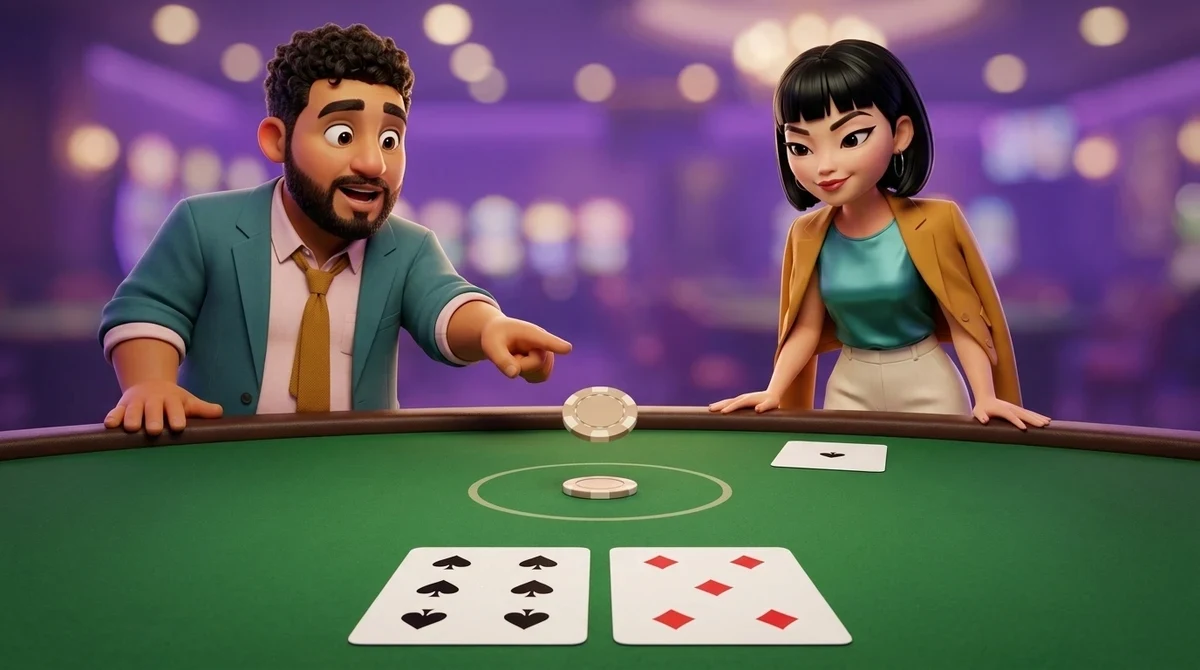
A second chip drops behind the one already in the betting circle while Leo points at it and Maya watches from the rail; six spades and five diamonds lie in front of the seat and the dealer shows a single ace.
Leo smiling, explaining with an open hand.

Leoformer dealer · rules and maths

Doubling is the only move that asks you for more money, so people play it on feeling: some never double at all, others double whenever the hand looks pretty. At these tables the chart’s answer is short, and it has one surprise in it.

When the chart asks for a second bet

No single card can take a hard 9, 10 or 11 over 21, and a 10 — the commonest card in the shoe — turns them into 19, 20 and 21. At Córdoba tables only the 11 may carry a second bet.

6655
Hard 11Double against 2 to 9

No card can take 11 over 21, and the commonest card in the shoe, a 10, makes 21. Against a 10 or an ace the chart takes the card instead: the dealer’s blackjack, turned over after you play, would take the second bet too.

6644
Hard 10No double at these tables

A 10 makes 20, and at many tables elsewhere this is a doubling total. Here the rules allow a double only on 11, so a 10 is simply hit, against every dealer card.

5544
Hard 9No double at these tables

A 10 makes 19. With no double on offer, a 9 is hit against every dealer card: one card cannot take it over 21.

Eight decks · the dealer stands on every 17 · double on 11 only · the dealer’s second card is turned after you play

Hard 9, 10 and 11, by the dealer’s card
Hard2345678910A
9HHHHHHHHHH
10HHHHHHHHHH
11DhDhDhDhDhDhDhDhHH
  • Hhit
  • Dhdouble; hit if you cannot double

And no other total. Never on 12 or more: from 12 a 10 takes you over 21, and a hand that can go over is not a hand to put more money on. Every other hard total is a hit-or-stand decision, and those rows are in the previous lesson.

Leo raising one finger, thinking something through.

Leoformer dealer · rules and maths

Look at the row for 11. It doubles against the weak cards and the middle ones, then stops at the 10. That is not caution. It is the dealer’s face-down card, and the next section is about it.

Why not against a 10 or an ace

The dealer takes a second card face down at the deal and turns it over only once every player has finished. If it makes a blackjack, the dealer’s blackjack takes every bet on your hand: the first bet and the double. A dealer showing a 10 has blackjack on 7.7% of hands, and a dealer showing an ace on 30.8%.

So on an example bet of 10 units, 11 against a 10 is worth +0.32 units a hand on average if you take the card, and +0.09 units if you double. Against an ace: −2.09 units for the card, −5.36 units for the double. The second bet would ride on the strong card and would also be there to lose when the blackjack is turned up. A plus sign here is an average over many hands; any one hand can still lose, and over all hands the house keeps its edge.

Not every rulebook in the country settles a dealer blackjack the same way, and the chart for 11 moves with it: how the rulebooks differ is a lesson of its own.

What a wrong call costs

Leo with a hand on his chest, looking concerned.

Leoformer dealer · rules and maths

The two mistakes run in opposite directions. Keeping the second bet in your pocket on a hand the chart doubles feels careful; putting it down against a 10 or an ace feels bold. Both have a price, and standing on 11 costs more than either.

What each call gives up on average, per hand, on an example bet of 10 units

Three bars, each the average cost of one call against the chart’s play. Standing on 11 against a 10 is by far the longest.

The careful mistake: taking the card on 11 against a 6 instead of doubling3.37 units
The eager mistake: doubling 11 against a 10, where the chart takes the card0.23 units
Standing on 11 against a 106.08 units

Amounts are for an example bet of 10 units: double the bet, roughly double the amount. Amounts are in betting units, not pesos: a unit can stand for any amount, and the arithmetic is the same at any scale.

The careful mistake

Taking the card instead of doubling

3.37 units

each time you take the card on 11 against a 6 instead of doubling. On 11 against a 2 the same habit costs 2.37 units; on 11 against a 9, 0.70 units.

Fix: on 11 against a 2 to 9, put the second bet down. It can still lose, and over all hands the house keeps its edge.


The eager mistake

Doubling against a 10 or an ace

0.23 units

each time you double 11 against a 10, and 3.27 units each time against an ace: the dealer’s blackjack, turned over after you play, takes the double with it.

Fix: against a 10 or an ace, take the card and keep the second bet.

The house keeps its edge; the chart only makes the edge smaller. Play every row of the chart and these rules still leave the house 2.08% of every bet with the full chart. Doubling where the chart asks lowers the price of the evening; it does not turn the game round.

At the table, with Maya

Maya smiling, explaining with an open hand.

Mayaformer floor supervisor · manners, money and breaks

Doubling is the one move where more of your money goes down in the middle of a hand, so it helps to know what the rules let you change and what they do not.

  • One card, face down. After a double the dealer gives you one card, face down, and your hand is over; you see the card when the hand is settled.
  • Only the double changes your bet. Once the deal starts, your first bet is not raised, lowered or taken back; the second bet of a double, or of a split, is the only change the rules allow.
  • The call is yours. Whether to double is your decision alone; advice from other players or onlookers counts for nothing.
Maya with a hand on her chest, speaking gently and seriously.

Mayaformer floor supervisor · manners, money and breaks

A double is a second bet, and an evening with several doubles is an evening in which more money went onto the felt than you counted at the door. Decide the limit first, and count the doubles inside that limit.

A losing double is not a reason to bet larger on the next hand. If the money starts to feel like money you need, stop and call one of the lines below.

If it stops being fun

If gambling stops being entertainment, help is available. Minimum entry age: each province sets its own. Where we found the rule or regulator that sets it, we cite it on the page; those we found set it at 18. More on responsible gaming.

Show all provinces
0800-666-6006Buenos Aires City (CABA) · Línea de orientación por juego problemático (LOTBA) · Monday to Friday, 9 to 17
0800-444-4000Buenos Aires Province · Programa de Prevención y Asistencia al Juego Compulsivo (IPLyC)
0800-777-2983Cordoba · Línea 0800-777-AYUDA (Lotería de Córdoba) · 24 hours
0800-268-5640Santa Fe · Línea gratuita de la APRECOD (Santa Fe) · Every day, 8 to 24
0800-888-2202Entre Rios · Departamento Juego Responsable (IAFAS, PREVENJUEGO)
0261-424-7536Mendoza · Programa de Juego Responsable (IPJyC) · Monday to Friday, 8 to 14
0800-888-5836Misiones · Programa de Juego Responsable del IPLyC S.E. (0800-888-LUDO)
0800-888-2008Chaco · Línea de Juego Responsable (Lotería Chaqueña)
0299-403-8900Neuquen · Líneas de contacto, orientación y tratamiento (IJAN, juego responsable) · Monday to Friday, 8 to 15
0800-222-1700Rio Negro · Línea de Orientación al Jugador Problemático (Lotería de Río Negro)
02901-433515Tierra del Fuego · Departamento Juego Responsable (IPRA, Ushuaia)
0800-555-7678Tucuman · Juego Responsable, Ley 8986 (Caja Popular de Ahorros)
0800-999-1314San Juan · Línea gratuita del Programa Provincial de Juego Responsable (Caja de Acción Social) · Monday to Friday, 08 to 12

If you are thinking about suicide, call 135 or 0800 345 1435 from anywhere in the country

Practice table

The practice table is the same one as in the previous lesson, and it keeps your place: level 1 is hard 12 to 16, and the double comes in on level 2, where every hard total is dealt. Its rule selector starts on the rules these figures follow, the ones published for Córdoba tables. Decide with the buttons or the keys H, S and D; the table tells you what the chart says, why, and what each choice costs on average, for an example bet of 10 units unless you pick another one — an example, not a suggested bet. Only your first move on each hand is scored, and when a level’s squares are full the next level begins by itself.

The practice table needs JavaScript. Here is one hand from it, with the answer.

Dealer shows a 7

77

You hard 16

101066

The chart says: Hit.

Hard 16 against a 7: The dealer card is strong: standing on 16 loses whenever the dealer finishes on 17 or more, 73.8% of hands against a 7.

Average result per hand on an example bet of 10 units (a minus means money lost): stand −4.77 units · hit −4.10 units. Standing instead costs about 0.67 units more each time.

How the practice table works

One strip, no rounds. Every square on the strip is one hand of this lesson, and they are all there from the start. The square keeps your first move on that hand; later moves in the same hand are still checked and explained.

Levels. Level 1: hard 12 to 16 against every dealer card. Level 2: hard 5 to 19, doubles included. Level 3: hard 9 to 16 against every dealer card; the clock is optional.

Amounts. The figures are averages for the example bet you pick: 5 units, 10 units or 25 units. There is no balance, and nothing adds up from one hand to the next.

Dealing. Cards come from a shuffled 8-deck shoe with a fresh seed each visit. A hand that does not belong to the level is set aside unseen. The correct play is the chart’s cell for the table rules you pick, and the averages come from the same engine as the chart above.

Check yourself

Maya with a finger raised and a knowing look.

Mayaformer floor supervisor · manners, money and breaks

Five quick ones. Pick an answer, then check it. No timer, no points: just whether it stuck.

A question marked “New situation” asks you to use the lesson on a case it did not show.

1You hold a 6 and a 5: hard 11. The dealer shows an ace. What does the chart say for these rules?

Show the answer

Answer: Hit: keep the second bet in your pocket against an ace. On these rules the chart doubles 11 against a 2 to 9 only. Against a 10 or an ace it takes the card, because the dealer’s second card lies face down until every player has finished, and a dealer blackjack then takes every bet on your hand.

  • Stand No card can take 11 over 21, so standing gives up a card that costs nothing to take: 5.60 units a hand on an example bet of 10 units.
  • Hit: keep the second bet in your pocket against an ace Against an ace the dealer turns up a blackjack on 30.8% of hands, after you have played, and at these tables that blackjack takes a double too. Taking the card alone does better.
  • Double: 11 is the doubling total Doubling is allowed on 11, but against an ace it costs about 3.27 units more than taking the card, each time on an example bet of 10 units: a dealer blackjack, turned over after you play, takes the second bet as well.
2You hold a 6 and a 4: hard 10. The dealer shows a 9. What does the chart say at this table?

Show the answer

Answer: Hit. Only a two-card 11 may be doubled here, so a 10 is hit against every dealer card.

  • Double: 10 against a 9 is a classic double Not at Córdoba tables: the rules allow a double only on two cards that make 11, and 10 is not 11.
  • Hit One card cannot take 10 over 21, so the card costs nothing to take, and with no double on offer taking it is the whole move.
  • Stand 10 cannot go over 21 with one card, and standing on 10 against a 9 gives up 6.60 units a hand on an example bet of 10 units.
3You hold a 7 and a 4: hard 11. The dealer shows a 6. What does the chart say?

Show the answer

Answer: Double. 11 against a 6 is a cell where the chart puts the second bet down. You get exactly one card, dealt face down, and the hand is over.

  • Stand: let the dealer go over No card can take 11 over 21, so standing throws away a free card: 8.27 units a hand on an example bet of 10 units.
  • Double Against a 6 the dealer goes over 21 on 42.3% of hands, and one card on 11 most often makes a strong total: the chart puts the second bet down. That bet is at risk too.
  • Hit: a second bet is too much risk Taking the card instead of doubling gives up 3.37 units a hand on an example bet of 10 units. Keeping the second bet in your pocket feels careful, and here it is the dearer habit.
4You double your 11. How much is the second bet?

Show the answer

Answer: The same again: a second bet as large as the first. The second bet is the same as the first, and it buys one card and no more.

  • Half your first bet Half your first bet is the stake of the desafío side bet, not a double. A double is the same again.
  • The same again: a second bet as large as the first The rule speaks of doubling your bet, for one card only, and names no smaller double.
  • Anything from the table minimum up to your first bet The rulebook these figures follow names no smaller double: the rule is to double the bet.
5You have doubled four times tonight, each time on a hand the chart asks for, and lost all four. The next hand is hard 11 against a 6. What has changed? new situation

Show the answer

Answer: Nothing about the hand has changed: the chart still asks for the second bet, and it is still at risk. Nothing that the chart can see. The chart is worked out over every hand of that kind, not over tonight’s four, and the price it quotes — 2.08% of every bet with the full chart — is an average many evenings come to, not a promise about any one of them. A second bet doubles both what this hand can return to you and what it can take. Decide your limit before you sit down.

  • The table has turned cold: take the card and keep the second bet in your pocket A shoe has no memory of the last four hands, and neither does the card about to come out of it. Nothing about this hand has changed.
  • Four in a row means the chart does not suit this table The chart is worked out from this table’s rules. One evening says nothing about whether the chart matches them.
  • Double twice as much and the four come back A double is the same bet again, so there is no twice as much to put out. And a larger bet only makes each hour dearer: nothing on the table owes you the four hands back.
  • Nothing about the hand has changed: the chart still asks for the second bet, and it is still at risk Four losses are four hands, not a verdict on the play. Taking the card instead of doubling on 11 against a 6 gives up 3.37 units a hand on an example bet of 10 units, tonight as on any night — and the second bet can lose again.

Where to play, and further reading

18+ under each province’s rules · Play responsibly · the helplines are further up this page

Further reading

How it’s worked out

Rules, numbers and hosts

Rules. The figures on this page follow the rules published for Córdoba casinos: at least eight decks (the figures take exactly eight), the dealer standing on every 17, blackjack paid 3 to 2, a double only on a two-card 11 with one card dealt face down, and a dealer’s second card turned over after the players, whose blackjack takes every bet on the hand. It is a preset for learning, not a statement about any one casino: the room settles anything its rulebook leaves open.

Numbers. Every figure is worked out when the page is built, by our blackjack engine. A mistake’s cost is the average result of the chart’s play minus that of the mistake, per hand, for an example bet of 10 units, with each average rounded to the hundredth first. Against a 10 or an ace the averages include the hands where the dealer turns up a blackjack. The house edge assumes the full chart, soft hands and pairs included, and cards shuffled after every hand.

Hosts. Leo and Maya are illustrated characters. Their backstories, a former dealer and a former floor supervisor, are written for the course: neither is a real person, and neither speaks for any casino. The rules and numbers on this page come from the sources it cites, not from their experience.

No promise. Blackjack is played against the house. The chart lowers the price of playing; nothing on this page removes that price, and nothing here tells you how an evening will end.

Spotted a mistake on this page? Tell us

Sending a report needs JavaScript. Without it, write to us through Contact and give the page address.

Please do not include personal details, such as health or money problems. For help with gambling, see Helplines by province.

Your report reaches us as an email and is not published. What we keep