Atlassino Academy · Craps · Lesson 13
El tirador: who throws the dice, and how
At a craps table in the provinces the dice go to one shooter at a time, who must have a bet on the line and throw by the rule book. Here is who throws, how a throw counts, and when the dice move on.
Your throw ends with one die leaning against a stack of chips. Does it count, or do you throw again?
The short answer
It counts, and the face read is the one opposite the face the die leans on. A throw is nulo only in the cases the rule book names: dice short of the middle line, no die against the cushion, dice sliding, a die off the table, dice stacked, a die in a money slot, or a die turned aside inside the table. The rest of the lesson is who gets to throw, and how long the dice stay with them.
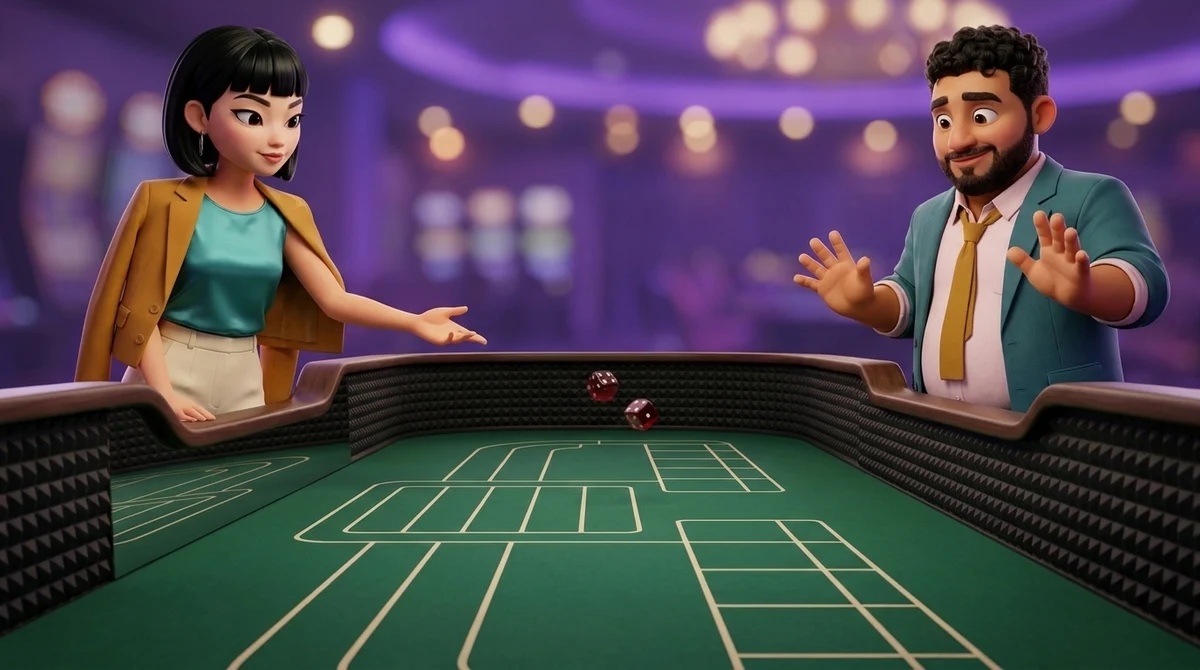

Mayaformer floor supervisor · manners, money and breaks
Nobody has to throw. But if the dice come to you, the rule book asks a few things of you: a bet on the line, one hand, the dice in plain sight, and a throw that reaches the far end of the table. None of it is hard, and all of it is written down.
Who throws, and how the first shooter is chosen
The shooter, the “tirador”, is the player who throws the dice. Only players standing in the throwing spaces marked along the rail throw, and a game starts as soon as one player wants to. When more than one player wants the first throw, it goes to the highest offer within the table’s limits.
A place at the rail
Only a player standing in one of the throwing spaces at the rail throws.
A bet on the line
The shooter has a bet on Buena or on Mala, never on both.
Five dice, two kept
A new shooter is offered 5 dice and sets 3 aside.
One hand, in view
The dice are shaken in plain sight and thrown with the same hand, at once.
Past the line, into the cushion
Both dice past the middle line, at least one against the cushion, neither sliding.
Every new shooter is offered 5 dice from a different set than the last shooter’s, keeps 2 and sets the other 3 aside. On every die the opposite faces add up to 7.
The shooter’s bet
To throw, a player must have a bet on Buena, the pass line, or on Mala, the don’t pass bar, and may switch between them once a pass is decided. The shooter may not bet on Buena and on Mala at the same time.
How to throw
The shooter takes the dice in one hand and throws them with that same hand, without delay; the shake before the throw has to be clear, in sight and inside the table.
The dice must not slide. Both have to pass the middle of the table, which is the printed line nearest the shooter, and at least one has to hit the padded cushion at the far end; otherwise the throw is “nulo” and does not count.

Leoformer dealer · rules and maths
A gentle throw that stops halfway down the table is nulo, and so is one where the dice only slide. Throw firmly enough for both dice to pass the middle line and for at least one to reach the cushion.
When a throw counts, and when it is nulo
Some throws that look spoiled still count: a die resting on a chip, a die leaning against something, which is read by the face opposite the one it leans on, and a die that bounces off the cloth, touches someone outside the table and comes back. Others do not: a die off the table, which is checked and replaced, dice stacked on each other, a die in a money slot, and a die turned aside by touching a player or an employee inside the table, below the rail.
| What happened | Verdict |
|---|---|
| Both dice roll past the middle line; one hits the cushion and both stop on the cloth. | Counts |
| Both dice hit the cushion; one comes to rest on a chip on the layout. | Counts |
| Both dice hit the cushion; one comes to rest leaning against a stack of chips. | Counts |
| Both dice hit the cushion; one bounces up, touches a player’s sleeve above the rail and falls back onto the cloth. | Counts |
| One die hits the cushion; the other stops before the middle line. | Nulo |
| Both dice roll past the middle line and stop on the cloth without touching the cushion. | Nulo |
| Both dice slide across the cloth without turning, past the middle line and into the cushion. | Nulo |
| One die hits the cushion and jumps over the rail onto the floor. | Nulo |
| Both dice hit the cushion and come to rest one on the other. | Nulo |
| One die is still rolling when it touches a player’s hand inside the table, below the rail, and changes direction. | Nulo |
When a roll or a touch is in doubt, the person in charge of the table decides, and the decision is final; a shooter who throws carelessly can have the throw disallowed.
How long the dice stay with you
On Buena, a 7 before the point loses the bet and ends the shooter’s turn. A loss on the first throw of a pass, a 2, 3 or 12, does not: the shooter may throw again by placing a new bet. Under the rules of the Buenos Aires Province that goes up to a third time in a row.
On Mala, a 12 on the first throw settles nothing, paid or lost, and the shooter may go on. A shooter on Mala who loses with a 7 or an 11 on the first throw may throw again with a new bet: Cordoba’s rules say so, and the Buenos Aires Province rule book allows it up to a third time in a row. Under the rules of the Buenos Aires Province, once a pass on Mala is decided, the shooter passes the dice, whatever the result.
A shooter who would rather stop does so once a pass is decided, gets the whole bet back, and the game goes on to the right. A shooter who lost does not throw again in the same round of the table, unless the other players give up their turn.

Mayaformer floor supervisor · manners, money and breaks
Throwing again after a loss on the first throw always means a new bet. Count that bet against the money you decided on at home, not against what you hope the next throw will bring back.
If the money on the table starts to feel like money you need, stop when the pass is decided: your bet comes back to you, and the lines below are there for exactly that.
If it stops being fun
If gambling stops being entertainment, help is available. Minimum entry age: each province sets its own. Where we found the rule or regulator that sets it, we cite it on the page; those we found set it at 18. More on responsible gaming.
Show all provinces
If you are thinking about suicide, call 135 or 0800 345 1435 from anywhere in the country
The lesson on one card
That is the lesson. Here it is on one card: print it or keep it on your phone, and ask at the table before you rely on it.
| What happened | Verdict |
|---|---|
| Both dice roll past the middle line; one hits the cushion and both stop on the cloth. | Counts |
| Both dice hit the cushion; one comes to rest on a chip on the layout. | Counts |
| Both dice hit the cushion; one comes to rest leaning against a stack of chips. | Counts |
| Both dice hit the cushion; one bounces up, touches a player’s sleeve above the rail and falls back onto the cloth. | Counts |
| One die hits the cushion; the other stops before the middle line. | Nulo |
| Both dice roll past the middle line and stop on the cloth without touching the cushion. | Nulo |
| Both dice slide across the cloth without turning, past the middle line and into the cushion. | Nulo |
| One die hits the cushion and jumps over the rail onto the floor. | Nulo |
| Both dice hit the cushion and come to rest one on the other. | Nulo |
| One die is still rolling when it touches a player’s hand inside the table, below the rail, and changes direction. | Nulo |
Throw with one hand, in sight, at once. You need a bet on Buena or Mala, never both.
A 7 after the point: the dice move on. A loss on the first throw: you may throw again with a new bet.
18+ under each province’s rules · Set a limit before you sit down · Play responsibly · the line for your province is at Helplines by province
If you are thinking about suicide, call 135 or 0800 345 1435 from anywhere in the country
Practice: valid or nulo, and who throws next
Level 1 describes where the dice came to rest and asks whether the throw counts. Level 2 describes a shooter’s bet and a result, and asks what happens to the dice.
Nothing is bet here, and nothing is random. Each question is a set situation, and the answer comes from the rules quoted on this page.
Lesson done
Review my mistakes (0)
Progress stays in this browser; nothing is sent anywhere.
The practice table needs JavaScript. Here is one question from it, with the answer.
- The throw Both dice hit the cushion; one comes to rest leaning against a stack of chips.
Does this throw count?
- It counts: the dice are read as they lie A die leaning against something still counts, and the face that counts is the one opposite the face it leans on.
- Nulo: the throw does not count It does count. A die leaning against something still counts, and the face that counts is the one opposite the face it leans on.
- Only the die that landed properly counts A throw counts or does not as a whole: there is no reading one die and throwing the other again.
A throw counts when both dice roll past the middle line, at least one hits the cushion, and neither slides; a die on a chip or leaning against something still counts. A die off the table, dice stacked on each other, a die in a money slot or a die turned aside inside the table make the throw nulo.
- What happened The shooter bets on Buena and throws a 3 on the first throw.
What happens to the dice now?
- The shooter keeps the dice The shooter may throw again, but only by placing a new bet: the bet that lost is gone.
- The shooter may throw again with a new bet A loss on the first throw does not end the turn: the shooter may throw again by placing a new bet, up to a third time in a row.
- The dice go to the next shooter The dice stay with this shooter. A loss on the first throw does not end the turn: the shooter may throw again by placing a new bet, up to a third time in a row.
A 7 after the point ends the shooter’s turn. A loss on the first throw lets the shooter throw again with a new bet, up to a third time in a row, on Buena and on Mala alike. Once a pass on Mala is decided, the dice move on, and a 12 on the first throw is neutral. A shooter who stops after a pass gets the bet back, and the game goes on to the right with a new shooter.
Every question in the practice run is worked out the same way: what happened to the dice is put through the rules quoted on this page, and the answer comes out of that, not out of anybody’s memory.
How the practice run works
Where the questions come from. Every answer is worked out when the page is built, from the rules of the rule books written down as two short functions: one for a throw, one for the shooter’s turn. The wrong answers are named mistakes: reading one die and throwing the other again, a nulo taken for a valid throw and the other way round, a new bet where none is needed, and a turn kept after it has ended.
One strip, and no rounds. Every square on the strip is one question of this lesson, and all of the squares are there from the start. Your first answer fills the square it belongs to; when the squares of one level are full, the next level begins by itself, with no button in between. Practising a question you got wrong turns its cross into “fixed in practice” and does not change the count, because only first answers count.
Your progress stays in this browser, and nothing is sent anywhere.
Check yourself

Mayaformer floor supervisor · manners, money and breaks
Five quick ones. Pick an answer, then check it. No timer, no points: just whether it stuck.
Back to the question we opened with. It counts: a die leaning against something is read by the face opposite the one it leans on, and you throw again only when the throw is nulo.
Where to go next, and further reading
18+ under each province’s rules · Play responsibly · the helplines are further up this page
Further reading
- Reglamento del juego de Craps · Lotería de Córdoba S.E.Córdoba’s craps rules with the pays for every bet, written as percentages of the stake.
- Resolución 1452/12, Anexo I: Craps (Reglamento del Juego) · Instituto Provincial de Lotería y Casinos de la Provincia de Buenos AiresThe Buenos Aires province rulebook with the full pay table and the rules for throwing the dice.
How it’s worked out
Rules, sources and hosts
Where the rules come from. Most of this page follows the rule book of the Buenos Aires Province, which sets out who throws, how a throw is made and every case where a throw counts or does not. The rules of Cordoba define the shooter, use two dice from a set of five, and say what a 7 after the point and a loss on the first throw do to the shooter’s turn. Where only one of them says something, as with a shooter on Mala after a decided pass, this page names which.
What is deliberately absent. What each bet pays is in the lessons on the pass line and on come bets. The Cordoba rules allow a shooter who loses on the first throw to throw again up to “3 (tres) oportunidades”, which can be read as three throws or three more; the question about a third loss in a row follows the Buenos Aires Province rule book, which says up to a third throw in a row. Neither rule book says in one sentence what a shooter on Buena does after making the point, so this page does not say it either.
Sources. Every rule on this page carries a button with the sentence it rests on, in the rule book’s own Spanish, the publisher who wrote that sentence and the date we read it.
Hosts. Maya and Leo are illustrated characters. Their backstories, a former floor supervisor and a former dealer, are written for the course: neither is a real person, and neither speaks for any casino. The rules and numbers on this page come from the sources it cites, not from their experience.
No promise. How a throw is made changes nothing about which numbers come up. Knowing the rules lets you take the dice without being stopped; nothing on this page says how a throw or an evening would end.
The shooter’s bet
Para oficiar de Tirador, en todos los casos deberá disponer de una apuesta en Buena o Mala, pudiendo cambiar de suerte luego de la definición del pase, quedando dicha apuesta sujeta a la siguiente reglamentación:Free translation: To act as Tirador (shooter), in all cases the player must have a bet on Buena (Pass) or Mala (Don't Pass), and may change sides after the pass has been decided, that bet being subject to the following rules:
No podrá efectuar apuestas en ambas suertes (Buena y Mala), en forma simultánea.Free translation: The player may not place bets on both sides (Buena and Mala) simultaneously.
Section Capítulo 13, Craps: Reglamento del Juego (13.1 a 13.8)
A valid throw
Arrojados los dados, estos no deberán deslizarse, siendo obligatorio que ambos dados pasen la mitad de la mesa y que por lo menos uno de ellos toque contra el tapizado o goma colocado al efecto, de no ser así, el tiro será calificado Nulo.Free translation: Once the dice are thrown, they must not slide; it is mandatory that both dice pass the middle of the table and that at least one of them touch the upholstery or rubber placed for that purpose; otherwise, the throw shall be declared void.
Se considera mitad de la mesa a la línea impresa donde comienza el Cuadro y las Camuninas más cercana al Tirador de turno.Free translation: The middle of the table is considered to be the printed line where the Cuadro and the Camuninas begin, closest to the Tirador whose turn it is.
Section Capítulo 13, Craps: Reglamento del Juego (13.1 a 13.8)
Throws that still count
El dado quede asentado de cualquier forma sobre una Ficha.Free translation: The die comes to rest in any way on a Chip.
El dado quede inclinado sobre cualquier elemento.Free translation: The die comes to rest leaning on any object.
Ante toda duda sobre la determinación del Punto válido en un dado inclinado, la cara opuesta a la que se encuentra apoyada es la cara válida.Free translation: In any doubt about determining the valid Point on a leaning die, the face opposite the one it rests on is the valid face.
El dado luego de rebotar sobre el paño toque ocasionalmente a un Apostador y/o empleado fuera de los limites de aquel y vuelva al mismo.Free translation: The die, after bouncing on the cloth, occasionally touches a Bettor and/or employee outside the limits of the table and returns to it.
Section Capítulo 13, Craps: Reglamento del Juego (13.1 a 13.8)
A 7 after the point
Si antes sale el 7 (siete), la Chance pierde y el tirador pierde el derecho a seguir tirando.Free translation: If the 7 (seven) comes up first, the Chance loses and the Tirador loses the right to keep throwing.
Lotería de Córdoba S.E. (portal) · Reglamento del juego de Craps · read
After a loss
Si resultare perdedor al arrojar los dados, no podrá hacerlo nuevamente en la misma vuelta, salvo excepción determinada en el articulado correspondiente.Free translation: If the player loses when throwing the dice, he may not throw again in the same round, except for an exception set out in the relevant articles.
Pudiendo hacerlo en el caso de renuncia de los demás componentes de la mesa o por ausencia de los mismos; debiendo cambiarse el juego de dados utilizado.Free translation: He may do so if the other members of the table waive or are absent; the set of dice used must be changed.
Si optare por retirarse, una vez definido el pase, se le hará entrega del total de la apuesta Si así ocurriere, continuará el juego por derecha con un nuevo Tirador.Free translation: If he chooses to withdraw, once the pass has been decided, he will be handed the full amount of the bet. If so, play will continue to the right with a new Tirador.
Section Capítulo 13, Craps: Reglamento del Juego (13.1 a 13.8)
Who may throw
Podrán arrojar los dados los Apostadores que estuvieran ubicados dentro de las separaciones realizadas a tal efecto.Free translation: Bettors located within the separations made for that purpose may throw the dice.
A los efectos de comenzar el juego se considerará constituido solamente con la voluntad de un Apostador que desee arrojar los dados. De haber más de un Apostador se rematará la primer tirada.Free translation: For the purpose of starting the game, it shall be considered constituted solely by the will of one Bettor who wishes to throw the dice. If there is more than one Bettor, the first throw shall be auctioned.
Section Capítulo 13, Craps: Reglamento del Juego (13.1 a 13.8)
TIRADOR: Apostador que arroja los dados.Free translation: TIRADOR: Bettor who throws the dice.
Lotería de Córdoba S.E. (portal) · Reglamento del juego de Craps · read
The first throw goes to auction
La primer tirada se adjudicará a la mejor oferta encuadrada dentro de los topes mínimos y máximos establecidos.Free translation: The first throw shall be awarded to the best offer falling within the established minimum and maximum limits.
Section Capítulo 13, Craps: Reglamento del Juego (13.1 a 13.8)
Five dice, two kept
En cada iniciación de tirada por un nuevo Apostador, le serán ofrecidos cinco(5) dados, (de un juego diferente al utilizado por el Apostador anterior) de los cuales separará los tres dados que no utilizará, los dos restantes son los que jugarán,Free translation: At the start of each throw by a new Bettor, he will be offered five(5) dice (from a set different from the one used by the previous Bettor), from which he will set aside the three dice he will not use; the remaining two are the ones that will be played,
Section Capítulo 13, Craps: Reglamento del Juego (13.1 a 13.8)
Se emplearán dos dados de un juego de cinco, de seis caras cada uno. Cada cara contendrá impreso un número de puntos equivalentes a los siguientes valores: 1 (uno), 2 (dos), 3 (tres), 4 (cuatro), 5 (cinco) y 6 (seis). La ubicación correcta de los puntos, se verifica sumando los puntos de cada cara con los de la opuesta, operación que en todos los casos debe dar siete.Free translation: Two dice from a set of five will be used, each with six faces. Each face will have printed a number of dots equivalent to the following values: 1 (one), 2 (two), 3 (three), 4 (four), 5 (five) and 6 (six). The correct placement of the dots is checked by adding the dots on each face to those on the opposite one, an operation that must in all cases give seven.
Lotería de Córdoba S.E. (portal) · Reglamento del juego de Craps · read
The shooter’s bet
Para oficiar de Tirador, en todos los casos deberá disponer de una apuesta en Buena o Mala, pudiendo cambiar de suerte luego de la definición del pase, quedando dicha apuesta sujeta a la siguiente reglamentación:Free translation: To act as Tirador (shooter), in all cases the player must have a bet on Buena (Pass) or Mala (Don't Pass), and may change sides after the pass has been decided, that bet being subject to the following rules:
No podrá efectuar apuestas en ambas suertes (Buena y Mala), en forma simultánea.Free translation: The player may not place bets on both sides (Buena and Mala) simultaneously.
Section Capítulo 13, Craps: Reglamento del Juego (13.1 a 13.8)
One hand, in plain sight
Una vez que fueran alcanzados al Tirador, éste los tomará con la mano de su voluntad y con la misma los deberá arrojar sin pérdida de tiempo.Free translation: Once they have been handed to the Tirador, he will take them with the hand of his choice and must throw them with that same hand without wasting time.
Al tomar los dados para efectuar el tiro, el batido de la mano que los arrojará deberá realizarse en forma clara, a la vista y dentro del perímetro de la mesa.Free translation: When taking the dice to make the throw, the shaking of the hand that will throw them must be done clearly, in plain view and within the perimeter of the table.
Section Capítulo 13, Craps: Reglamento del Juego (13.1 a 13.8)
A valid throw
Arrojados los dados, estos no deberán deslizarse, siendo obligatorio que ambos dados pasen la mitad de la mesa y que por lo menos uno de ellos toque contra el tapizado o goma colocado al efecto, de no ser así, el tiro será calificado Nulo.Free translation: Once the dice are thrown, they must not slide; it is mandatory that both dice pass the middle of the table and that at least one of them touch the upholstery or rubber placed for that purpose; otherwise, the throw shall be declared void.
Se considera mitad de la mesa a la línea impresa donde comienza el Cuadro y las Camuninas más cercana al Tirador de turno.Free translation: The middle of the table is considered to be the printed line where the Cuadro and the Camuninas begin, closest to the Tirador whose turn it is.
Section Capítulo 13, Craps: Reglamento del Juego (13.1 a 13.8)
Throws that still count
El dado quede asentado de cualquier forma sobre una Ficha.Free translation: The die comes to rest in any way on a Chip.
El dado quede inclinado sobre cualquier elemento.Free translation: The die comes to rest leaning on any object.
Ante toda duda sobre la determinación del Punto válido en un dado inclinado, la cara opuesta a la que se encuentra apoyada es la cara válida.Free translation: In any doubt about determining the valid Point on a leaning die, the face opposite the one it rests on is the valid face.
El dado luego de rebotar sobre el paño toque ocasionalmente a un Apostador y/o empleado fuera de los limites de aquel y vuelva al mismo.Free translation: The die, after bouncing on the cloth, occasionally touches a Bettor and/or employee outside the limits of the table and returns to it.
Section Capítulo 13, Craps: Reglamento del Juego (13.1 a 13.8)
Throws that do not count
Uno o ambos dados saliesen de la mesa.Free translation: One or both dice leave the table.
Los dados queden asentados uno sobre otro.Free translation: The dice come to rest one on top of the other.
El dado quede asentado en alguno de los monederos.Free translation: The die comes to rest in one of the monederos (chip trays).
Si el dado fuera desviado por tocar a un Apostador o empleado dentro del perímetro de la mesa y por debajo de la altura de las barandas, el tiro será nulo.Free translation: If the die is deflected by touching a Bettor or employee within the perimeter of the table and below the height of the rails, the throw will be void.
Toda vez que el dado salga fuera de la mesa, será sometido a control. El Apostador deberá optar por otro en su reemplazo.Free translation: Whenever the die leaves the table, it will be subject to inspection. The Bettor must choose another in its place.
Section Capítulo 13, Craps: Reglamento del Juego (13.1 a 13.8)
The table decides
En caso de dudoso rodamiento o toque del dado, la decisión que tome al respecto el responsable de la mesa, será inapelable.Free translation: In case of a doubtful roll or touch of the die, the decision taken in that regard by the person in charge of the table shall be final.
Si se observaran actitudes negligentes por parte del Tirador, la autoridad competente podrá desautorizar el tiro; como así también el par de dados en juego y de persistir dicha actitud, será invitado a abandonar el juego de forma inmediata.Free translation: If negligent conduct is observed on the part of the Tirador, the competent authority may disallow the throw, as well as the pair of dice in play, and if such conduct persists, he will be asked to leave the game immediately.
Section Capítulo 13, Craps: Reglamento del Juego (13.1 a 13.8)
A 7 after the point
Si antes sale el 7 (siete), la Chance pierde y el tirador pierde el derecho a seguir tirando.Free translation: If the 7 (seven) comes up first, the Chance loses and the Tirador loses the right to keep throwing.
Lotería de Córdoba S.E. (portal) · Reglamento del juego de Craps · read
A loss on the first throw
No obstante el jugador puede optar por tirar nuevamente realizando una nueva apuesta. De sucederse las pérdidas en forma consecutiva, podrá ejercer la opción por 3 (tres) oportunidades como máximo.Free translation: However, the player may choose to throw again by placing a new bet. If losses occur consecutively, he may exercise the option a maximum of 3 (three) times.
Lotería de Córdoba S.E. (portal) · Reglamento del juego de Craps · read
arrojar por Buena: el Apostador podrá tirar hasta una tercera vez consecutiva, si perdiera en los dos primeros tiros como consecuencia de haber arrojado 2 - 3 ó 12.Free translation: throwing for Buena: the Bettor may throw up to a third consecutive time, if he lost on the first two throws as a result of having thrown 2 - 3 or 12.
Section Capítulo 13, Craps: Reglamento del Juego (13.1 a 13.8)
The shooter on Mala
Si obtiene el 12 (doce), la chance no gana ni pierde, y el Tirador puede seguir arrojando sin cambiar de suerte, o puede desistir de arrojar los dados y retirar la apuesta.Free translation: If he gets the 12 (twelve), the chance neither wins nor loses, and the Tirador may keep throwing without changing sides, or may decline to throw the dice and withdraw the bet.
Si saca el 7 (siete) u 11 (once), la chance pierde. No obstante el Tirador puede optar por tirar nuevamente realizando una nueva apuesta.Free translation: If he throws the 7 (seven) or 11 (eleven), the chance loses. However, the Tirador may choose to throw again by placing a new bet.
Lotería de Córdoba S.E. (portal) · Reglamento del juego de Craps · read
arrojar por Mala: El Apostador podrá hacerlo en una sola oportunidad, independientemente del resultado; gane o pierda deberá pasar los dados.Free translation: throwing for Mala: The Bettor may do so only once, regardless of the result; whether he wins or loses he must pass the dice.
Si perdiera en los dos primeros tiros como consecuencia de haber arrojado 7 u 11 podrá arrojar hasta una tercera vez consecutiva.Free translation: If he lost on the first two throws as a result of having thrown 7 or 11, he may throw up to a third consecutive time.
En caso de salir el 12 se considerará neutro y podrá continuar.Free translation: If the 12 comes up it shall be considered neutral and he may continue.
Section Capítulo 13, Craps: Reglamento del Juego (13.1 a 13.8)
Passing the dice
Si resultare perdedor al arrojar los dados, no podrá hacerlo nuevamente en la misma vuelta, salvo excepción determinada en el articulado correspondiente.Free translation: If the player loses when throwing the dice, he may not throw again in the same round, except for an exception set out in the relevant articles.
Pudiendo hacerlo en el caso de renuncia de los demás componentes de la mesa o por ausencia de los mismos; debiendo cambiarse el juego de dados utilizado.Free translation: He may do so if the other members of the table waive or are absent; the set of dice used must be changed.
Si optare por retirarse, una vez definido el pase, se le hará entrega del total de la apuesta Si así ocurriere, continuará el juego por derecha con un nuevo Tirador.Free translation: If he chooses to withdraw, once the pass has been decided, he will be handed the full amount of the bet. If so, play will continue to the right with a new Tirador.
Section Capítulo 13, Craps: Reglamento del Juego (13.1 a 13.8)