Atlassino Academy · First visit · Lesson 1
What happens at the door
The first lesson of the course: who a casino in Argentina admits, which document it asks for at the door, and the other reasons security turns people away.
The first lesson of the course. It is about the few minutes between arriving and being inside: what the door asks for, what it checks, and what closes it. The games come later.
Before we start: you are well over 18 and you have your DNI. Which of these could still keep you out — being on your province’s self-exclusion register, or arriving in torn and dirty clothes? Nothing here is scored; the answer comes at the end.
The short answer
Bring your DNI. The age at the door is 18 in every provincial rule we read that names one, and each province sets it in its own rules. Some doors check the DNI of every visitor against the province’s self-exclusion register, in some rooms with cameras that recognise faces. And a casino may refuse entry for other reasons its rules name — drink, weapons, torn or dirty clothes, a ban — and asks for bags at the cloakroom and phones off inside.
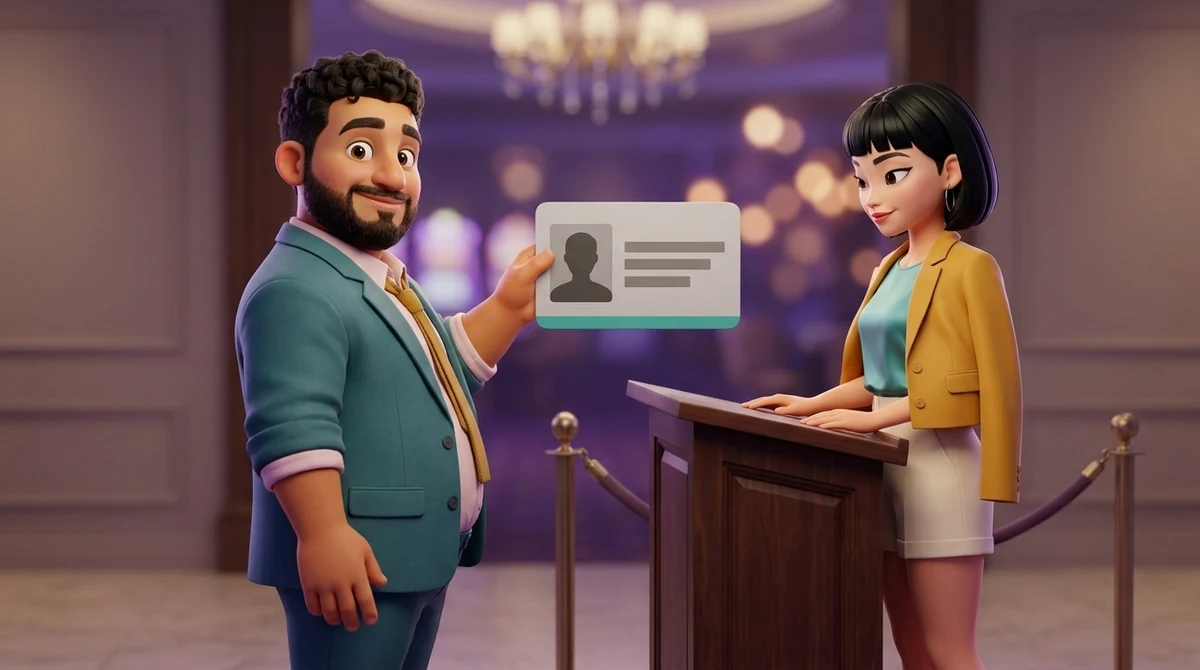

Mayaformer floor supervisor · manners, money and breaks
I spent years on the floor, and the door is where most evenings go wrong before they start: no document, the wrong clothes, a bag nobody wants to leave behind. None of it is complicated once you know what is asked.
18, under each province’s rules
The minimum age at a casino door is set province by province: the rules that set it are provincial, and we found no national law that does. Every provincial rule we read that names an age names the same one, 18.
And it covers the whole building, not only the gaming room: in one province’s rules for its casino annexes, staff control the entry of minors whether the gaming room is open or not and into any part of the annex, and may ask for a document or refuse entry when in doubt.
Casinos print the same age on their own pages, in a line you will see again and again. The age is the rule of the province the casino stands in.
Your DNI at the door
Bring your DNI, the card itself. In one province the rule is written for every room: the DNI is asked of every visitor, to check that they are of age and that no exclusion — voluntary or ordered by the authorities — applies to them.
Casinos write it on their own pages too: one answers its visitors that only adults of 18 and over may enter, on showing their DNI.
Where the DNI is not asked of everyone, it can still be asked of you: one operator writes that its staff are trained to check visitors’ age and to ask for a document when they need to.
And security can ask anybody: in one province’s casinos, security staff may ask any visitor to show an official identity document and their belongings.
The documents we read name the DNI, or an official identity document. None of them says whether a photo of one on a phone, or a copy, would do — so bring the card itself.
Checked against a list
Self-exclusion is a provincial programme you sign yourself: you ask to be refused entry to the province’s gaming rooms for the term the programme sets, and the door does what you asked. The self-exclusion guide sets out each province’s programme.
Some doors check every visitor. In one province, the DNI shown at the door is checked to see that the visitor is of age and that no exclusion applies — one they asked for, or one ordered by the competent authority, and the system identifies the self-excluded as they try to enter, keeping no record of the entry of anyone who is not one of them.
Others use cameras. In the gaming rooms of one jurisdiction, facial-recognition devices at the entrances look for people enrolled in its register; in another province, every gaming room had to install facial-recognition cameras connected to the regulator’s database.
Getting past the door does not end it. The self-exclusion forms we read say, in the signer’s own first person, that anyone who tries to get in, or manages to, will be asked to leave — in some of them with a written record of it.
None of this is aimed at anyone who has not signed up: a self-exclusion register lists the people who asked to be on it.
The other reasons a door closes
Casinos reserve the right of admission and of staying — the “derecho de admisión y permanencia” you will see on their pages — and the rules we read set limits on that right: one province exercises it under the national law on public events, and the City’s regulator requires an exclusion to rest on objective conditions of admission that are the same for every visitor.
| The reason | In the rule’s own terms |
|---|---|
| Under age | Under 18 |
| Drink or drugs | Clearly under the influence, and a nuisance or a risk to others |
| Weapons and conduct | Weapons, fireworks or other dangerous objects; discriminatory symbols or incitement to violence |
| Dress and hygiene | A lack of personal hygiene, or worn-out or torn clothes that bother other visitors |
| A ban | On the register of people barred, with the ban not yet over |
The same rules require the reasons for refusing entry to be posted at every entrance to the gaming rooms, in writing that is easy to read and in plain view.
You will also see a warning at the entrance — that gambling compulsively is harmful to health. That is not the casino’s choice either: provincial rules require it at the entrance of the gaming rooms, in set words.
Through the door: bag, phone, fee
- Bags go to the cloakroom. Bags of any kind, cameras, umbrellas and anything with no obvious connection to the gaming room are left at the cloakroom.
- Phones off. In one province’s casinos, phones are switched off on entering the gaming room, and refusing to switch one off means being excluded from the room.
- No animals, except those that support a person with a disability.
- Sometimes a fee. One casino’s own page gives a price for entry. The sum is printed only inside the quote, with the date we read it: a price in pesos goes out of date.
Practice: at the door
Visitors at a casino door on one example evening, 14 March 2027. Each moment gives you a person, what they have in hand and what is going on at that door; you decide whether they go in, go in after something else first, or are turned away tonight. The answer comes with the sentence it rests on.
Lesson done
Review my mistakes (0)
Progress stays in this browser; nothing is sent anywhere.
The practice table needs JavaScript. Here is one moment from it, with the answer.
Level 1 · Age and the DNI
- Tonight
- 14 March 2027
- Name
- A. Fernández
- Date of birth
- 9 July 2000
- Lives in
- In the same province
- In hand
- a DNI — the card itself
- Second piece in the wallet
- nothing else
What happens at the door?
The answer: Goes in.
On 14 March 2027, A. Fernández is 26. The provincial rules we read bar people under 18 from the gaming rooms, and A. Fernández has the DNI in hand.
Level 2 · The list at the door
A rule published by Instituto Provincial de Lotería y Casinos (IPLyC).
- Tonight
- 14 March 2027
- Name
- F. Pérez
- Date of birth
- 17 February 1981
- Lives in
- In the same province
- In hand
- a DNI — the card itself
- Second piece in the wallet
- nothing else
- At this door
- Signed up to the province’s self-exclusion programme
What happens at the door?
The answer: Turned away tonight.
On 14 March 2027, F. Pérez is 46. Of age and with the DNI — but F. Pérez signed up to be refused entry to the province’s gaming rooms, and that is what the door does.
Level 3 · Other reasons
A rule published by Instituto Provincial de Lotería y Casinos (IPLyC).
- Tonight
- 14 March 2027
- Name
- L. Álvarez
- Date of birth
- 26 January 1998
- Lives in
- In the same province
- In hand
- a DNI — the card itself
- Second piece in the wallet
- nothing else
- At this door
- Clearly drunk, and bothering the people in the queue
What happens at the door?
The answer: Turned away tonight.
On 14 March 2027, L. Álvarez is 29. Of age and with the DNI, but the casinos of the province can refuse entry to people who are unmistakably drunk and bother others or are a risk to them.
Every moment is worked out the same way, from the rules the casino, its operator or its province state, and each explanation carries the sentence it rests on.
How the practice table works
Where the answers come from. Each answer is worked out from a rule a province, a regulator or a casino published, and the explanation carries that sentence with the date we read it. Where only one body publishes a rule, the moment says whose it is.
The people are invented. Names and dates of birth are examples; the evening is the same for every moment, so that an age is worked out against one date. Progress stays in this browser; nothing is sent anywhere.
Check yourself

Mayaformer floor supervisor · manners, money and breaks
Five quick ones. Pick an answer, then check it. No timer, no points: just whether it stuck.
The question we opened with. Both. A self-exclusion register is a request to be refused at the door, and the door does what was asked; torn and dirty clothes are on the list of reasons one province’s casinos may refuse entry. Age and a DNI are where the door starts, not where it ends.
Where to check this
18+ under each province’s rules · Play responsibly · the helplines are at the end of this page
Further reading
- Resolución N° 1.853/13 — Normas Complementarias a las Acciones del Departamento Seguridad Interna · Instituto Provincial de Lotería y Casinos de la Provincia de Buenos AiresQuién puede ser rechazado en la puerta de un casino provincial, qué puede pedir el personal de seguridad al entrar y qué se deja en el guardarropa.
- Juego Responsable — Registro Único de Autoexcluidos de la Provincia de Salta · Ente Regulador del Juego de Azar de Salta (ENREJA)Qué se pide en la puerta de las salas de Salta (el DNI) y cómo el registro identifica a los autoexcluidos al intentar ingresar.
- Procedimiento y obligaciones para la implementación del Programa de Autoexclusión en las Salas de Juego e inscripción en el Registro Voluntario de Autoexclusión (ReVA) · Lotería de la Ciudad de Buenos Aires S.E. (LOTBA)Lo que deben hacer en la puerta las salas bajo jurisdicción de LOTBA: identificar a los autoexcluidos, usar reconocimiento facial y labrar un acta de detección.
- Reglamento General de funcionamiento para Casinos Anexos del Casino de Mendoza (Resolución de Presidencia N° 002/22) · Instituto Provincial de Juegos y Casinos de Mendoza (IPJyC)Control de menores, de vestimenta y de higiene en los ingresos de los anexos, y qué pasa con quien no cumple.
- Juego Responsable — Protección de menores · Casino Club S.A.Lo que dice un operador sobre la verificación de edad y el pedido de documentación en la entrada.
- Preguntas frecuentes · City Center RosarioLa respuesta de un casino a «¿A partir de qué edad se puede entrar al casino?», y el valor de la entrada.

Leoformer dealer · rules and maths
Once you are through the door, the next thing is money: how much the evening gets, decided before you leave home. That is the next lesson — deciding the money.
If it stops being fun
If gambling stops being entertainment, help is available. Minimum entry age: each province sets its own. Where we found the rule or regulator that sets it, we cite it on the page; those we found set it at 18. More on responsible gaming.
Show all provinces
If you are thinking about suicide, call 135 or 0800 345 1435 from anywhere in the country
How it’s worked out
Sources, numbers and hosts
Sources. Every rule on this page is quoted from the document that states it, in Spanish, and the ⓘ beside it opens that sentence with its publisher and the date we read it: provincial laws on the age at the door, the security rules of Instituto Provincial de Lotería y Casinos (IPLyC), the self-exclusion programmes and registers of the provinces, the entry rules of casino annexes, and what operators and casinos say on their own pages. Each rule binds the casinos of the body that wrote it; where only one body publishes a rule, the page says whose it is rather than making it sound national.
The age. 18 is the age every provincial rule we read names. We found no national law on the age at a casino door, so the page does not say “across Argentina”: it says “under each province’s rules”.
What is deliberately absent. Whether a photo of a DNI on a phone, or a copy, would do: none of the documents we read says, so the page tells you to bring the card. Dress codes beyond what the rules name. And nothing here says which casino to go to.
Hosts. Maya and Leo are illustrated characters. Their backstories, a former floor supervisor and a former dealer, are written for the course: neither is a real person, and neither speaks for any casino. The rules and numbers on this page come from the sources it cites, not from their experience.
No promise. This lesson is about getting through a door, not about what happens after it. Nothing on this page says an evening at a casino is a good idea for you.
Minors are barred by provincial law
En ningún caso se admitirá la presencia de menores de dieciocho (18) años en casinos, bingos, salas de juego.Free translation: Under no circumstances shall the presence of minors under eighteen (18) years of age be permitted in casinos, bingo halls or gaming rooms.
Section art. 7
Provincia de Buenos Aires — Sistema de Normas · Ley 14.050 (Prov. Buenos Aires), art. 7 · read
Minors are barred by provincial law
En todos los casos queda prohibida la entrada a las salas de juego a los menores de 18 años.-Free translation: In all cases, minors under 18 years of age are prohibited from entering the gaming rooms.-
Section art. 8
Lotería de Santa Fe (Caja de Asistencia Social) · Ley 11.998 (Santa Fe) — Ley de Casinos, art. 2 · read
Minors are barred by provincial law
Queda prohibido el ingreso de menores de dieciocho (18) años a los locales donde se exploten las máquinas objeto de la presente Ley.Free translation: Minors under eighteen (18) years of age are prohibited from entering premises where the machines covered by this Law are operated.
Section art. 9
The DNI at the door
Para ingresar a las Salas y Casinos de la Provincia de Salta, se solicitará la presentación del DNI a efectos de verificar que el cliente sea mayor de edad y no se encuentre alcanzado con una medida de exclusión, voluntaria o dispuesta por la autoridad competente.Free translation: To enter the Rooms and Casinos of the Province of Salta, presentation of the DNI will be required in order to verify that the customer is of legal age and is not subject to an exclusion measure, whether voluntary or ordered by the competent authority.
Staff check age
El acceso a los casinos y la participación en juegos de azar está estrictamente prohibida para menores de 18 años.Free translation: Access to casinos and participation in games of chance is strictly prohibited for persons under 18 years of age.
Nuestro personal está capacitado para verificar la edad de los visitantes y solicitar documentación en caso de ser necesario.Free translation: Our staff are trained to verify the age of visitors and to request documentation if necessary.
Self-exclusion at the door
Toda persona que considere de su interés, no participar en juegos de azar; para lo cual voluntariamente acordará mantenerse fuera, y autorizar ser rechazado su ingreso a todas las Salas de Juegos de Azar de las que este Instituto resulta Autoridad de Aplicación, a través de la suscripción del Formulario de Solicitud de Autoexclusión (Anexo II).Free translation: Any person who considers it in their interest not to take part in games of chance, and who for that purpose voluntarily agrees to stay away and authorizes that their entry be refused to all the Gaming Rooms for which this Institute is the Enforcement Authority, by signing the Self-Exclusion Request Form (Annex II).
La solicitud efectuada respecto de alguna de las Salas de Juego, importará idéntico efecto respecto de las restantes Salas de Juego de la Provincia.Free translation: A request made with respect to any one of the Gaming Halls shall have the same effect with respect to all the other Gaming Halls of the Province.
Que si intentara, o lograra ingresar a cualquier Sala de Juego, me será requerido el retiro del lugar.Free translation: That if I attempt to enter, or manage to enter, any Gaming Room, I will be required to leave the premises.
Section Anexo I, arts. 2, 4 y 5; Anexo II (formulario)
Facial recognition at the entrance
Detectar a toda persona que intente ingresar a las Salas de Juego y se encuentre inscripta en el “ReVA”, mediante dispositivos de reconocimiento facial dispuestos en los ingresos a las mismas.Free translation: To detect any person who attempts to enter the Gaming Rooms and is registered in the "ReVA", by means of facial recognition devices placed at their entrances.
Section arts. 1° l) y 2° a)–c)
LOTBA · Procedimiento y obligaciones del Programa de Autoexclusión (IF-2023-41294680-GCABA-LOTBA) · read
Facial recognition at the entrance
Así, para la aplicación de esta normativa, todas las salas de juego debieron incorporar cámaras de reconocimiento facial interconectadas con la base de datos del IPJyC.Free translation: Thus, for the application of this regulation, all gaming rooms had to install facial recognition cameras interconnected with the IPJyC database.
Checked against the register
Para ingresar a las Salas y Casinos de la Provincia de Salta, se solicitará la presentación del DNI a efectos de verificar que el cliente sea mayor de edad y no se encuentre alcanzado con una medida de exclusión, voluntaria o dispuesta por la autoridad competente.Free translation: To enter the Rooms and Casinos of the Province of Salta, presentation of the DNI will be required in order to verify that the customer is of legal age and is not subject to an exclusion measure, whether voluntary or ordered by the competent authority.
Permite identificar a los autoexcluidos al momento de intentar ingresar a la Sala y no queda registro del ingreso de ningún cliente que no se encuentre autoexcluido.Free translation: It makes it possible to identify self-excluded persons at the moment they try to enter the Room, and no record is kept of the entry of any customer who is not self-excluded.
An enrolled visitor found inside
Que, si intentara o lograra ingresar a cualquier sala de juego, autorizo se me sea requerido mi retiro del establecimiento, dejando constancia de ello por medio de la suscripción del Acta de Detección.Free translation: That, if I attempt to enter or manage to enter any gaming room, I authorize that I be required to leave the establishment, with a record of this made by signing the Detection Report.
Asimismo, autorizo a la empresa a emplear la fuerza pública en caso de negarme a realizar mi retiro voluntario.Free translation: Likewise, I authorize the company to use the police force in the event that I refuse to leave voluntarily.
Programa de Juego Responsable del IPLyC S.E. (Misiones) · Formulario de Autoexclusión 2026 · read
An enrolled visitor found inside
Que si intentara, o lograra ingresar a cualquier Casino, Salas, y Locales donde se exploten Juegos de azar autorizados por Lotería Chaqueña, por medio de ardides diversos me será requerido el retiro del lugar, labrándose un acta descriptiva de mi conducta a la que me prestaré voluntariamente.Free translation: That if I attempt to enter, or manage to enter, any Casino, Room or Premises where games of chance authorized by Lotería Chaqueña are operated, by means of various ruses, I will be required to leave the place, and a report describing my conduct will be drawn up, to which I will voluntarily submit.
An enrolled visitor found inside
En función de lo expuesto autoriza a través de la presente al personal de Emprendimientos Crown S.A. y Casino Club Rio Negro S.A.U, se le impida la entrada al predio, como así también la expulsión del mismo en el caso de que haya conseguido por cualquier medio ingresar a cualquiera de las salas.Free translation: In light of the foregoing, he/she hereby authorizes the staff of Emprendimientos Crown S.A. and Casino Club Rio Negro S.A.U to prevent his/her entry to the premises, as well as his/her expulsion from them if he/she has managed by any means to enter any of the rooms.
Who may be refused entry
Se podrá impedir la admisión y permanencia de los concurrentes a las Salas de Juego de los Casinos Provinciales en los casos en que los mismos:Free translation: The admission and stay of visitors to the Gaming Rooms of the Provincial Casinos may be prevented in cases where they:
Presenten evidentes síntomas de haber consumido sustancias alucinógenas o estupefacientes o se encuentren en un indudable estado de embriaguez que con sus actitudes molesten o sean un peligro potencial para el resto de las personas.Free translation: Show obvious symptoms of having consumed hallucinogenic substances or narcotics, or are in a clear state of drunkenness such that their behavior bothers others or is a potential danger to the rest of the people.
Se encuentren adheridos al programa de AUTOEXCLUSIÓN, referente a la prevención y asistencia al juego compulsivo, según lo normado en la Resolución 417/06 del IPLyC .Free translation: Are enrolled in the SELF-EXCLUSION program, relating to the prevention of and assistance with compulsive gambling, as provided in Resolution 417/06 of the IPLyC.
Section Título II «De la admisión y permanencia en las salas de juego»; Título V; Título VIII
Weapons and conduct
Se podrá impedir la admisión y permanencia de los concurrentes a las Salas de Juego de los Casinos Provinciales en los casos en que los mismos:Free translation: The admission and stay of visitors to the Gaming Rooms of the Provincial Casinos may be prevented in cases where they:
Porten armas, pirotecnia u otros objetos susceptibles de poner en riesgo la seguridad.Free translation: Carry weapons, fireworks or other objects liable to put safety at risk.
Lleven inscripciones y/o símbolos de carácter discriminatorio o inciten a la violencia en los términos previstos en el Código Penal.Free translation: Wear inscriptions and/or symbols of a discriminatory nature or that incite violence within the meaning of the Criminal Code.
Section Título II «De la admisión y permanencia en las salas de juego»; Título V; Título VIII
Dress and hygiene
Se podrá impedir la admisión y permanencia de los concurrentes a las Salas de Juego de los Casinos Provinciales en los casos en que los mismos:Free translation: The admission and stay of visitors to the Gaming Rooms of the Provincial Casinos may be prevented in cases where they:
Presenten falta de aseo personal y/o utilicen prendas deterioradas, rotas o que por sus características provoquen molestias a otros concurrentes.Free translation: Show a lack of personal hygiene and/or wear worn, torn clothing or clothing that, by its nature, causes discomfort to other visitors.
Section Título II «De la admisión y permanencia en las salas de juego»; Título V; Título VIII
Dress and hygiene
Controlar la vestimenta y condiciones integrales de higiene en los ingresos, según criterios emanados de la Superioridad del Instituto Provincial de Juegos y Casinos (basado en el derecho de admisión del Casino) y coordinados con los Jefes del Anexo o Encargados de Turno. En caso de no reunir los requisitos mínimos, no se permitirá su entrada.Free translation: To check clothing and overall hygiene conditions at the entrances, according to criteria issued by the Senior Management of the Instituto Provincial de Juegos y Casinos (based on the Casino's right of admission) and coordinated with the Annex Heads or Shift Managers. If the minimum requirements are not met, entry will not be permitted.
Section Art. 7 a) y art. 8 a) 2–3
The cloakroom
Se deberá controlar que aquellas personas que porten cualquier tipo de bulto (valija, mochila, maletín, bolso, etc.), cámaras fotográficas, cámaras filmadoras, paraguas, sombrillas y todo elemento que no revista relación lógica con la finalidad que tienen las Salas de Juego, procedan a dejar los mismos indefectiblemente en el GUARDARROPAS, colaborando en dicha tarea con el personal de la DIVISIÓN INTENDENCIAFree translation: It shall be checked that persons carrying any kind of bundle (suitcase, backpack, briefcase, bag, etc.), photographic cameras, video cameras, umbrellas, parasols and any item that has no logical relation to the purpose of the Gaming Rooms, invariably leave them in the CLOAKROOM, cooperating in that task with the staff of the DIVISIÓN INTENDENCIA
Section Título II «De la admisión y permanencia en las salas de juego»; Título V; Título VIII
Phones off
Los concurrentes no tendrán permitido, por razones de seguridad, el uso de teléfonos celulares, los cuales deberán apagar al ingresar a la Sala de Juegos. En caso de detectarse una trasgresión a lo dispuesto precedentemente se le solicitará al cliente amablemente que apague su teléfono celular. La negativa a tal requerimiento determinará inmediatamente su exclusión de la Sala de Juegos.Free translation: For security reasons, visitors will not be allowed to use mobile phones, which they must turn off upon entering the Gaming Room. If a breach of the foregoing is detected, the customer will be kindly asked to turn off their mobile phone. Refusal to comply with this request will result in their immediate exclusion from the Gaming Room.
Section Título II «De la admisión y permanencia en las salas de juego»; Título V; Título VIII
An entry fee
La entrada al casino tiene un valor de $300 pesos argentinos.Free translation: Admission to the casino costs 300 Argentine pesos.
Under age
Se podrá impedir la admisión y permanencia de los concurrentes a las Salas de Juego de los Casinos Provinciales en los casos en que los mismos:Free translation: The admission and stay of visitors to the Gaming Rooms of the Provincial Casinos may be prevented in cases where they:
Sean menores de dieciocho (18) años.Free translation: Are under eighteen (18) years of age.
Section Título II «De la admisión y permanencia en las salas de juego»; Título V; Título VIII
Drink or drugs
Se podrá impedir la admisión y permanencia de los concurrentes a las Salas de Juego de los Casinos Provinciales en los casos en que los mismos:Free translation: The admission and stay of visitors to the Gaming Rooms of the Provincial Casinos may be prevented in cases where they:
Presenten evidentes síntomas de haber consumido sustancias alucinógenas o estupefacientes o se encuentren en un indudable estado de embriaguez que con sus actitudes molesten o sean un peligro potencial para el resto de las personas.Free translation: Show obvious symptoms of having consumed hallucinogenic substances or narcotics, or are in a clear state of drunkenness such that their behavior bothers others or is a potential danger to the rest of the people.
Se encuentren adheridos al programa de AUTOEXCLUSIÓN, referente a la prevención y asistencia al juego compulsivo, según lo normado en la Resolución 417/06 del IPLyC .Free translation: Are enrolled in the SELF-EXCLUSION program, relating to the prevention of and assistance with compulsive gambling, as provided in Resolution 417/06 of the IPLyC.
Section Título II «De la admisión y permanencia en las salas de juego»; Título V; Título VIII
Weapons and conduct
Se podrá impedir la admisión y permanencia de los concurrentes a las Salas de Juego de los Casinos Provinciales en los casos en que los mismos:Free translation: The admission and stay of visitors to the Gaming Rooms of the Provincial Casinos may be prevented in cases where they:
Porten armas, pirotecnia u otros objetos susceptibles de poner en riesgo la seguridad.Free translation: Carry weapons, fireworks or other objects liable to put safety at risk.
Lleven inscripciones y/o símbolos de carácter discriminatorio o inciten a la violencia en los términos previstos en el Código Penal.Free translation: Wear inscriptions and/or symbols of a discriminatory nature or that incite violence within the meaning of the Criminal Code.
Section Título II «De la admisión y permanencia en las salas de juego»; Título V; Título VIII
Dress and hygiene
Se podrá impedir la admisión y permanencia de los concurrentes a las Salas de Juego de los Casinos Provinciales en los casos en que los mismos:Free translation: The admission and stay of visitors to the Gaming Rooms of the Provincial Casinos may be prevented in cases where they:
Presenten falta de aseo personal y/o utilicen prendas deterioradas, rotas o que por sus características provoquen molestias a otros concurrentes.Free translation: Show a lack of personal hygiene and/or wear worn, torn clothing or clothing that, by its nature, causes discomfort to other visitors.
Section Título II «De la admisión y permanencia en las salas de juego»; Título V; Título VIII
Controlar la vestimenta y condiciones integrales de higiene en los ingresos, según criterios emanados de la Superioridad del Instituto Provincial de Juegos y Casinos (basado en el derecho de admisión del Casino) y coordinados con los Jefes del Anexo o Encargados de Turno. En caso de no reunir los requisitos mínimos, no se permitirá su entrada.Free translation: To check clothing and overall hygiene conditions at the entrances, according to criteria issued by the Senior Management of the Instituto Provincial de Juegos y Casinos (based on the Casino's right of admission) and coordinated with the Annex Heads or Shift Managers. If the minimum requirements are not met, entry will not be permitted.
Section Art. 7 a) y art. 8 a) 2–3
A ban
Se podrá impedir la admisión y permanencia de los concurrentes a las Salas de Juego de los Casinos Provinciales en los casos en que los mismos:Free translation: The admission and stay of visitors to the Gaming Rooms of the Provincial Casinos may be prevented in cases where they:
Figuren en los registros de personas inhabilitadas sin haber cumplido a la fecha la sanción impuesta.Free translation: Appear in the registers of disqualified persons without having yet served the sanction imposed.
Section Título II «De la admisión y permanencia en las salas de juego»; Título V; Título VIII
Minors are barred by provincial law
En ningún caso se admitirá la presencia de menores de dieciocho (18) años en casinos, bingos, salas de juego.Free translation: Under no circumstances shall the presence of minors under eighteen (18) years of age be permitted in casinos, bingo halls or gaming rooms.
Section art. 7
Provincia de Buenos Aires — Sistema de Normas · Ley 14.050 (Prov. Buenos Aires), art. 7 · read
En todos los casos queda prohibida la entrada a las salas de juego a los menores de 18 años.-Free translation: In all cases, minors under 18 years of age are prohibited from entering the gaming rooms.-
Section art. 8
Lotería de Santa Fe (Caja de Asistencia Social) · Ley 11.998 (Santa Fe) — Ley de Casinos, art. 2 · read
Queda prohibido el ingreso de menores de dieciocho (18) años a los locales donde se exploten las máquinas objeto de la presente Ley.Free translation: Minors under eighteen (18) years of age are prohibited from entering premises where the machines covered by this Law are operated.
Section art. 9
Self-exclusion at the door
Toda persona que considere de su interés, no participar en juegos de azar; para lo cual voluntariamente acordará mantenerse fuera, y autorizar ser rechazado su ingreso a todas las Salas de Juegos de Azar de las que este Instituto resulta Autoridad de Aplicación, a través de la suscripción del Formulario de Solicitud de Autoexclusión (Anexo II).Free translation: Any person who considers it in their interest not to take part in games of chance, and who for that purpose voluntarily agrees to stay away and authorizes that their entry be refused to all the Gaming Rooms for which this Institute is the Enforcement Authority, by signing the Self-Exclusion Request Form (Annex II).
La solicitud efectuada respecto de alguna de las Salas de Juego, importará idéntico efecto respecto de las restantes Salas de Juego de la Provincia.Free translation: A request made with respect to any one of the Gaming Halls shall have the same effect with respect to all the other Gaming Halls of the Province.
Que si intentara, o lograra ingresar a cualquier Sala de Juego, me será requerido el retiro del lugar.Free translation: That if I attempt to enter, or manage to enter, any Gaming Room, I will be required to leave the premises.
Section Anexo I, arts. 2, 4 y 5; Anexo II (formulario)
ID and belongings
El personal dependiente del Departamento Seguridad Interna tiene permitido solicitar a cualquier concurrente la exhibición de un documento oficial de identidad a los fines de su individualización, así como la de sus pertenencias personales.Free translation: Staff of the Departamento Seguridad Interna are permitted to ask any visitor to show an official identity document for the purpose of identifying them, as well as to show their personal belongings.
Se deberá controlar que aquellas personas que porten cualquier tipo de bulto (valija, mochila, maletín, bolso, etc.), cámaras fotográficas, cámaras filmadoras, paraguas, sombrillas y todo elemento que no revista relación lógica con la finalidad que tienen las Salas de Juego, procedan a dejar los mismos indefectiblemente en el GUARDARROPAS, colaborando en dicha tarea con el personal de la DIVISIÓN INTENDENCIAFree translation: It shall be checked that persons carrying any kind of bundle (suitcase, backpack, briefcase, bag, etc.), photographic cameras, video cameras, umbrellas, parasols and any item that has no logical relation to the purpose of the Gaming Rooms, invariably leave them in the CLOAKROOM, cooperating in that task with the staff of the DIVISIÓN INTENDENCIA
Section Título II «De la admisión y permanencia en las salas de juego»; Título V; Título VIII
The right of admission
El IPLyC se reserva la facultad de permitir el acceso y permanencia de personas a las Salas de Juego de los Casinos de la Provincia de Buenos Aires, haciendo uso para ello del Derecho de Admisión y Permanencia según se define en el Artículo 4 de la Ley 26.370 referente a los espectáculos públicos.Free translation: The IPLyC reserves the right to permit access to and stay in the Gaming Rooms of the Casinos of the Province of Buenos Aires, making use for this purpose of the Right of Admission and Stay as defined in Article 4 of Law 26.370 concerning public entertainment events.
Section Título II «De la admisión y permanencia en las salas de juego»; Título V; Título VIII
El concesionario podrá prohibir el ingreso o la permanencia en los casinos y salas de juego de personas que, a su exclusivo juicio, pueda perjudicar o afectar el normal desarrollo de las actividades concesionadas. En especial podrá impedir el acceso o la permanencia de toda persona que: a) adoptare una actitud o conducta contraria a los intereses de la sala de juego. b) tuviere un trato que afectare al personal y autoridades de las salas. c) adoptare actitudes que, por sus características, calidad o circunstancias, constituyan un factor de perturbación para el normal desenvolvimiento de las actividades de la sala de juego.Free translation: The concessionaire may prohibit entry to or stay in the casinos and gaming rooms of persons who, in its sole judgment, may harm or affect the normal conduct of the concessioned activities. In particular, it may prevent access or stay of any person who: a) adopts an attitude or conduct contrary to the interests of the gaming room. b) behaves in a manner that affects the staff and authorities of the rooms. c) adopts attitudes that, by their nature, quality or circumstances, constitute a disruptive factor for the normal running of the activities of the gaming room.
Section arts. 27, 37, 38 y 55
El Concesionario y/o Agente Operador se reserva la atribución de admitir o excluir a terceros de las salas de juego, siempre que la exclusión se fundamente en condiciones objetivas de admisión y permanencia. A esos fines deberá, entre otras cosas, mantener iguales condiciones objetivas de admisión para todos los concurrentes, brindando un trato igualitario, respetuoso y amable a las personas en las mismas condiciones, respetando la dignidad de ellas y protegiendo su integridad física y moral.Free translation: The Concessionaire and/or Operating Agent reserves the power to admit or exclude third parties from the gaming rooms, provided that the exclusion is based on objective conditions of admission and stay. To that end it must, among other things, maintain the same objective conditions of admission for all visitors, giving equal, respectful and courteous treatment to people in the same conditions, respecting their dignity and protecting their physical and moral integrity.
Section Anexo IF-2020-05619108-GCABA-LOTBA, arts. 151, 169 y 170
The warning at the door
Todos los juegos de azar habilitados bajo las modalidades creadas o a crearse en su entrada, en spots o ventanillas de recepción y carga de dinero, en máquinas y mesas de juego o unidades de apuesta, así como en sus páginas web, debe exhibirse un cartel preventivo advirtiendo a la comunidad los daños vinculados a la temática de la presente ley, con la siguiente leyenda y cualquier otra que entienda prudente la Autoridad de aplicación de la presente ley: “El juego compulsivo es perjudicial para la salud”.Free translation: In all games of chance authorized under the modalities created or to be created, at their entrance, at reception and cash-loading spots or windows, on machines and gaming tables or betting units, as well as on their websites, a warning sign must be displayed alerting the community to the harms linked to the subject of this law, with the following legend and any other that the Enforcement Authority of this law deems prudent: "Compulsive gambling is harmful to health".
Section arts. 6, 10 y 12
Establécese que, en lugares visibles de las puertas de acceso a los locales de juegos de azar, capturas de apuestas y salas de máquinas tragamonedas de la Provincia, deberá colocarse la leyenda, “Jugar compulsivamente es perjudicial para la salud” dando cumplimiento a los artículos 1º y 2º de la LEY N° 5663 “DE PREVENCION DEL JUEGO COMPULSIVO”.Free translation: It is established that, in visible places on the access doors of the premises for games of chance, bet-taking points and slot machine rooms of the Province, the legend "Gambling compulsively is harmful to health" must be placed, in compliance with articles 1 and 2 of LAW No. 5663 "ON THE PREVENTION OF COMPULSIVE GAMBLING".
Section arts. 27, 37, 38 y 55
la dirección de Casinos y Bingos exige a los concesionarios la colocación en los accesos a las salas de juego, (en letra y lugar visibles), la leyenda "el jugar compulsivamente es perjudicial para la salud"Free translation: the Dirección de Casinos y Bingos requires concessionaires to place at the entrances to the gaming rooms (in visible lettering and location) the legend "gambling compulsively is harmful to health"
Minors are barred by provincial law
En ningún caso se admitirá la presencia de menores de dieciocho (18) años en casinos, bingos, salas de juego.Free translation: Under no circumstances shall the presence of minors under eighteen (18) years of age be permitted in casinos, bingo halls or gaming rooms.
Section art. 7
Provincia de Buenos Aires — Sistema de Normas · Ley 14.050 (Prov. Buenos Aires), art. 7 · read
En todos los casos queda prohibida la entrada a las salas de juego a los menores de 18 años.-Free translation: In all cases, minors under 18 years of age are prohibited from entering the gaming rooms.-
Section art. 8
Lotería de Santa Fe (Caja de Asistencia Social) · Ley 11.998 (Santa Fe) — Ley de Casinos, art. 2 · read
Queda prohibido el ingreso de menores de dieciocho (18) años a los locales donde se exploten las máquinas objeto de la presente Ley.Free translation: Minors under eighteen (18) years of age are prohibited from entering premises where the machines covered by this Law are operated.
Section art. 9
The whole building
Controlar el ingreso de menores de edad (se encuentre la Sala de Juego abierta o no y a cualquier zona del Anexo) por lo que a criterio pueden solicitar documentación que acredite su identidad y/o prohibir la entrada en casos de incertidumbre.Free translation: To control the entry of minors (whether the Gaming Room is open or not and to any area of the Annex), for which, at their discretion, they may request documentation proving their identity and/or prohibit entry in cases of uncertainty.
Section Art. 7 a) y art. 8 a) 2–3
Casinos print the age
Prohibido el ingreso a menores de 18 años.Free translation: Entry is prohibited to persons under 18 years of age.
Jugar compulsivamente es perjudicial para la salud. Prohibido el ingreso a menores de 18 años.Free translation: Gambling compulsively is harmful to health. Entry prohibited to persons under 18 years of age.
Prohibido el ingreso a menores de 18 años.Free translation: Entry is prohibited to persons under 18 years of age.
The DNI at the door
Para ingresar a las Salas y Casinos de la Provincia de Salta, se solicitará la presentación del DNI a efectos de verificar que el cliente sea mayor de edad y no se encuentre alcanzado con una medida de exclusión, voluntaria o dispuesta por la autoridad competente.Free translation: To enter the Rooms and Casinos of the Province of Salta, presentation of the DNI will be required in order to verify that the customer is of legal age and is not subject to an exclusion measure, whether voluntary or ordered by the competent authority.
The DNI at one casino
Pueden ingresar al casino sólo mayores de 18 años presentando su Documento Nacional de Identidad.Free translation: Only people aged 18 or over may enter the casino, presenting their Documento Nacional de Identidad.
Staff check age
El acceso a los casinos y la participación en juegos de azar está estrictamente prohibida para menores de 18 años.Free translation: Access to casinos and participation in games of chance is strictly prohibited for persons under 18 years of age.
Nuestro personal está capacitado para verificar la edad de los visitantes y solicitar documentación en caso de ser necesario.Free translation: Our staff are trained to verify the age of visitors and to request documentation if necessary.
ID and belongings
El personal dependiente del Departamento Seguridad Interna tiene permitido solicitar a cualquier concurrente la exhibición de un documento oficial de identidad a los fines de su individualización, así como la de sus pertenencias personales.Free translation: Staff of the Departamento Seguridad Interna are permitted to ask any visitor to show an official identity document for the purpose of identifying them, as well as to show their personal belongings.
Se deberá controlar que aquellas personas que porten cualquier tipo de bulto (valija, mochila, maletín, bolso, etc.), cámaras fotográficas, cámaras filmadoras, paraguas, sombrillas y todo elemento que no revista relación lógica con la finalidad que tienen las Salas de Juego, procedan a dejar los mismos indefectiblemente en el GUARDARROPAS, colaborando en dicha tarea con el personal de la DIVISIÓN INTENDENCIAFree translation: It shall be checked that persons carrying any kind of bundle (suitcase, backpack, briefcase, bag, etc.), photographic cameras, video cameras, umbrellas, parasols and any item that has no logical relation to the purpose of the Gaming Rooms, invariably leave them in the CLOAKROOM, cooperating in that task with the staff of the DIVISIÓN INTENDENCIA
Section Título II «De la admisión y permanencia en las salas de juego»; Título V; Título VIII
Self-exclusion at the door
Toda persona que considere de su interés, no participar en juegos de azar; para lo cual voluntariamente acordará mantenerse fuera, y autorizar ser rechazado su ingreso a todas las Salas de Juegos de Azar de las que este Instituto resulta Autoridad de Aplicación, a través de la suscripción del Formulario de Solicitud de Autoexclusión (Anexo II).Free translation: Any person who considers it in their interest not to take part in games of chance, and who for that purpose voluntarily agrees to stay away and authorizes that their entry be refused to all the Gaming Rooms for which this Institute is the Enforcement Authority, by signing the Self-Exclusion Request Form (Annex II).
La solicitud efectuada respecto de alguna de las Salas de Juego, importará idéntico efecto respecto de las restantes Salas de Juego de la Provincia.Free translation: A request made with respect to any one of the Gaming Halls shall have the same effect with respect to all the other Gaming Halls of the Province.
Que si intentara, o lograra ingresar a cualquier Sala de Juego, me será requerido el retiro del lugar.Free translation: That if I attempt to enter, or manage to enter, any Gaming Room, I will be required to leave the premises.
Section Anexo I, arts. 2, 4 y 5; Anexo II (formulario)
Checked against the register
Para ingresar a las Salas y Casinos de la Provincia de Salta, se solicitará la presentación del DNI a efectos de verificar que el cliente sea mayor de edad y no se encuentre alcanzado con una medida de exclusión, voluntaria o dispuesta por la autoridad competente.Free translation: To enter the Rooms and Casinos of the Province of Salta, presentation of the DNI will be required in order to verify that the customer is of legal age and is not subject to an exclusion measure, whether voluntary or ordered by the competent authority.
Permite identificar a los autoexcluidos al momento de intentar ingresar a la Sala y no queda registro del ingreso de ningún cliente que no se encuentre autoexcluido.Free translation: It makes it possible to identify self-excluded persons at the moment they try to enter the Room, and no record is kept of the entry of any customer who is not self-excluded.
Facial recognition at the entrance
Detectar a toda persona que intente ingresar a las Salas de Juego y se encuentre inscripta en el “ReVA”, mediante dispositivos de reconocimiento facial dispuestos en los ingresos a las mismas.Free translation: To detect any person who attempts to enter the Gaming Rooms and is registered in the "ReVA", by means of facial recognition devices placed at their entrances.
Section arts. 1° l) y 2° a)–c)
LOTBA · Procedimiento y obligaciones del Programa de Autoexclusión (IF-2023-41294680-GCABA-LOTBA) · read
Así, para la aplicación de esta normativa, todas las salas de juego debieron incorporar cámaras de reconocimiento facial interconectadas con la base de datos del IPJyC.Free translation: Thus, for the application of this regulation, all gaming rooms had to install facial recognition cameras interconnected with the IPJyC database.
An enrolled visitor found inside
Que, si intentara o lograra ingresar a cualquier sala de juego, autorizo se me sea requerido mi retiro del establecimiento, dejando constancia de ello por medio de la suscripción del Acta de Detección.Free translation: That, if I attempt to enter or manage to enter any gaming room, I authorize that I be required to leave the establishment, with a record of this made by signing the Detection Report.
Asimismo, autorizo a la empresa a emplear la fuerza pública en caso de negarme a realizar mi retiro voluntario.Free translation: Likewise, I authorize the company to use the police force in the event that I refuse to leave voluntarily.
Programa de Juego Responsable del IPLyC S.E. (Misiones) · Formulario de Autoexclusión 2026 · read
Que si intentara, o lograra ingresar a cualquier Casino, Salas, y Locales donde se exploten Juegos de azar autorizados por Lotería Chaqueña, por medio de ardides diversos me será requerido el retiro del lugar, labrándose un acta descriptiva de mi conducta a la que me prestaré voluntariamente.Free translation: That if I attempt to enter, or manage to enter, any Casino, Room or Premises where games of chance authorized by Lotería Chaqueña are operated, by means of various ruses, I will be required to leave the place, and a report describing my conduct will be drawn up, to which I will voluntarily submit.
En función de lo expuesto autoriza a través de la presente al personal de Emprendimientos Crown S.A. y Casino Club Rio Negro S.A.U, se le impida la entrada al predio, como así también la expulsión del mismo en el caso de que haya conseguido por cualquier medio ingresar a cualquiera de las salas.Free translation: In light of the foregoing, he/she hereby authorizes the staff of Emprendimientos Crown S.A. and Casino Club Rio Negro S.A.U to prevent his/her entry to the premises, as well as his/her expulsion from them if he/she has managed by any means to enter any of the rooms.
The right of admission
El IPLyC se reserva la facultad de permitir el acceso y permanencia de personas a las Salas de Juego de los Casinos de la Provincia de Buenos Aires, haciendo uso para ello del Derecho de Admisión y Permanencia según se define en el Artículo 4 de la Ley 26.370 referente a los espectáculos públicos.Free translation: The IPLyC reserves the right to permit access to and stay in the Gaming Rooms of the Casinos of the Province of Buenos Aires, making use for this purpose of the Right of Admission and Stay as defined in Article 4 of Law 26.370 concerning public entertainment events.
Section Título II «De la admisión y permanencia en las salas de juego»; Título V; Título VIII
El concesionario podrá prohibir el ingreso o la permanencia en los casinos y salas de juego de personas que, a su exclusivo juicio, pueda perjudicar o afectar el normal desarrollo de las actividades concesionadas. En especial podrá impedir el acceso o la permanencia de toda persona que: a) adoptare una actitud o conducta contraria a los intereses de la sala de juego. b) tuviere un trato que afectare al personal y autoridades de las salas. c) adoptare actitudes que, por sus características, calidad o circunstancias, constituyan un factor de perturbación para el normal desenvolvimiento de las actividades de la sala de juego.Free translation: The concessionaire may prohibit entry to or stay in the casinos and gaming rooms of persons who, in its sole judgment, may harm or affect the normal conduct of the concessioned activities. In particular, it may prevent access or stay of any person who: a) adopts an attitude or conduct contrary to the interests of the gaming room. b) behaves in a manner that affects the staff and authorities of the rooms. c) adopts attitudes that, by their nature, quality or circumstances, constitute a disruptive factor for the normal running of the activities of the gaming room.
Section arts. 27, 37, 38 y 55
El Concesionario y/o Agente Operador se reserva la atribución de admitir o excluir a terceros de las salas de juego, siempre que la exclusión se fundamente en condiciones objetivas de admisión y permanencia. A esos fines deberá, entre otras cosas, mantener iguales condiciones objetivas de admisión para todos los concurrentes, brindando un trato igualitario, respetuoso y amable a las personas en las mismas condiciones, respetando la dignidad de ellas y protegiendo su integridad física y moral.Free translation: The Concessionaire and/or Operating Agent reserves the power to admit or exclude third parties from the gaming rooms, provided that the exclusion is based on objective conditions of admission and stay. To that end it must, among other things, maintain the same objective conditions of admission for all visitors, giving equal, respectful and courteous treatment to people in the same conditions, respecting their dignity and protecting their physical and moral integrity.
Section Anexo IF-2020-05619108-GCABA-LOTBA, arts. 151, 169 y 170
Posted at every entrance
Las causales de admisión y permanencia enunciadas en los TÍTULOS II y V deberán exhibirse en todos y cada uno de los ingresos a las Salas de Juego de los Casinos de la Provincia de Buenos Aires, en forma escrita y fácilmente legible, y en lugar visible.Free translation: The grounds for admission and stay set out in TITLES II and V must be displayed at each and every entrance to the Gaming Rooms of the Casinos of the Province of Buenos Aires, in writing and easily legible, in a visible place.
Section Título II «De la admisión y permanencia en las salas de juego»; Título V; Título VIII
The warning at the door
Todos los juegos de azar habilitados bajo las modalidades creadas o a crearse en su entrada, en spots o ventanillas de recepción y carga de dinero, en máquinas y mesas de juego o unidades de apuesta, así como en sus páginas web, debe exhibirse un cartel preventivo advirtiendo a la comunidad los daños vinculados a la temática de la presente ley, con la siguiente leyenda y cualquier otra que entienda prudente la Autoridad de aplicación de la presente ley: “El juego compulsivo es perjudicial para la salud”.Free translation: In all games of chance authorized under the modalities created or to be created, at their entrance, at reception and cash-loading spots or windows, on machines and gaming tables or betting units, as well as on their websites, a warning sign must be displayed alerting the community to the harms linked to the subject of this law, with the following legend and any other that the Enforcement Authority of this law deems prudent: "Compulsive gambling is harmful to health".
Section arts. 6, 10 y 12
Establécese que, en lugares visibles de las puertas de acceso a los locales de juegos de azar, capturas de apuestas y salas de máquinas tragamonedas de la Provincia, deberá colocarse la leyenda, “Jugar compulsivamente es perjudicial para la salud” dando cumplimiento a los artículos 1º y 2º de la LEY N° 5663 “DE PREVENCION DEL JUEGO COMPULSIVO”.Free translation: It is established that, in visible places on the access doors of the premises for games of chance, bet-taking points and slot machine rooms of the Province, the legend "Gambling compulsively is harmful to health" must be placed, in compliance with articles 1 and 2 of LAW No. 5663 "ON THE PREVENTION OF COMPULSIVE GAMBLING".
Section arts. 27, 37, 38 y 55
la dirección de Casinos y Bingos exige a los concesionarios la colocación en los accesos a las salas de juego, (en letra y lugar visibles), la leyenda "el jugar compulsivamente es perjudicial para la salud"Free translation: the Dirección de Casinos y Bingos requires concessionaires to place at the entrances to the gaming rooms (in visible lettering and location) the legend "gambling compulsively is harmful to health"
The cloakroom
Se deberá controlar que aquellas personas que porten cualquier tipo de bulto (valija, mochila, maletín, bolso, etc.), cámaras fotográficas, cámaras filmadoras, paraguas, sombrillas y todo elemento que no revista relación lógica con la finalidad que tienen las Salas de Juego, procedan a dejar los mismos indefectiblemente en el GUARDARROPAS, colaborando en dicha tarea con el personal de la DIVISIÓN INTENDENCIAFree translation: It shall be checked that persons carrying any kind of bundle (suitcase, backpack, briefcase, bag, etc.), photographic cameras, video cameras, umbrellas, parasols and any item that has no logical relation to the purpose of the Gaming Rooms, invariably leave them in the CLOAKROOM, cooperating in that task with the staff of the DIVISIÓN INTENDENCIA
Section Título II «De la admisión y permanencia en las salas de juego»; Título V; Título VIII
Phones off
Los concurrentes no tendrán permitido, por razones de seguridad, el uso de teléfonos celulares, los cuales deberán apagar al ingresar a la Sala de Juegos. En caso de detectarse una trasgresión a lo dispuesto precedentemente se le solicitará al cliente amablemente que apague su teléfono celular. La negativa a tal requerimiento determinará inmediatamente su exclusión de la Sala de Juegos.Free translation: For security reasons, visitors will not be allowed to use mobile phones, which they must turn off upon entering the Gaming Room. If a breach of the foregoing is detected, the customer will be kindly asked to turn off their mobile phone. Refusal to comply with this request will result in their immediate exclusion from the Gaming Room.
Section Título II «De la admisión y permanencia en las salas de juego»; Título V; Título VIII
Animals
No está permitido el acceso con animales a las Salas de Juego salvo aquéllos que sirvan de apoyo para personas con discapacidad.Free translation: Access with animals to the Gaming Rooms is not permitted, except for those that serve as support for persons with disabilities.
Section Título II «De la admisión y permanencia en las salas de juego»; Título V; Título VIII
An entry fee
La entrada al casino tiene un valor de $300 pesos argentinos.Free translation: Admission to the casino costs 300 Argentine pesos.