Atlassino Academy · Slots · Lesson 2
Return to player: twins that aren't
Two machines can carry the same glass, land a prize just as often, and still give back different shares of everything staked — and the share is printed on neither of them.
Lesson 2 of the slots track. One number, fixed before a machine ever reaches the floor, and how little an evening at that machine has to say about it.
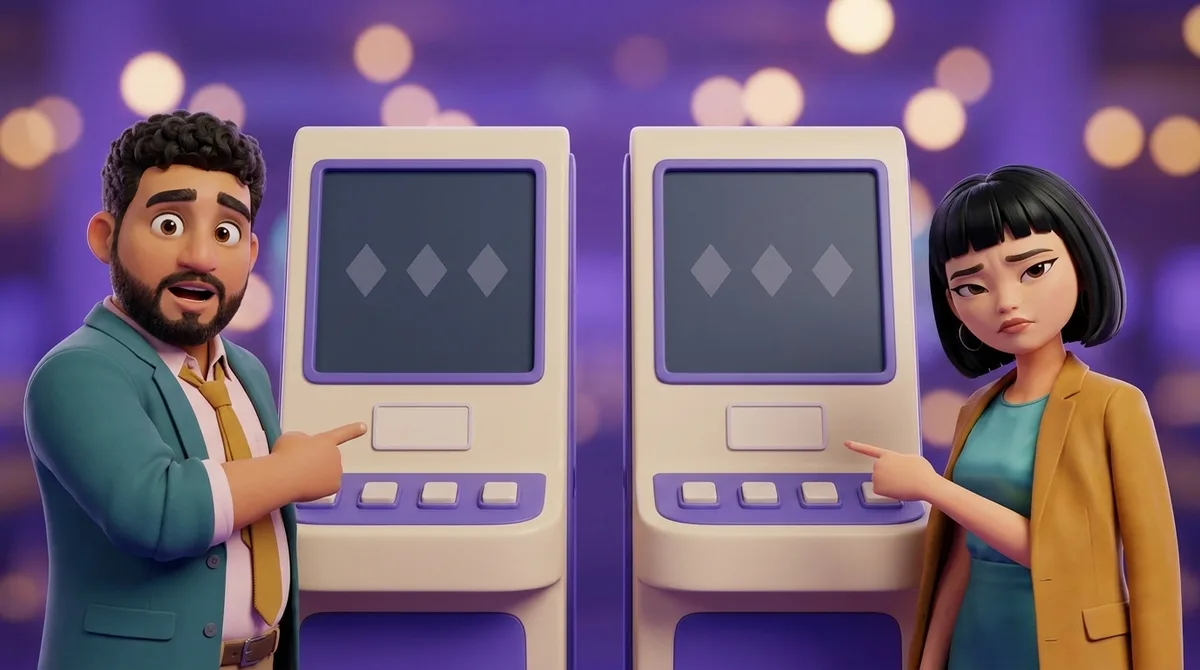
Two machines stand side by side with the same picture on the glass. One has been paying all evening and one has not. Which one do you sit at?
The short answer
Nothing you can see decides it. A return figure counts what a game gives back across its whole working life, and a thousand spins of that life is a rounding error: stand a machine that gives back 90% beside one that gives back 97%, run 1,000 spins on each, and the poorer of the two machines finishes level with the other machine or ahead of it 40 times in a hundred. Neither figure is printed anywhere on the cabinet, and the two machines can match down to how often they land a prize.
- The cabinet, and how old it is
- How bright the screen is
- How often the machine lands a prize
- What the machine paid ten minutes ago
- The figure published for the province
- What each symbol pays, printed on the paytable where anyone can read it
- How many stops on the reel carry each symbol, printed nowhere

Leoformer dealer · rules and maths
What is attached to it is a number set in a factory and checked before the machine came through the door. So: what that number counts, how long it takes to show itself, and what two machines wearing the same picture can be hiding from each other.
What the figure counts
Return to player is a share of the bets, not a share of what is in your pocket. Money goes in, some of it comes back, the same money goes in again, and it keeps going in until nothing is left — so ten bets in front of a machine buy far more than ten spins, and every one of those spins counts in the figure. That is turnover.
Ten bets, one bet a spin, nothing added and nothing taken out. The bars are the same ten bets on two machines, and the only thing that differs between the two bars is the share the machine gives back: what a machine keeps on every spin is what empties the ten bets.
The rate is fixed and the spin is not. Every prize is drawn at random; what was programmed is how often each prize comes up, and those chances were set according to the share the game is built to give back. So 90% describes no evening you will ever sit through, and was never meant to: it describes the working life of the machine — every spin from the day it is switched on to the day it is carted out.
How long it takes to show
A player has one instrument and it is a blunt one: money in against money out. Point it at a machine that gives back 90% and at one that gives back 97%, and it reads like this.
| After | The 90% machine has shown | The 97% machine has shown |
|---|---|---|
| 100 spins | 30% to 180% | 35% to 190% |
| 1,000 spins | 62% to 141% | 68% to 148% |
| 10,000 spins | 78% to 104% | 85% to 112% |
| 1,000,000 spins | 89% to 91% | 96% to 98% |
Nine runs in ten land inside the range shown. Only at 1,000,000 spins do the two ranges come apart, and by then ninety-nine runs in a hundred on the 90% machine sit within 2.1 points of its figure.
Now stand the two machines side by side, run the same number of spins on each, and pick the machine whose counter is higher. The machine that gives back the smaller share finishes level with the other machine or ahead of it this often:
| After | The 90% machine is level or ahead |
|---|---|
| 100 spins | 47 in 100 |
| 1,000 spins | 40 in 100 |
| 10,000 spins | 27 in 100 |
| 100,000 spins | 3 in 100 |
Two machines, one difference
Both machines carry the same glass and the same paytable. Both land a prize on 8.8% of spins. On both, the largest prize sits on 1 in 5,000 spins. Behind each is a reel of ten thousand stops, every stop as likely as any other. Both machines are made up: no manufacturer we could read publishes a real reel strip.
| Symbol | The 90% machine | The 97% machine |
|---|---|---|
| pays 500 times the bet | 2 | 2 |
| pays 100 times | 8 | 8 |
| pays 25 times | 85 | 120 |
| pays 10 times | 230 | 230 |
| pays 5 times | 555 | 520 |
| pays nothing | 9,120 | 9,120 |
Only two rows differ, and in opposite directions; every other row is identical.
- 35 stops come off the symbol that pays five times the bet and go on to the symbol that pays twenty-five times the bet.
- Each stop that moved pays 20 bets more than it paid before, every time the reel lands on it.
- Over ten thousand spins the stops that moved bring back 700 bets more than they did.
- Ten thousand spins are ten thousand bets staked, so 700 bets more is 7 points more: 90% becomes 97%.
Two machines can look identical and carry different figures. How a reel of ten thousand stops is mapped to the three or five you watch come round is a question this page leaves aside; what it does to an evening — the same share arriving in trickles or in one thunderclap — is the next one.
What each province puts in writing
| Province | What is in writing | Published by |
|---|---|---|
| Jujuy | 90% — the least any game may return, over its working life | Boletín Oficial de Jujuy N° 144 (INPROJUY) |
| Buenos Aires Province | no figure of its own: the rule says only that a game must pay, in theory, the percentage the law sets, over the life of the game | IPLyC Buenos Aires (Sistema de Normas) |
A floor and a reference to a law are different animals, and neither is a number about the machine in front of you.
What a machine owes the people at it is the information on its pay tables, accessible before the player commits to a bet. That is a duty about what each prize pays. It does not ask for a return figure for the game being played.
Practice: which machine, and how long
Nothing spins here. Level 1 sets two machines side by side and lists what differs between them line by line, and you say whether any of those differences moves the share that comes back. The answers are not all the same: most of the differences move nothing at all, one of them is printed on the paytable where anyone can read it, and two of them lie on a reel nobody at the machine can see. Level 2 shows the counters after a finished run and asks what a run that long settles. Level 3 takes five things a return figure is read as promising.
Only level 1 is scored: every square on the strip below is one of its questions, and they are all there from the start. When they are full, level 2 begins by itself. Levels 2 and 3 have no squares and no score — there one answer fits every question of its kind, and a mark out of ten would be measuring patience.
Lesson done
Review my mistakes (0)
Progress stays in this browser; nothing is sent anywhere.
The practice table needs JavaScript. Here is one question from it, with the answer.
Level 1 · Which machine
Same maker, two cabinets
Two machines, line by line
| Machine A | Machine B | |
|---|---|---|
| Picture on the glass | the same game | the same game |
| Lands a prize on | 8.8% of spins | 8.8% of spins |
| Largest prize | on 1 in 5,000 spins | on 1 in 5,000 spins |
| Cabinet | this year | eight years old |
| Screen | bright | dim |
Which of the two machines gives back a bigger share of everything staked?
The answer: Nothing in this list changes the share
Two machines can look identical and still give back different shares, and two machines that look nothing alike can give back the same share. A cabinet is not evidence either way.
Level 2 · How long it takes
Two machines: one gives back 90%, one gives back 97% · 50 spins each · one bet a spin
50 spins on each, side by side
Machine A
staked50 bets
came back35 bets
70%
Machine B
staked50 bets
came back40 bets
80%
After 50 spins each, how far can the higher of the two counters be trusted?
The answer: Not at all: right about half the time
Over 50 spins the machine that gives back 90% still finishes level with the machine that gives back 97% or ahead of it 49 times in a hundred, so picking by the counters gets it right 51% of the time.
Level 3 · What it will not do
A figure and an evening
At the machine
This machine gives back 97%, so nine evenings in ten I should come out somewhere near level.
How far does the claim follow?
The answer: The claim does not follow
An evening is not a short version of a machine’s working life. One evening is a single draw out of a very wide range of possible evenings, and that range only narrows after tens of thousands of spins.
Every counter in the practice table is a real draw from the outcome table of that machine, made when the page is built; the shares beside it come from the exact distribution rather than from more draws.
How the practice table works
Where the counters come from. Each counter on level 2 is a real draw from the outcome table of that machine, made when the page is built, so the picture and the figures can never disagree. Nothing is drawn again until it comes out a particular way: the question there is how long a run has to be, not who happens to be in front.
The shares beside them are not more draws. They are the exact distribution of that many spins, worked out by the same code as the tables above, because a hundred draws would land near the true figure rather than on it.
What is scored and what is not. Level 1 has a rule to learn and it is graded. Levels 2 and 3 are a reference you page through.
Check yourself

Mayaformer floor supervisor · manners, money and breaks
Five quick ones. Pick an answer, then check it. No timer, no points: just whether it stuck.
Where to look this up
18+ under each province’s rules · Play responsibly · helplines by province are at the end of this page

Mayaformer floor supervisor · manners, money and breaks
Here is the practical half. The figure is not something you can look up for the machine you are at, and the counter on it is not something you can read. Which leaves two numbers in the room that are yours: how long you meant to stay, and how much you meant to spend. Decide both of those before you sit down, and do not let the last hour move either one.
If the money on the machine starts to feel like money you need, stop there and call one of the lines below. That is what they are for.
If it stops being fun
If gambling stops being entertainment, help is available. Minimum entry age: each province sets its own. Where we found the rule or regulator that sets it, we cite it on the page; those we found set it at 18. More on responsible gaming.
Show all provinces
If you are thinking about suicide, call 135 or 0800 345 1435 from anywhere in the country
Further reading
The documents this track is written from, in full.
- Resolución 705/13: requisitos para máquinas electrónicas de juegos de azar · Instituto Provincial de Lotería y Casinos de la Provincia de Buenos AiresThe technical rules a machine must meet: independent random draws, no “near miss” tricks, a minimum payout set by law.
- Resolución 00296-P/2023: Reglamento de Salas Tragamonedas · Instituto de Juegos y Casinos de Jujuy (InProJuy)Jujuy’s slot-room rules: a theoretical return of at least 90 %, and what a machine must display.
- PAR sheets, probabilities, and slot machine play · Kevin Harrigan and Mike Dixon, Journal of Gambling Issues (2009)What a manufacturer’s PAR sheet says about a machine: how often it pays, how much the payback swings, and the several versions of one game.
- Key terms relating to live return to player performance monitoring of games of chance · UK Gambling CommissionA regulator’s definition of volatility: the standard deviation of the game, and what “very large but rare” and “small and often” prizes mean.
How it’s worked out
Sources, numbers and hosts
Where this happens. Every machine on this page is a cabinet standing in a room you can walk into.
Sources. Every figure attributed to a province is quoted where it is used, with the publisher, the document and the date it was read behind the button beside it. No publisher we could read gives a figure for any one machine on any one floor, and this page does not supply one either.
The two machines. They are ours, and they are not real games: each is a reel of ten thousand stops, every stop as likely as any other, and the two differ only in how many of those stops carry the symbol that pays twenty-five times the bet and how many carry the symbol that pays five times. No manufacturer we could read publishes a real reel strip, and inventing a real machine’s would be worse than teaching on a declared toy. The lower share, 90%, is the floor a province has actually published; the higher one, 97%, is ours, chosen so that the two differ by the same seven points on the same reel.
Numbers. Worked out when the page is built. What a machine gives back is the sum of its stops times their pays, over ten thousand; what a run of that machine shows is the exact distribution of that many spins, not a simulation of it. Every figure counts bets, never money: a flat bet of any size gives the same tables, and what an evening costs in money belongs to the last lesson of this track.
The model, stated plainly. Every table here assumes the same flat bet on every spin, exactly that many spins, and nobody stopping early. Real evenings do none of those things, so these are shares of runs of this model — not shares of people.
What is deliberately absent. There is no pace on this page: no spins a minute and no hours, so a run here is a number of spins and nothing else, and how long a run of that many spins takes at a real machine is left to the lessons that have a figure for it. There is no measure of how hard a run swings from spin to spin, and no figure for how often a machine pays beyond the one both machines share — how often a machine pays, and how big its prizes are, is the next lesson in this track. And there are two teaching machines rather than three, because two is enough to show the point.
Hosts. Leo and Maya are illustrated characters. Their backstories, a former dealer and a former floor supervisor, are written for the course: neither is a real person, and neither speaks for any casino. The rules and numbers on this page come from the sources it cites, not from their experience.
No promise. Nothing on this page says that one machine is a better choice than another, or that a longer run is, or that an evening at a casino is. In every table on this page the machine keeps a share of everything staked, on both machines and at every length of run.
The minimum, and the bets it covers
En todos los casos, los premios que otorguen las maquinas en un ciclo determinado (porcentaje de retorno teórico) deberá ser igual o superior al 90 % (noventa por ciento) de su recaudación bruta.Free translation: In all cases, the prizes awarded by the machines in a given cycle (theoretical return percentage) must be equal to or greater than 90 % (ninety percent) of their gross revenue.
Section Reglamento de Salas Tragamonedas, InProJuy
Cada juego pagará teóricamente como mínimo el porcentaje establecido por la Ley N ° 13.063, durante el tiempo de vida del juego.Free translation: Each game shall theoretically pay at least the percentage established by Law N ° 13.063, during the lifetime of the game.
Section Requisitos de la máquina de juego, software: reglas de juego, generador de números aleatorios, porcentajes de pago, juegos con bonificación (4-1 a 4-4)
Los requisitos del porcentaje mínimo deberán cumplirse en todo momento.Free translation: The minimum percentage requirements must be met at all times.
Section Requisitos de la máquina de juego, software: reglas de juego, generador de números aleatorios, porcentajes de pago, juegos con bonificación (4-1 a 4-4)
What a return-to-player figure is
j.- Porcentaje Teórico de Devolución: Es el establecido por el fabricante de un Puesto de Juego y expresa la diferencia, en porcentaje, que se calcula sobre las apuestas y los pagos teóricos realizados por ese Puesto de Juego. Admite variantes dentro de un rango predeterminado y un plazo específico para su verificación.Free translation: j.- Theoretical Return Percentage: It is the one established by the manufacturer of a Gaming Position and expresses the difference, as a percentage, calculated on the bets and the theoretical payouts made by that Gaming Position. It allows variations within a predetermined range and a specific period for its verification.
Section Reglamento de Salas Tragamonedas, InProJuy
How the rate and the prize relate
El uso de un generador de números aleatorios resultará en la selección de símbolos de la partida o la producción de resultados de las partidas. La selección deberá: * Ser estadísticamente independiente; * Cumplir con la distribución aleatoria deseada; * Pasar varias pruebas estadísticas reconocidas; * Ser impredecible.Free translation: The use of a random number generator shall result in the selection of the game's symbols or the production of the game's results. The selection shall: * Be statistically independent; * Meet the desired random distribution; * Pass several recognized statistical tests; * Be unpredictable.
Section Requisitos de la máquina de juego, software: reglas de juego, generador de números aleatorios, porcentajes de pago, juegos con bonificación (4-1 a 4-4)
The figure is a life cycle, not an evening
Cada juego pagará teóricamente como mínimo el porcentaje establecido por la Ley N ° 13.063, durante el tiempo de vida del juego.Free translation: Each game shall theoretically pay at least the percentage established by Law N ° 13.063, during the lifetime of the game.
Section Requisitos de la máquina de juego, software: reglas de juego, generador de números aleatorios, porcentajes de pago, juegos con bonificación (4-1 a 4-4)
j.- Porcentaje Teórico de Devolución: Es el establecido por el fabricante de un Puesto de Juego y expresa la diferencia, en porcentaje, que se calcula sobre las apuestas y los pagos teóricos realizados por ese Puesto de Juego. Admite variantes dentro de un rango predeterminado y un plazo específico para su verificación.Free translation: j.- Theoretical Return Percentage: It is the one established by the manufacturer of a Gaming Position and expresses the difference, as a percentage, calculated on the bets and the theoretical payouts made by that Gaming Position. It allows variations within a predetermined range and a specific period for its verification.
Section Reglamento de Salas Tragamonedas, InProJuy
Look-alike machines
Ontario approves multiple versions of the same slot machine game, with the major difference between versions being the payback percentage.
The minimum in Jujuy
En todos los casos, los premios que otorguen las maquinas en un ciclo determinado (porcentaje de retorno teórico) deberá ser igual o superior al 90 % (noventa por ciento) de su recaudación bruta.Free translation: In all cases, the prizes awarded by the machines in a given cycle (theoretical return percentage) must be equal to or greater than 90 % (ninety percent) of their gross revenue.
Section Reglamento de Salas Tragamonedas, InProJuy
The rule in Buenos Aires Province
Cada juego pagará teóricamente como mínimo el porcentaje establecido por la Ley N ° 13.063, durante el tiempo de vida del juego.Free translation: Each game shall theoretically pay at least the percentage established by Law N ° 13.063, during the lifetime of the game.
Section Requisitos de la máquina de juego, software: reglas de juego, generador de números aleatorios, porcentajes de pago, juegos con bonificación (4-1 a 4-4)
What must be accessible before a bet
Toda información de las tablas de pago deberá estar accesible para el jugador, antes de que este se comprometa a una apuesta.Free translation: All pay table information must be accessible to the player before the player commits to a bet.
Section Requisitos de la máquina de juego, software: reglas de juego, generador de números aleatorios, porcentajes de pago, juegos con bonificación (4-1 a 4-4)