Atlassino Academy · How casinos work · Lesson 1
The house edge: a price inside every bet
Every bet carries a price that is settled before the ball drops, and you can find that price by counting pockets: here is where the price hides in the payout, and how to count it out.
Two bets on the same wheel, the same money on each: one chip on a single number, one chip on red. The single number is paid rarely and pays a lot; red is paid often and pays a little. Which of the two bets costs you more?
The short answer
A wheel with one zero has 37 pockets, and the table pays a single number 35 to 1. A payout of 36 to 1 would leave nobody ahead after one full turn of the wheel: one chip lost on each of the 36 pockets that are not yours, 36 chips paid on the one pocket that is. The table pays one chip less than that, and that one chip out of 37 pockets is the house edge (the share of all the money bet that the casino keeps on average, over many rounds) — here, 2.70%.
Count the pockets on the wheel and the pockets your bet covers; the payout that would leave nobody ahead follows from those two counts. Whatever the table pays instead leaves some pockets out, and those pockets, as a share of the wheel, are the price of the bet.
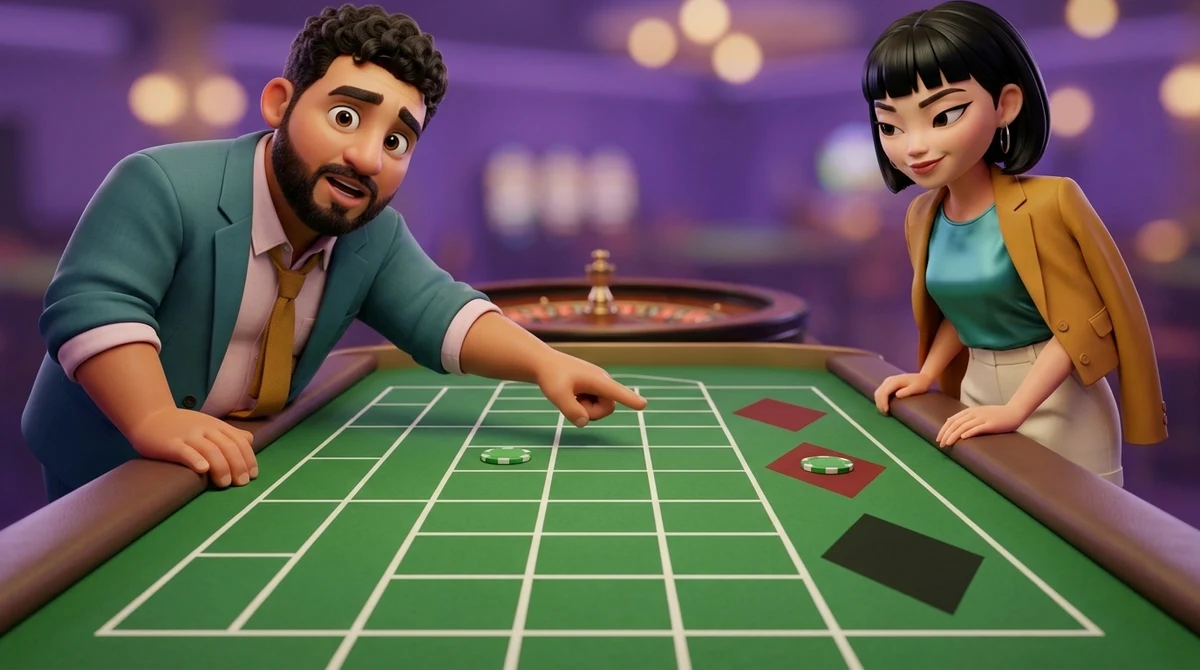

Leoformer dealer · rules and maths
I dealt for years, and the question I was asked most was some version of “which of these is the good bet?” Nobody expects the answer, which is that the table says the price out loud before a chip goes down: the price of every bet is in its payout.
Once you can read the price off the payout, you never need anybody’s opinion about a bet again.
A price, decided before the ball drops
You know what a coffee costs before you order it. A bet looks like the one purchase that works the other way round: you hand the money over first and find out afterwards what the bet cost you. It is not. The price of a bet is settled before the ball is thrown, and the only thing the spin decides is which side pays that price tonight.
The price is an average. It is what a bet loses over many spins, measured against the money you put down on it. Three things follow from that, and none of the three is obvious.
- The price is an average, not tonight’s result.You can sit down, be paid twice and walk out ahead, and the price was still charged on every bet you made. The price shows in the average over many bets, never in any one evening.
- The price is charged on each bet, not on your wallet.The same chips go down again and again across an evening, and the price is charged every time they go down.

Leoformer dealer · rules and maths
People hear “the house has an edge” and take it as a mood, as if the room were simply against them. The house edge is a number. It is the same number for a first-timer and for somebody who has played for thirty years, and you can work it out in ten seconds once you know where to look.
Where the price hides: count the pockets
Here is a wheel with one zero: 37 pockets, the numbers 1 to 36 and a zero. Your chip is on 17.
Your chip covers 1 pocket of 37
0123456789101112131415161718192021222324252627282930313233343536The marked pocket is your number. The other 36 pockets belong to the table.
Now count. Picture one full turn of the wheel: 37 spins, with the ball landing in each pocket once. On 36 of those spins your number stays away and you lose one chip each time. On the one spin your number lands, the table pays you. If the table paid 36 chips for that one chip, you would end the full turn exactly where you started, 36 chips out and 36 chips in. That payout has a name, the level payout, and on a single number the level payout is 36 to 1.
One chip out of 37 is the price of a single number. Written as a share of the wheel, one pocket out of 37 comes to 2.70%, and that share is what the house edge of the bet means.
The price of a bet is the share of the wheel that its payout leaves out. The price is not the size of the payout, it is not how often the bet comes in, and it is not how the last hour went.
The same count in money. Put 10 units on that number and keep it there for one full turn of the wheel, and you have made 37 bets of 10 units, one on each spin.
- Goes down over the full turn370 units37 bets of 10 units, one bet on each spin
- Comes back360 unitsthe one spin your number lands, paid 35 to 1, with the bet it was on handed back
- Stays with the table10 unitsone bet, for the one pocket the payout leaves out
Amounts are in betting units, not pesos: a unit can stand for any amount, and the arithmetic is the same at any scale.
One wheel, one price
Now do the same count for red. Red covers 18 of the 37 pockets, and the table pays it 1 to 1: one chip paid for each chip staked.
Red covers 18 pockets of 37
0123456789101112131415161718192021222324252627282930313233343536The 18 marked pockets are the low numbers, 1 to 18. Red is 18 pockets as well, and so are black, odd, even and high: for the price it makes no difference which 18 pockets are yours, only how many. The other 19 pockets belong to the table.
| The count | A single number | Red |
|---|---|---|
| Pockets that are yours | 1 | 18 |
| What the table pays | 35 to 1 | 1 to 1 |
| Chips in your hand after a spin the bet is paid on, for one chip staked | 36 | 2 |
| Chips back over one full turn, for 37 chips put down | 36 | 36 |
| Pockets the payout leaves out | 1 | 1 |
| The level payout | 36 to 1 | 19 to 18 |
| The price of the bet | 2.70% | 2.70% |
That is not a coincidence, and it is the heart of the whole lesson: every payout on this cloth is built for a wheel of thirty-six pockets. A single number paid 35 to 1 brings back 36 chips over a full turn. Red paid 1 to 1 brings back 36. A dozen paid 2 to 1 brings back 36. A wheel with thirty-six pockets and no zeros would take exactly 36 chips over a full turn, one on each spin, and every one of those payouts would be a level payout on it. This wheel has 37 pockets, and the one extra pocket, the zero, is the one chip that every payout leaves out.
| Bet | Pockets it covers | How often it is paid | What the table pays | The level payout | The price |
|---|---|---|---|---|---|
| One number | 1 | 2.70% | 35 to 1 | 36 to 1 | 2.70% |
| Two numbers | 2 | 5.41% | 17 to 1 | 35 to 2 | 2.70% |
| Three numbers | 3 | 8.11% | 11 to 1 | 34 to 3 | 2.70% |
| Four numbers | 4 | 10.81% | 8 to 1 | 33 to 4 | 2.70% |
| Six numbers | 6 | 16.22% | 5 to 1 | 31 to 6 | 2.70% |
| A dozen | 12 | 32.43% | 2 to 1 | 25 to 12 | 2.70% |
| Red, black, odd, even, high, low | 18 | 48.65% | 1 to 1 | 19 to 18 | 2.70% |
The house edge tool does the same count for every bet of every game on this site.
No row is unlike the others. On a wheel with one zero every bet on the cloth leaves the same share of the wheel out, so every row comes out at 2.70%. The one bet that breaks the pattern belongs to the other wheel, the one with two zeros, and it comes up next. Lesson 4.3 takes the whole cloth apart.
The same payout on a longer wheel
Some wheels carry a second green pocket, a double zero. Add it to the wheel and change nothing else. A single number is still paid 35 to 1, and 35 to 1 still brings back 36 chips over a full turn. But a full turn of that wheel is 38 spins, not 37, so the payout leaves two pockets out instead of one.
| A single number | Wheel with one zero | Wheel with a zero and a double zero |
|---|---|---|
| Pockets on the wheel | 37 | 38 |
| What the table pays | 35 to 1 | 35 to 1 |
| The level payout | 36 to 1 | 37 to 1 |
| Pockets the payout leaves out | 1 | 2 |
| The price of the bet | 2.70% | 5.26% |
The price is about double, on a wheel that looks the same as this one from a metre away. The payout did not change; the number of pockets that the payout had to stretch across did.
One bet exists only on that wheel. The bet on the zero, the double zero and 1, 2 and 3 covers five pockets and is paid 6 to 1, and 6 to 1 on five pockets brings back only 35 chips over a full turn of 38. That payout leaves 3 pockets out, and 3 pockets of 38 is 7.89%, dearer than any bet on either wheel.
Count the zeros before you sit down
You can check the number of pockets with your own eyes, and you do not need to count all of them: count the zeros. The rule book behind a Lotería de Córdoba table describes its wheel in one line:
cualquiera de los treinta y siete (37) números en que está dividido el tablero.Free translation: any of the thirty-seven (37) numbers into which the board is divided.
- Look at the wheel. One zero, or a zero and a double zero?
- Look at the head of the betting cloth. The zeros on the wheel are printed on the layout as well, so a wheel you cannot see past other players can still be read from the cloth.
- Two zeros means 38 pockets, and about twice the price of one zero on every bet the two wheels share. One zero means 37 pockets.
That check takes thirty seconds, standing up, before any money goes down.
House edge, return to player, hold
House edge and return to player are one measurement seen from its two ends. Hold is a different measurement, and it is often mistaken for the house edge.
| Name | What it measures | On a wheel with one zero |
|---|---|---|
| House edge | The share of all the money bet that stays with the table, on average, over many bets. | 2.70% |
| Return to player | The same figure from the other end: the share of the money bet that comes back. House edge and return to player add up to 100%. | 97.30% |
| Hold | A different measurement: counted from the money you brought to the table, not from each bet. Because the same money is bet many times over, hold comes out far bigger than the house edge. | no single figure: it depends on how many times the money goes down |
On a wheel, house edge and return to player are one subtraction apart: when 2.70% of the money bet stays with the table, 97.30% of it comes back, and on the wheel with two zeros 5.26% stays and 94.74% comes back. Slot machines do not print their return to player at all; lesson 2.2 explains why, and what can be read on a machine instead.
Hold is the name to watch. Hold counts from the money you brought to the table, not from each bet, and because the same money goes down over and over, hold comes out far larger than the house edge. That is why an evening costs more than the price of one bet suggests.
Practice: set a level payout
You are not choosing a bet here, and there is nothing to guess. The wheel is in front of you, your chip is already down, and the only question is what that bet would have to pay to cost nothing at all. Count the pockets that are yours, count the pockets that are not, and the level payout falls out of the two counts.
The practice is one run through three levels. Level 1 is a single number or a pair of numbers, on either wheel. Level 2 is the rest of the cloth: colours, dozens, corners and the one bet with a price of its own. Level 3 turns the question round: the payout is given, and you count the price. Every square on the strip is one moment of the run, and all of the squares are there from the start; when the squares of one level are full, the next level begins by itself.
Lesson done
Review my mistakes (0)
Progress stays in this browser; nothing is sent anywhere.
The practice table needs JavaScript. Here is one moment from it, with the answer.
Level 1 · One number
A wheel of 38 pockets
38 pockets · your bet covers 1
000123456789101112131415161718192021222324252627282930313233343536Your number: 17. The table pays this bet 35 to 1.
What would this bet have to pay to cost nothing at all?
The answer: 37 to 1.
Count, do not guess. 1 pocket is yours and 37 are not, so the level payout is 37 to 1. The table pays 35 to 1 instead, and the 2 pockets between the two payouts are the price: 5.26% of every unit bet.
Every moment is worked out the same way: count the pockets your bet covers, count the pockets it does not cover, and the payout that balances the two counts is the level payout. What the table pays instead of the level payout is the price.
How the practice table works
Where the moments come from. Nothing is written down as an answer anywhere. Each moment names a wheel and a bet, and the count is done when the page is built: pockets covered, pockets not covered, the payout that balances the two. The wheels and what their tables pay are the same model the house edge tool uses, so a figure you see here and a figure you see there cannot drift apart: they come from the same lines of code.
What you will not see. No moment suggests a bet, and no moment tells you a cheaper bet is a good one. A shorter payout on level 3 is a thought experiment about arithmetic, not a claim about any table anywhere.
One strip, no rounds. Every square on the strip is one moment of this lesson, and all of the squares are there from the start. Your first answer fills the square; when the squares of one level are full, the next level begins by itself, with no button in between. Practising a mistake turns a cross into “fixed in practice” and does not change the count: only first answers do. Progress stays in this browser; nothing is sent anywhere.
Check yourself

Mayaformer floor supervisor · manners, money and breaks
Five quick ones. Pick an answer, then check it. No timer, no points: just whether it stuck.
The question we opened with. Neither: the single number and red cost exactly the same. Both bets leave the same one pocket of the wheel unpaid, the zero, so both bets carry 2.70% of every bet. What differs between the two bets is only how the evening feels: the single number is paid rarely and pays a lot, red is paid often and pays a little. The price is identical, and that is the point: the price lives in the payout, not in the drama.
Where to check this
18+ under each province’s rules · Play responsibly · the helplines are at the end of this page
Further reading
- Guía de referencia legislativa de ALEA · Asociación de Loterías Estatales Argentinas (ALEA), publicada por la Lotería de Santa CruzDónde las propias loterías provinciales dicen que regular el juego es competencia de cada provincia y no de la Nación.
- Dossier legislativo 306: juegos de azar y/o apuestas (octubre de 2024) · Biblioteca del Congreso de la NaciónEl repaso de la legislación nacional y provincial sobre juego, con el fallo de la Corte Suprema que lo declara materia no federal.
- Nómina de organismos reguladores · ARCA (ex AFIP)Qué organismo regula el juego en cada provincia y en la Ciudad de Buenos Aires, según la lista del organismo nacional de recaudación.
- Ley 7.020 de Salta: Marco Regulatorio de los Juegos de Azar · Legislatura de Salta (vía argentina.gob.ar/normativa)Una ley provincial que baja hasta el piso del casino: licencias, límites de apuesta, cuadro de pagos, cámaras y reclamos.
- Ley 11.536 de la Provincia de Buenos Aires (texto actualizado) · Legislatura PBA (Sistema de Normas)Qué juegos autoriza la ley en los casinos bonaerenses y cómo define el beneficio bruto del juego.
- Reglamento General de Casinos de Mendoza (Res. Dir. 225/01) · IPJyC Mendoza (compilación SAPIA)Las obligaciones del operador, el registro de exclusiones y lo que no se puede llevar a la mesa.
- Información sobre juegos vivos o de paño: RULETAS, pagos, probabilidades · IPJyC Mendoza (S.A.P.I.A., Res. Dir. 812-16)Cómo se pagan las apuestas de la ruleta y cuánto se queda la casa en la rueda de un cero y en la de dos ceros: el único documento oficial argentino que encontramos que pone el margen de la casa en números.
- Salas y Casinos · Ente Regulador del Juego de Azar de Salta (ENREJA)Cómo describe un regulador provincial lo que controla en las salas: informes, máquinas, mesas y reclamos.
- Casinos de la provincia de Misiones · Instituto Provincial de Lotería y Casinos de MisionesCómo sigue un regulador, en tiempo real, los movimientos de cajas, mesas y máquinas de cada permisionario.

Mayaformer floor supervisor · manners, money and breaks
One thing to carry out of here, and it is not about roulette. The price follows the number of bets you make, and the number of bets is the part of the evening you decide, before you sit down, while nothing is happening yet.
Knowing the price does not make an evening cheaper, and nothing here suggests that an evening at the wheel is a good idea for you. Knowing the price only means you are no longer paying it without knowing.
If it stops being fun
If gambling stops being entertainment, help is available. Minimum entry age: each province sets its own. Where we found the rule or regulator that sets it, we cite it on the page; those we found set it at 18. More on responsible gaming.
Show all provinces
If you are thinking about suicide, call 135 or 0800 345 1435 from anywhere in the country
How it’s worked out
Sources, numbers and hosts
Numbers. Every figure on this page is worked out when the page is built, by the same code that runs the house edge tool: a wheel of so many pockets, a bet covering so many of those pockets, a payout of so much. Nothing is typed in by hand, and each figure is recomputed by our checks from the engine rather than read back from this page.
Sources. The definition comes from IPJyC Mendoza (SAPIA, Res. Dir. 812-16), and the two published prices, with the one bet that pays less than the rest, from IPJyC Mendoza (SAPIA, Res. Dir. 812-16), quoted word for word behind the source buttons on this page, each with the date we read it. They are not decoration: the page refuses to build if the figure our own counting produces is not the figure in the quote. The layout of the wheel is quoted from the rule book published by Lotería de Córdoba for its own tables, dated where it stands.
Which wheel. The counting on this page is done on a wheel with one zero, because that is the wheel the rule book quoted above describes. The wheel with a zero and a double zero appears only as the comparison.
What is counted, and what is not. The payout a table gives a bet is part of the model this course computes with, the same one the tool uses; the published price is what checks it. 35 to 1 is the only whole-number payout on a wheel of 37 pockets that produces the published 2.70%, and the same 35 to 1 is the only one on 38 pockets that produces 5.26%: one payout, two prices, because the counts differ. So the counting, the model and the published figure are three roads to one place.
The picture of red. The eighteen pockets marked for red on this page are the low numbers, 1 to 18, because the price depends on how many pockets a bet covers and not on which ones; the colour of each pocket is not something this page reads from a rule book, so it is not something this page draws.
What this page does not say. No bet is put forward here as a good one, and no system of any kind is either. A lower price is still a price, charged on every bet, and no arrangement of bets changes it — that is lesson 10.2.
Hosts. Leo and Maya are illustrated characters. Their backstories, a former dealer and a former floor supervisor, are written for the course: neither is a real person, and neither speaks for any casino. The rules and numbers on this page come from the sources it cites, not from their experience.
The price of a bet on a wheel with one zero
−1×36/37 + 35×1/37 = −0.0270 (2.70% de margen de la casa)Free translation: −1×36/37 + 35×1/37 = −0.0270 (2.70% house edge)
What the house edge is
El porcentaje o Margen de la Casa (llamado también ganancia esperada) es la cantidad que el jugador pierde en relación con cualquier apuesta que haga, como promedio.Free translation: The percentage or House Edge (also called expected gain) is the amount that the player loses, on average, in relation to any bet he makes.
The price of a bet on a wheel with two zeros
−1×37/38 + 35×1/38 = −0.0526 (5.26% de margen de la casa)Free translation: −1×37/38 + 35×1/38 = −0.0526 (5.26% house edge)
0, 00, 1, 2, 3 6:1 13.16% 7.89%
What the house edge is
El porcentaje o Margen de la Casa (llamado también ganancia esperada) es la cantidad que el jugador pierde en relación con cualquier apuesta que haga, como promedio.Free translation: The percentage or House Edge (also called expected gain) is the amount that the player loses, on average, in relation to any bet he makes.
One wheel, one price
−1×36/37 + 35×1/37 = −0.0270 (2.70% de margen de la casa)Free translation: −1×36/37 + 35×1/37 = −0.0270 (2.70% house edge)
Two zeros instead of one
−1×37/38 + 35×1/38 = −0.0526 (5.26% de margen de la casa)Free translation: −1×37/38 + 35×1/38 = −0.0526 (5.26% house edge)
0, 00, 1, 2, 3 6:1 13.16% 7.89%
The one bet on that wheel that costs more
0, 00, 1, 2, 3 6:1 13.16% 7.89%
The wheel, in the words of Lotería de Córdoba
cualquiera de los treinta y siete (37) números en que está dividido el tablero.Free translation: any of the thirty-seven (37) numbers into which the board is divided.
Section Art. 5