Atlassino Academy · Other tables · Lesson 11
Siete y medio: seven and a half against the bank
Siete y medio is played with forty cards against the bank, under the rule book of the Buenos Aires Province. Here are the cards, the bank’s fixed rule, the three kinds of seven and a half, and what each choice costs.
You hold a 4, the bank’s card is face down, and everyone at the table seems to know what to do next. Is there a right answer?
The short answer
Yes, and it is printed on the cloth. Siete y medio is played with forty cards against the bank, and the bank has to draw on 4½ or less and stand on 5 or more. By our count, the choice that costs you least is the same line, with one addition: two picture cards as your first two are opened into two hands. Played that way, a bet costs 2.57% of itself on average; standing on your first card every time costs 26.42%.
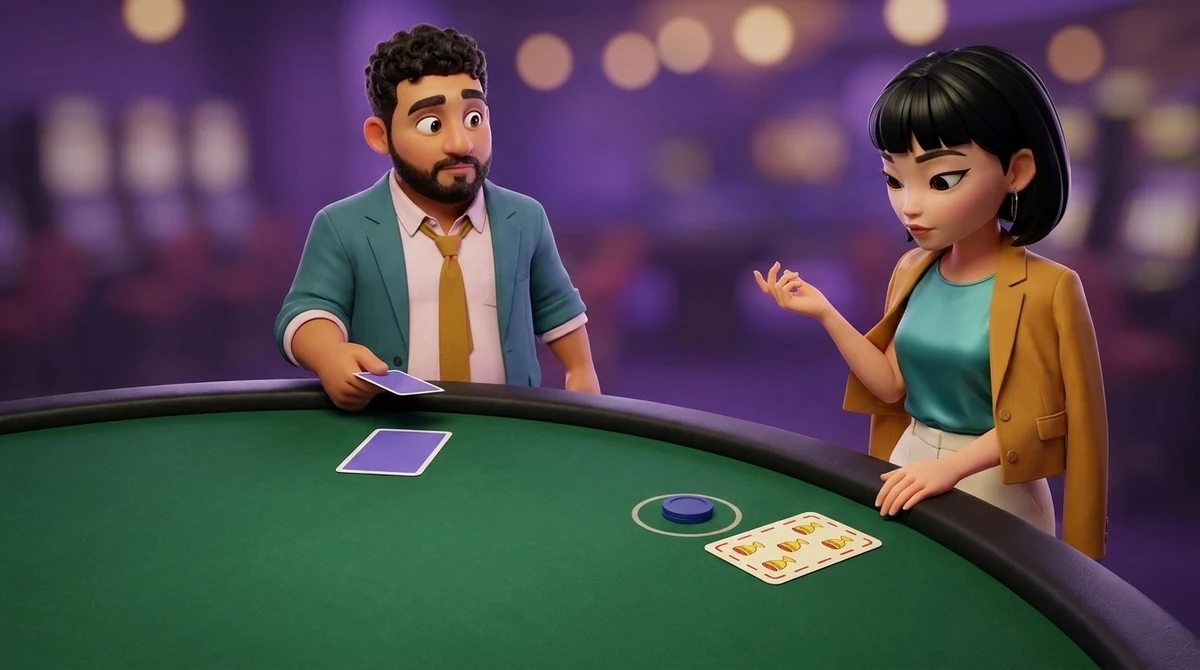

Leoformer dealer · rules and maths
Siete y medio looks like a quiet cousin of blackjack, but it has its own deck, its own half points and its own three kinds of seven and a half. Everything on this page comes from one rule book, and every number from one count.
Forty cards, one aim
The game uses French cards without the eights, nines and tens, and the aim is a total of seven and a half, or as close to it as you can get without going over; the player plays to get closer than the dealer. The shoe holds ten decks of forty, four hundred cards.
| Card | Counts |
|---|---|
| Ace | 1 |
| 2 to 7 | Its number |
| Jack, queen, king | ½ |
A picture card is half a point, so totals go up in halves: ½, 1, 1½ and so on to 7½.
Each player plays the bank alone, not the other players: how much to bet and whether to take another card are each player’s own choice.
One deal, from the bets to the payout
The dealer gives every player one card face up and takes one face down for the bank. The bank’s card is turned over only after the last player has stood or gone over; if every player has gone over, the bank turns over only its first card.
Bets
Every seated player bets on every deal, inside the table’s minimum and maximum.
One card each
Each player gets one card face up; the bank takes one face down.
Your choices
Stand, or draw one card at a time, until you stand or go over 7½.
The bank
Turns its card over and draws or stands by its fixed rule.
Paid
Each box is settled against the bank on its own.
You may stand on any total from your first card, or draw one card at a time until you choose to stop or go over, but never draw on seven and a half. A box that goes over is lost at once, before the bank plays. Every seated player bets on every deal, or gives up the seat.
The bank’s rule
The bank has no choices. It has to draw on 4½ or less and stand on any total from 5 to 7½, and the line is printed on the cloth. Over a fresh shoe, by our count, the bank goes over 7½ on 26.42% of deals, ends on seven and a half on 6.75%, and stands on exactly 5 on 19.97%.

Leoformer dealer · rules and maths
The bank’s line is also the line that costs you least. In our count, every total from ½ to 4½ is cheaper drawn than stood on, and every total from 5 up is cheaper stood on. You do not need a chart: read the cloth.
Three kinds of seven and a half
Seven and a half comes in three kinds. Siete y medio real, a seven and a picture card of the same suit, loses to nothing. Siete y medio mayor, a seven and a picture card of different suits, loses only to real. Siete y medio menor, made with three cards or more, loses to real and to mayor.
| Kind | Made with | Paid on a bet of 10 units | Loses to |
|---|---|---|---|
| Real | A seven and a picture card of the same suit | 20 units | Nothing |
| Mayor | A seven and a picture card of different suits | 15 units | Real |
| Menor | Three cards or more | 10 units | Real and mayor |
Every other paid bet gets 100% of itself; real gets 200% and mayor 150%. A box with the same total as the bank neither gains nor loses, and you may take the bet back, except at seven and a half. When both sides make seven and a half, the player is paid 50% of the bet: 5 units on 10 units.
We read the 50% as the case of two sevens and a half of the same kind, as the table printed in the rule book says; when the kinds differ, the higher kind decides, as the three rules above say.
Opening two picture cards
When your first card is a picture card and your second is another, you may play a second bet the size of the first on each of them, and draw on each as you like without going over seven and a half. Only one such opening is allowed per box, and a seven and a half made on an opened hand is paid like any other.
By our count it is the one choice in the game that departs from the bank’s line, and it is worth taking: two picture cards opened come to +8.78% of the first bet on average, against −18.79% for drawing to 1 and −47.14% for standing.
What a bet costs
The rule book prints the payouts, not a price. The table below is our own count: every way a fresh shoe of 400 cards can deal one box against the bank, with the bank playing by its rule and each way of playing priced by the payouts above.
| How you play | Cost of the bet, on average |
|---|---|
| Draw on 4½ or less, stand on 5 or more, and open two picture cards | 2.57% |
| The same line, but never open two picture cards | 5.04% |
| Stand on your first card, every time | 26.42% |
Two things make the price. Your box is settled first: when you go over, the bet is lost even on the deals where the bank would go over too. Against that, real and mayor are paid more than 100%, and two picture cards can be opened. Playing the bank’s line and opening the pictures, a bet costs 2.57%; skipping the opening costs 2.47% more of every bet.

Mayaformer floor supervisor · manners, money and breaks
Playing the cheapest line does not make the bet cheap: it still costs something every deal, and a seat at this table means a bet on every deal. Decide the money and the time at home, and leave the seat when either runs out.
If you find yourself staying to get back what is gone, the lines below are there for exactly that.
If it stops being fun
If gambling stops being entertainment, help is available. Minimum entry age: each province sets its own. Where we found the rule or regulator that sets it, we cite it on the page; those we found set it at 18. More on responsible gaming.
Show all provinces
If you are thinking about suicide, call 135 or 0800 345 1435 from anywhere in the country
Betting from behind a seated player
Players standing behind the table may bet on any seated player’s box, and the two bets together may not pass the table maximum. The choices belong to the seated player alone. Nobody may advise a seated player about their choices while the game is on, or comment on them.
If the seated player opens two picture cards and you do not put up a second bet, your bet plays the first card only.
Practice: draw or stand, pay the box
Level 1 shows your cards while the bank’s card is face down and asks what costs less. Level 2 shows both hands and asks what your bet of 10 units is paid. The 10 units is an example bet, not a suggested bet.
Nothing is bet here, and nothing is random. Each question is a set picture of cards, and the answer is worked out from the same rules and the same count as the rest of the page.
Lesson done
Review my mistakes (0)
Progress stays in this browser; nothing is sent anywhere.
The practice table needs JavaScript. Here is one question from it, with the answer.
YOU
- Your total 1
The bank’s card is face down. What costs you less?
- Draw a card Drawing on 1 costs more: −18.79% of the bet on average, against +8.78%.
- Stand Standing on 1 costs more: −47.14% of the bet on average, against +8.78%.
- Open them into two hands Two picture cards can be opened into two hands, each with a bet the size of the first. That comes to +8.78% of the first bet on average, against −18.79% for drawing to 1.
By our count over a fresh shoe, the right choice depends on your total alone: draw on 4½ or less, stand on 5 or more, the same line the bank has to follow. The one exception is two picture cards as your first two: open them into two hands.
BANCA
YOU
- You siete y medio menor
- Banca siete y medio mayor
What is paid on your bet of 10 units?
- The bet is lost Siete y medio menor loses to siete y medio mayor.
- Nothing: the bet stays where it is Not here. Siete y medio menor loses to siete y medio mayor.
- 10 units paid Not here. Siete y medio menor loses to siete y medio mayor.
Over 7½ loses at once. Seven and a half is paid by its kind: real 200%, mayor 150%, menor 100%; the same kind on both sides is paid 50%. Any other paid bet gets 100%, and an equal total below 7½ leaves the bet where it is.
Every question in the practice run is worked out the same way: the cards are put through the same rules and the same count as the rest of the page, and the answer comes out of that, not out of anybody’s memory.
How the practice run works
Where the questions come from. Every answer is worked out when the page is built: draw or stand by the same count our engine uses for the prices above, and every payout by the rules of the Buenos Aires Province rule book. The wrong answers are named mistakes: standing low out of caution, drawing on a total the bank would stand on, an equal total taken for a loss, and two kinds of seven and a half taken for one.
One strip, and no rounds. Every square on the strip is one question of this lesson, and all of the squares are there from the start. Your first answer fills the square it belongs to; when the squares of one level are full, the next level begins by itself. Practising a question you got wrong turns its cross into “fixed in practice” and does not change the count, because only first answers count.
Your progress stays in this browser, and nothing is sent anywhere.
Check yourself

Mayaformer floor supervisor · manners, money and breaks
Four quick ones. Pick an answer, then check it. No timer, no points: just whether it stuck.
Back to the question we opened with. Yes: on a 4 you draw, as the bank would. The bank’s line is printed on the cloth, and in our count it is also the cheapest line for you, with two picture cards opened as the one exception.
Where to go next, and further reading
18+ under each province’s rules · Play responsibly · the helplines are further up this page
Further reading
- Resolución 1452/12, Anexo I: Siete y Medio (Reglamento del Juego) · Instituto Provincial de Lotería y Casinos de la Provincia de Buenos AiresThe rules of the table: the 40-card deck, the bank’s fixed rule, the three kinds of seven and a half and what each is paid.
How it’s worked out
Rules, numbers, sources and hosts
Where the rules come from. Everything on this page follows chapters 17 and 18 of resolution 1452/12 of the Buenos Aires Province lottery and casino institute, the rules of siete y medio and the technical rules of the table. We found no other province’s rules for the game, and nothing here says how a table elsewhere is run.
Numbers. Every payout comes from the percentages of the rule book, applied by our siete y medio engine. Every price and share is counted exactly over a fresh shoe of 400 cards: every way the cards can fall for one box and the bank, with the bank drawing by its rule. Nothing here is typed in by hand.
What the count leaves out. The count is for one player at the table; the cards other players take are left out. For the bank’s seven and picture card, the count takes the same suit as one chance in four. A split is counted as two hands, each played from the shoe without the other picture card; that the second hand draws from the same shoe as the first is left out. No document we could read prints how many deals an hour a table plays, so there is no price of an hour here.
Our readings. The rule book pays 50% when “the bank and a player” both make seven and a half; read with its own table (“of equal value”) and the order of the three kinds, we take it as the case of the same kind on both sides. A box that goes over is lost at once, as the bank turns over only its first card when every player has gone over.
Sources. Every rule on this page carries a button with the sentence it rests on, in the rule book’s own Spanish, the publisher who wrote that sentence and the date we read it.
Hosts. Leo and Maya are illustrated characters. Their backstories, a former dealer and a former floor supervisor, are written for the course: neither is a real person, and neither speaks for any casino. The rules and numbers on this page come from the sources it cites, not from their experience.
No promise. Siete y medio is played against a price. Playing the cheapest line lowers what each bet costs on average; nothing on this page changes which cards come out of the shoe, and nothing here says how an evening at the table would end.
Equal totals
Los casilleros que hayan obtenido un puntaje igual al de la Banca, con la excepción del SIETE Y MEDIO, no ganan ni pierden, pudiendo los Apostadores retirar su apuesta.Free translation: Boxes that have obtained a score equal to that of the Banca, with the exception of the SIETE Y MEDIO, neither win nor lose, and the Bettors may withdraw their bet.
Section Capítulos 17 y 18, Siete y Medio: Reglamento del Juego (17.1 a 17.12) y Reglamento Técnico Funcional (18.1, 18.2, 18.12)
Three kinds
SIETE Y MEDIO REAL: Formado con un siete y una figura del mismo palo. No pierde contra ningún puntaje.Free translation: SIETE Y MEDIO REAL: Made up of a seven and a face card of the same suit. It does not lose against any score.
SIETE Y MEDIO MAYOR: Formado con un siete y una figura de distinto palo solo pierde contra SIETE Y MEDIO REAL.Free translation: SIETE Y MEDIO MAYOR: Made up of a seven and a face card of a different suit, it loses only against SIETE Y MEDIO REAL.
SIETE Y MEDIO MENOR: Formado con tres o más cartas, pierde contra SIETE Y MEDIO REAL Y SIETE Y MEDIO MAYOR.Free translation: SIETE Y MEDIO MENOR: Made up of three or more cards, it loses against SIETE Y MEDIO REAL and SIETE Y MEDIO MAYOR.
Section Capítulos 17 y 18, Siete y Medio: Reglamento del Juego (17.1 a 17.12) y Reglamento Técnico Funcional (18.1, 18.2, 18.12)
What each is paid
Todas las apuestas ganadoras cobrarán el cien por cien (100%) del monto total apostado. Excepto el SIETE Y MEDIO REAL que cobrará el 200% y el SIETE Y MEDIO MAYOR que cobrará el ciento cincuenta por ciento (150%).Free translation: All winning bets shall be paid one hundred percent (100%) of the total amount bet. Except for the SIETE Y MEDIO REAL, which shall be paid 200%, and the SIETE Y MEDIO MAYOR, which shall be paid one hundred and fifty percent (150%).
Siete y medio Real 200%Siete y medio Mayor 150%Siete y medio Menor 100%Ancar de Siete y Medio de igual valor 50%Free translation: Ancar de Siete y Medio of equal value 50%
Section Capítulos 17 y 18, Siete y Medio: Reglamento del Juego (17.1 a 17.12) y Reglamento Técnico Funcional (18.1, 18.2, 18.12)
Opening two picture cards
APERTURA DE FIGURAS: Es la opción del Apostador, que teniendo una figura y recibiendo como segundo naipe otra figura, de poder jugar una postura igual a la original en cada uno de ellos, recibiendo cuantos naipes desee; siempre y cuando no se exceda de SIETE Y MEDIO.Free translation: APERTURA DE FIGURAS (splitting face cards): This is the option of the Bettor who, holding a face card and receiving another face card as the second card, may play a bet equal to the original one on each of them, receiving as many cards as desired, provided that SIETE Y MEDIO is not exceeded.
Solo se podrá efectuar una APERTURA DE FIGURAS por casillero.Free translation: Only one APERTURA DE FIGURAS may be made per box.
El SIETE Y MEDIO formado por la APERTURA DE FIGURAS ganará los porcentajes establecidos en el articulo precedente.Free translation: The SIETE Y MEDIO formed through the APERTURA DE FIGURAS shall win the percentages established in the preceding article.
Section Capítulos 17 y 18, Siete y Medio: Reglamento del Juego (17.1 a 17.12) y Reglamento Técnico Funcional (18.1, 18.2, 18.12)
Betting from behind
También pueden participar en el juego los Apostadores que se encuentren de pie, quienes pueden hacerlo a favor de cualquiera de los que están sentados. El monto de ambas apuestas sumadas no puede superar el máximo establecido.Free translation: Bettors who are standing may also take part in the game, and may do so in favor of any of those who are seated. The amount of both bets added together may not exceed the established maximum.
Las decisiones sobre el juego son exclusivas del Apostador sentado.Free translation: Decisions about the game belong exclusively to the seated Bettor.
En caso que el Apostador sentado decidiera por la variante APERTURA DE FIGURAS, el Apostador de pie que no hiciese la misma opción, jugará exclusivamente con la primera carta.Free translation: If the seated Bettor decides on the APERTURA DE FIGURAS variant, the standing Bettor who does not make the same choice will play only with the first card.
Section Capítulos 17 y 18, Siete y Medio: Reglamento del Juego (17.1 a 17.12) y Reglamento Técnico Funcional (18.1, 18.2, 18.12)
No advice at the table
No se admitirá a persona alguna, aconsejar al Apostador sentado, acerca de sus decisiones en el desarrollo del juego, ni efectuar manifestación alguna al respecto.Free translation: No person shall be permitted to advise the seated Bettor about his or her decisions during the course of the game, nor to make any statement in that regard.
Section Capítulos 17 y 18, Siete y Medio: Reglamento del Juego (17.1 a 17.12) y Reglamento Técnico Funcional (18.1, 18.2, 18.12)
Forty cards, ten decks
El juego se desarrolla con naipes del tipo francés sin los naipes con valor 8Free translation: The game is played with French-type cards without the cards with value 8
y 10, y consiste en tratar de obtener con el valor de un (1) naipe que recibe inicialmente o con el agregado de posteriores un puntaje de siete y medio (7y1/2) o lo más cercano a éste, sin pasarse. El objetivo es superar el juego del Tallador.Free translation: and 10, and consists of trying to obtain, with the value of one (1) card received initially or with the addition of later ones, a score of seven and a half (7y1/2) or as close to it as possible, without going over. The objective is to beat the Tallador's hand.
El Sabot será armado con DIEZ (10) juegos de barajas de CUARENTA (40) naipes cada uno, totalizando cuatrocientos (400) naipes.Free translation: The Sabot shall be made up of TEN (10) decks of FORTY (40) cards each, totaling four hundred (400) cards.
Section Capítulos 17 y 18, Siete y Medio: Reglamento del Juego (17.1 a 17.12) y Reglamento Técnico Funcional (18.1, 18.2, 18.12)
What each card counts
AS 1 puntoFree translation: ACE 1 point
2 AL 7 El valor indicado en el mismo.Free translation: 2 TO 7 The value shown on the card.
Valet: del francés, que significa criado. Es el undécimo naipe de cada palo. Su valor para la suma de los naipes es de medio puntoFree translation: Valet: from the French, meaning servant. It is the eleventh card of each suit. Its value for the sum of the cards is half a point
Dama: es el duodécimo naipe de cada palo. Su valor para la suma de los naipes es de medio punto.Free translation: Dama (Queen): it is the twelfth card of each suit. Its value for the sum of the cards is half a point.
Rey: es el décimo tercer naipe de cada palo. Su valor para la suma de los naipes es de medio punto.Free translation: Rey (King): it is the thirteenth card of each suit. Its value for the sum of the cards is half a point.
Section Capítulos 17 y 18, Siete y Medio: Reglamento del Juego (17.1 a 17.12) y Reglamento Técnico Funcional (18.1, 18.2, 18.12)
Against the bank, on your own
El Siete y Medio es un juego de contrapartida, lo que significa que el Apostador individualmente juega contra la Banca, intentando superar el juego de la misma.Free translation: Siete y Medio is a game against the house, which means that each Bettor plays individually against the Banca, trying to beat its hand.
Las apuestas de cada Apostador son de su exclusivo albedrío, tanto en cuanto al monto a jugar, como al de solicitar o no naipes adicionales. Es decir el SIETE Y MEDIO no es un juego de grupo.Free translation: The bets of each Bettor are entirely at his or her own discretion, both as to the amount to wager and as to whether or not to request additional cards. That is, SIETE Y MEDIO is not a group game.
Section Capítulos 17 y 18, Siete y Medio: Reglamento del Juego (17.1 a 17.12) y Reglamento Técnico Funcional (18.1, 18.2, 18.12)
The deal
El Tallador entregará un naipe DESCUBIERTO a cada Apostador, según lo indicado en el artículo precedente, y para sí mismo uno CUBIERTO.Free translation: The Tallador shall deal one card FACE UP to each Bettor, as indicated in the preceding article, and one FACE DOWN to himself or herself.
El Tallador descubrirá su naipe una vez que el último Apostador haya decidido plantar o se hubiese excedido.Free translation: The Tallador shall reveal his or her card once the last Bettor has decided to stand or has gone over.
Habiéndose excedido todos los Apostadores, la Banca solo descubrirá la CARTA SUPERIOR.Free translation: If all the Bettors have gone over, the Banca shall reveal only the TOP CARD.
Section Capítulos 17 y 18, Siete y Medio: Reglamento del Juego (17.1 a 17.12) y Reglamento Técnico Funcional (18.1, 18.2, 18.12)
Your choices
Podrá plantar con el puntaje que desee a partir de su primer naipe o pedir uno por uno hasta que lo considere oportuno o se exceda. Pero en ningún caso podrá pedir naipes teniendo SIETE Y MEDIO.Free translation: The Bettor may stand on any score from the first card onward or ask for cards one by one until he or she considers it appropriate or goes over. But in no case may the Bettor ask for cards when holding SIETE Y MEDIO.
Section Capítulos 17 y 18, Siete y Medio: Reglamento del Juego (17.1 a 17.12) y Reglamento Técnico Funcional (18.1, 18.2, 18.12)
Over seven and a half
EXCEDIDO: Anuncia que el Apostador excedió la puntuación de siete y medio.Free translation: EXCEDIDO (over): Announces that the Bettor has exceeded the score of seven and a half.
Los casilleros excedidos no tendrán derecho a reclamo alguno.Free translation: Boxes that have gone over shall have no right to any claim.
Habiéndose excedido todos los Apostadores, la Banca solo descubrirá la CARTA SUPERIOR.Free translation: If all the Bettors have gone over, the Banca shall reveal only the TOP CARD.
Section Capítulos 17 y 18, Siete y Medio: Reglamento del Juego (17.1 a 17.12) y Reglamento Técnico Funcional (18.1, 18.2, 18.12)
A bet on every deal
Deberán apostar obligatoriamente en cada una de las tallas, en caso de no hacerlo deberá dejar libre el asiento.Free translation: They must bet in each of the deals; if they fail to do so, they must vacate the seat.
Deberán efectuarse dentro de los mínimos y máximos establecidos.Free translation: They must be made within the established minimums and maximums.
Section Capítulos 17 y 18, Siete y Medio: Reglamento del Juego (17.1 a 17.12) y Reglamento Técnico Funcional (18.1, 18.2, 18.12)
The bank’s rule
El Tallador debe obligatoriamente pedir naipes si su puntuación fuese de CUATRO Y MEDIO (4 Y 1/2) puntos o menor. Habiendo obtenido 5, 5 y ½ , 6, 6 y ½,7 ó 7 y ½ , está obligado a PLANTAR.Free translation: The Tallador must draw cards if his or her score is FOUR AND A HALF (4 Y 1/2) points or less. Having obtained 5, 5 y ½, 6, 6 y ½, 7 or 7 y ½, he or she is obliged to STAND.
Una leyenda inscripta en el tapete indica la puntuación con la que el Tallador debe pedir o plantar obligatoriamenteFree translation: A legend inscribed on the layout indicates the score at which the Tallador must mandatorily draw or stand
Section Capítulos 17 y 18, Siete y Medio: Reglamento del Juego (17.1 a 17.12) y Reglamento Técnico Funcional (18.1, 18.2, 18.12)
Three kinds
SIETE Y MEDIO REAL: Formado con un siete y una figura del mismo palo. No pierde contra ningún puntaje.Free translation: SIETE Y MEDIO REAL: Made up of a seven and a face card of the same suit. It does not lose against any score.
SIETE Y MEDIO MAYOR: Formado con un siete y una figura de distinto palo solo pierde contra SIETE Y MEDIO REAL.Free translation: SIETE Y MEDIO MAYOR: Made up of a seven and a face card of a different suit, it loses only against SIETE Y MEDIO REAL.
SIETE Y MEDIO MENOR: Formado con tres o más cartas, pierde contra SIETE Y MEDIO REAL Y SIETE Y MEDIO MAYOR.Free translation: SIETE Y MEDIO MENOR: Made up of three or more cards, it loses against SIETE Y MEDIO REAL and SIETE Y MEDIO MAYOR.
Section Capítulos 17 y 18, Siete y Medio: Reglamento del Juego (17.1 a 17.12) y Reglamento Técnico Funcional (18.1, 18.2, 18.12)
What each is paid
Todas las apuestas ganadoras cobrarán el cien por cien (100%) del monto total apostado. Excepto el SIETE Y MEDIO REAL que cobrará el 200% y el SIETE Y MEDIO MAYOR que cobrará el ciento cincuenta por ciento (150%).Free translation: All winning bets shall be paid one hundred percent (100%) of the total amount bet. Except for the SIETE Y MEDIO REAL, which shall be paid 200%, and the SIETE Y MEDIO MAYOR, which shall be paid one hundred and fifty percent (150%).
Siete y medio Real 200%Siete y medio Mayor 150%Siete y medio Menor 100%Ancar de Siete y Medio de igual valor 50%Free translation: Ancar de Siete y Medio of equal value 50%
Section Capítulos 17 y 18, Siete y Medio: Reglamento del Juego (17.1 a 17.12) y Reglamento Técnico Funcional (18.1, 18.2, 18.12)
Equal totals
Los casilleros que hayan obtenido un puntaje igual al de la Banca, con la excepción del SIETE Y MEDIO, no ganan ni pierden, pudiendo los Apostadores retirar su apuesta.Free translation: Boxes that have obtained a score equal to that of the Banca, with the exception of the SIETE Y MEDIO, neither win nor lose, and the Bettors may withdraw their bet.
Section Capítulos 17 y 18, Siete y Medio: Reglamento del Juego (17.1 a 17.12) y Reglamento Técnico Funcional (18.1, 18.2, 18.12)
Seven and a half on both sides
En caso que la Banca y algún otro Apostador obtuvieran SIETE Y MEDIO REAL, SIETE Y MEDIO MAYOR ó SIETE Y MEDIO MENOR, el Apostador ganará el cincuenta por ciento (50%) de lo jugado.Free translation: If the Banca and any other Bettor both obtain SIETE Y MEDIO REAL, SIETE Y MEDIO MAYOR or SIETE Y MEDIO MENOR, the Bettor shall win fifty percent (50%) of the amount played.
Ancar de Siete y Medio de igual valor 50%Free translation: Ancar de Siete y Medio of equal value 50%
Section Capítulos 17 y 18, Siete y Medio: Reglamento del Juego (17.1 a 17.12) y Reglamento Técnico Funcional (18.1, 18.2, 18.12)
Opening two picture cards
APERTURA DE FIGURAS: Es la opción del Apostador, que teniendo una figura y recibiendo como segundo naipe otra figura, de poder jugar una postura igual a la original en cada uno de ellos, recibiendo cuantos naipes desee; siempre y cuando no se exceda de SIETE Y MEDIO.Free translation: APERTURA DE FIGURAS (splitting face cards): This is the option of the Bettor who, holding a face card and receiving another face card as the second card, may play a bet equal to the original one on each of them, receiving as many cards as desired, provided that SIETE Y MEDIO is not exceeded.
Solo se podrá efectuar una APERTURA DE FIGURAS por casillero.Free translation: Only one APERTURA DE FIGURAS may be made per box.
El SIETE Y MEDIO formado por la APERTURA DE FIGURAS ganará los porcentajes establecidos en el articulo precedente.Free translation: The SIETE Y MEDIO formed through the APERTURA DE FIGURAS shall win the percentages established in the preceding article.
Section Capítulos 17 y 18, Siete y Medio: Reglamento del Juego (17.1 a 17.12) y Reglamento Técnico Funcional (18.1, 18.2, 18.12)
Betting from behind
También pueden participar en el juego los Apostadores que se encuentren de pie, quienes pueden hacerlo a favor de cualquiera de los que están sentados. El monto de ambas apuestas sumadas no puede superar el máximo establecido.Free translation: Bettors who are standing may also take part in the game, and may do so in favor of any of those who are seated. The amount of both bets added together may not exceed the established maximum.
Las decisiones sobre el juego son exclusivas del Apostador sentado.Free translation: Decisions about the game belong exclusively to the seated Bettor.
En caso que el Apostador sentado decidiera por la variante APERTURA DE FIGURAS, el Apostador de pie que no hiciese la misma opción, jugará exclusivamente con la primera carta.Free translation: If the seated Bettor decides on the APERTURA DE FIGURAS variant, the standing Bettor who does not make the same choice will play only with the first card.
Section Capítulos 17 y 18, Siete y Medio: Reglamento del Juego (17.1 a 17.12) y Reglamento Técnico Funcional (18.1, 18.2, 18.12)
No advice at the table
No se admitirá a persona alguna, aconsejar al Apostador sentado, acerca de sus decisiones en el desarrollo del juego, ni efectuar manifestación alguna al respecto.Free translation: No person shall be permitted to advise the seated Bettor about his or her decisions during the course of the game, nor to make any statement in that regard.
Section Capítulos 17 y 18, Siete y Medio: Reglamento del Juego (17.1 a 17.12) y Reglamento Técnico Funcional (18.1, 18.2, 18.12)