Atlassino Academy · Blackjack · Lesson 1
Card values, soft and hard hands
The first thing a table asks you to know: what your cards add up to, and whether the ace among them can still be eleven.
You do not need to know anything about blackjack yet. How a round is played, who acts first and what the moves are all come in later lessons. Today you only count: what your cards add up to, and what the hand you are holding is called. Never sat at a table? Joining a table in the first-visit track shows you how.
You hold a four and a two, and the next card is an ace. What is the hand worth?
The short answer
An ace counts 1 or 11. A jack, a queen and a king count ten; every other card counts the number printed on it. While an ace can still be eleven without taking the hand over 21, the hand is soft and has two totals at once; otherwise the hand is hard and has one total. At a Córdoba table an ace among your first two cards is declared 1 or 11 and keeps that number. A blackjack is 21 on your first two cards, an ace and a ten-value card, and no other 21 is a blackjack.
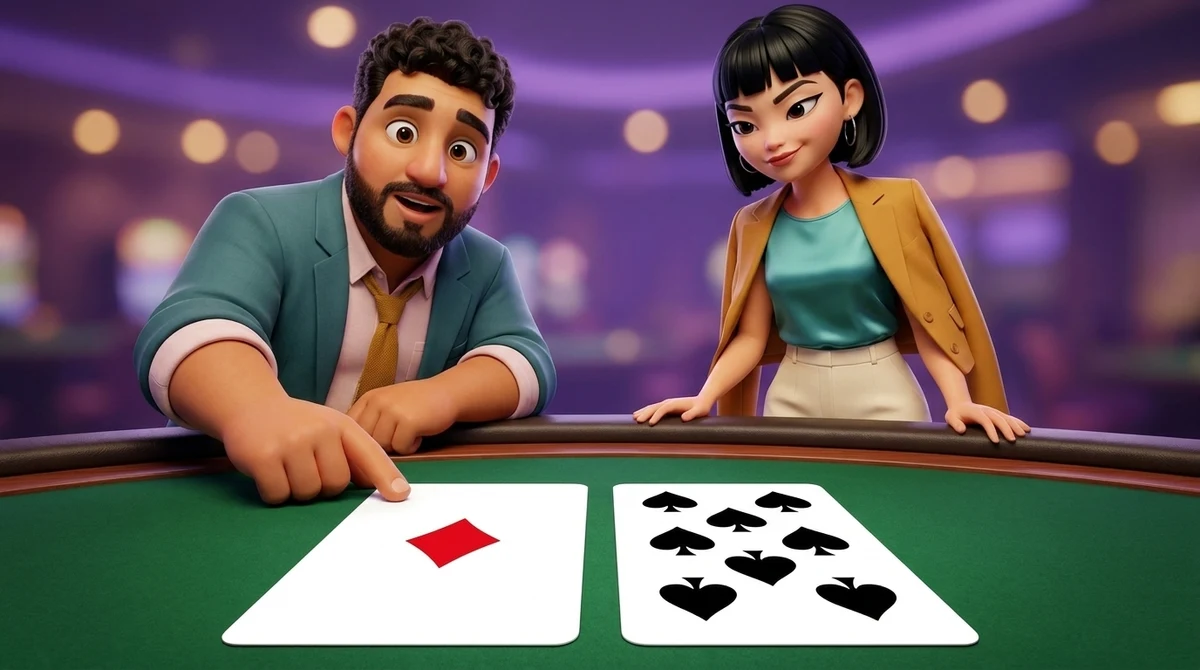

Leoformer dealer · rules and maths
I dealt this game before I taught it, and the quietest mistake at a table looks like this: the player makes the right move for a hand he is not holding. Every decision in blackjack is a decision about a number, so the number has to be the right one before anything else.
What each card is worth
You are trying to finish with a higher total than the dealer, without going over 21. The whole game sits in that one sentence, so the first skill to have is adding up the cards in your hand, quickly and without a mistake.
Cards 2 to 10 count the number printed on them
A jack, a queen and a king count ten, all three of them
The picture on the card is different; the value of the card is not.
Cards come out of a shoe (the box the dealer deals from, holding several decks shuffled together) of 8 decks, and four of the thirteen kinds put ten on your hand: 30.8% of the cards in the box.
The ace: two numbers at once
The ace is the only card with two values: one or eleven. An ace that can still be eleven without taking the hand over 21 gives the hand two totals at once; once eleven no longer fits, the ace is one and the hand has one total. The words for the two cases are soft and hard, and the test is one question, the eleven question:
- Step 1Count the ace as one and add the hand up.A four, a two and an ace: 4 + 2 + 1 is 7.
- Step 2Add ten to that total.7 + 10 is 17.
- Step 3Is the new total 21 or under?Yes: the ace can be eleven, the hand has two totals, and the hand is soft. No: the ace is one, the hand has one total, and the hand is hard.
Soft
7 or 17A four, a two, then an ace. With the ace at eleven the hand is 17, inside 21: two totals.
Hard, no ace
17A ten and a seven. No card in the hand has two values: one total.
Hard, with an ace
17A ten and a six, then an ace. With the ace at eleven the hand would be 27: the ace is one, and the hand has one total.
At a Córdoba table: the ace you declare
One rule changes the ace among your first two cards. At a Córdoba table the dealer asks you to declare that ace 1 or 11, and the answer holds until the hand is settled. So an ace and a six there is not 7 and 17 at once: it is a 7 or a 17, by your word.
Declared 11
17An ace and a six, the ace declared eleven: a hard 17 for the rest of the hand.
Declared 1
7The same two cards, the ace declared one: a hard 7, and a later four makes 11, not 21.
An ace that comes after your first two cards is not declared, and it counts the way the rest of this page counts it. What to declare against each dealer card, and what the rule costs, is the soft-hands lesson.
When a soft hand turns hard
Every new card asks the eleven question again.
Before the card
7 or 17A soft 17.
A three comes
10 or 20Still soft: 4 + 2 + 11 + 3 is 20, inside 21.
A ten comes
17Hard now: with the ace at eleven the hand would be 27, so the ace is one.
Two aces never both count eleven: 11 + 11 is already 22. However many aces a hand holds, at most one of them is eleven.
Blackjack, and what is not one
One hand at this table has a name of its own: the blackjack (twenty-one on your first two cards: the one hand a table pays at a rate of its own). A blackjack is an ace and a ten-value card as your first two cards. There is nothing to declare on it: it is 21 at once.
A blackjack is worth knowing on sight because of what it pays.
| Your hand | Paid at | Back, on an example bet of 10 units |
|---|---|---|
| Higher than the dealer’s hand | 1 to 1 | 10 units |
| A blackjack, when the dealer has no blackjack | 3 to 2 | 15 units |
| 21 on three cards or more | 1 to 1 | 10 units |
Twenty-one built from three cards or more pays the ordinary 1 to 1, and against a blackjack it is the lower hand.
Twenty-one on a split hand. An ace and a ten-value card on a hand made by splitting a pair is 21 on two cards, and at a Córdoba table it is paid 1 to 1, not as a blackjack.
Two blackjacks. In the Entre Rios guide a blackjack against the dealer’s blackjack is a tie, and your bet comes back. Not every rulebook in the country settles this hand the same way.
What a misread costs
A misread is a move made for a hand you are not holding. Read a hard 17 with an ace in it as a soft 17, and you take a card on a hand that the chart stands on.
A hard 17 read as soft, against a 7
3.72 unitsa hand, on an example bet of 10 units: what taking another card costs against standing.
A hard 18 read as soft, against a 9
4.29 unitsa hand, on an example bet of 10 units, for the same mistake.
Amounts are for an example bet of 10 units; at twice the bet, twice the cost. Amounts are in betting units, not pesos: a unit can stand for any amount, and the arithmetic is the same at any scale.
Even read correctly, every hand of the evening still costs: these rules leave the house 2.08% of every bet when every hand is played by the full chart. Reading the hand right keeps you from paying more than that.

Mayaformer floor supervisor · manners, money and breaks
Counting right is the first skill, and a limit set before you sit down is the second. If the money on the table starts to feel like money you need, stop and call one of the lines below.
If it stops being fun
If gambling stops being entertainment, help is available. Minimum entry age: each province sets its own. Where we found the rule or regulator that sets it, we cite it on the page; those we found set it at 18. More on responsible gaming.
Show all provinces
If you are thinking about suicide, call 135 or 0800 345 1435 from anywhere in the country
Practice table
Four levels: two cards, one more card, more than one ace, and the dealer waiting with the price of a misread. Every answer is the reading of the cards on the felt; the one hand with an ace among the first two cards asks what you may declare.
Lesson done
Review my mistakes (0)
Progress stays in this browser; nothing is sent anywhere.
The practice table needs JavaScript. Here is one hand from it, with the answer.
Level 2 · One more card
Blackjack · 8 decks, dealt from a shoe
You
A four and a two, then an ace. What do you hold?
The answer: A soft 17.
An ace drawn after your first two cards is not declared: 1 + 4 + 2 is 7, and with the ace at eleven 17, still inside 21. Two totals, and the hand is soft.
En el caso de que alguna de las dos primeras cartas del apostador sea un " AS ", el pagador solicitará a aquél que defina su puntaje , haciendo valer al " AS " como Uno ( 1 ) o como Once ( 11 ). Esta decisión será irrevocable hasta la completa definición del pase.-Free translation: If either of the bettor's first two cards is an " ACE ", the dealer shall ask the bettor to define his score, counting the " ACE " as One ( 1 ) or as Eleven ( 11 ). This decision shall be irrevocable until the hand is completely settled.-
Lotería de Córdoba S.E. (portal) · Reglamento del juego «Black Jack» · readTodas las cartas se cuentan según su valor, excepto las figuras (J,Q,K) que valen 10 (diez) y los ases que pueden valer 1 (uno) u 11 (once) según la conveniencia o criterio del jugador.Free translation: All cards are counted at their face value, except the face cards (J,Q,K), which are worth 10 (ten), and the aces, which may be worth 1 (one) or 11 (eleven) at the player's convenience or discretion.
IAFAS Entre Ríos · Black Jack / Juegos Tradicionales de Casinos (DOC-H8-GCA-CSJ-001 V00) · readLas cartas numéricas suman su valor, las figuras suman 10 y el as es un 11 o un 1, según como convenga al jugadorFree translation: Numbered cards add up to their value, face cards count as 10, and the ace is an 11 or a 1, whichever suits the player
IPJyC Mendoza (SAPIA, Res. Dir. 812-16) · Información sobre juegos vivos o de paño: JUEGOS CARTEADOS, pagos, probabilidades · readLevel 1 · Two cards
Blackjack · 8 decks, dealt from a shoe
You
At a Córdoba table you are dealt an ace and a six, and the dealer asks you to declare the ace. What can the hand be?
The answer: A 7 or a 17, as you declare, and then only that.
The rule asks for the declaration while the ace is one of your first two cards, and makes it final for the hand. What to declare against each dealer card is the soft-hands lesson of this track.
En el caso de que alguna de las dos primeras cartas del apostador sea un " AS ", el pagador solicitará a aquél que defina su puntaje , haciendo valer al " AS " como Uno ( 1 ) o como Once ( 11 ).Free translation: If either of the bettor's first two cards is an " ACE ", the dealer shall ask the bettor to define his score, counting the " ACE " as One ( 1 ) or as Eleven ( 11 ).
Esta decisión será irrevocable hasta la completa definición del pase.Free translation: This decision shall be irrevocable until the hand is completely settled.
Lotería de Córdoba · Reglamento del juego «Black Jack» · section Desarrollo del juego, 10) · readEvery hand is read the same way: add the cards, then ask whether an ace among them can still be eleven. At a Córdoba table an ace among your first two cards is declared instead.
Check yourself

Mayaformer floor supervisor · manners, money and breaks
Five quick ones. Pick an answer, then check it. No timer, no points: just whether it stuck.
And the question we opened with
A four, a two and then an ace: a soft 17, worth 7 or 17. The ace came after your first two cards, so nothing was declared, and the ace stays free to be eleven until a card takes the eleven away.
Where to play, and further reading
18+ under each province’s rules · Play responsibly · help, day or night: Línea 0800-777-AYUDA (Lotería de Córdoba) 0800-777-2983, 24 hours
Further reading
- Reglamento del juego «Black Jack» · Lotería de Córdoba S.E.Córdoba’s full rules for blackjack: eight decks, the dealer stands on 17, a blackjack pays 150 %, and how doubling, splitting and insurance work.
- Resolución 1452/12, Anexo I: Black Jack modalidad carta descubierta (Reglamento del Juego) · Instituto Provincial de Lotería y Casinos de la Provincia de Buenos AiresThe Buenos Aires province rulebook for its face-up blackjack, including the rules for opening pairs, aces and tens.
- Black Jack / Juegos tradicionales de casinos (DOC-H8-GCA-CSJ-001 V00) · Instituto de Ayuda Financiera a la Acción Social, Entre RíosA one-page player guide from Entre Ríos, approved 20 August 2021.
- Información sobre juegos vivos o de paño: juegos carteados · Instituto Provincial de Juegos y Casinos de Mendoza (SAPIA)Mendoza’s public information on card games: blackjack terms, payouts and the dealer’s fixed rule.
How it’s worked out
Rules, numbers and hosts
Soft and hard. The two words are the trade’s words, and the definition on this page is ours: a hand is soft while an ace in it can count eleven without the hand going over 21, and hard otherwise. The rulebooks we read give the card values and the ace’s two values, and none of them defines soft and hard; the practice table reads every hand by this definition.
Rules. The decks, the 3 to 2 and the figures follow the rules Lotería de Córdoba publishes for Córdoba casinos: at least eight decks (the figures take exactly eight), blackjack paid 3 to 2, and an ace among the first two cards declared 1 or 11 for the hand. It is a preset for learning, not a statement about any one casino: the room settles anything its rulebook leaves open.
Numbers. The share of ten-value cards is card arithmetic on the shoe. A misread’s cost is worked out by our blackjack engine: the average result of the chart’s move minus that of the move made for the wrong hand, for an example bet of 10 units, each average rounded to the hundredth first. The house edge assumes the full chart and cards shuffled after every hand.
Hosts. Leo and Maya are illustrated characters. Their backstories, a former dealer and a former floor supervisor, are written for the course: neither is a real person, and neither speaks for any casino. The rules and numbers on this page come from the sources it cites, not from their experience.
No promise. Blackjack is played against the house. Reading your hand correctly keeps you from paying more than the game already costs; nothing on this page removes that cost or says how an evening will end.
An ace counts two ways
En el caso de que alguna de las dos primeras cartas del apostador sea un " AS ", el pagador solicitará a aquél que defina su puntaje , haciendo valer al " AS " como Uno ( 1 ) o como Once ( 11 ). Esta decisión será irrevocable hasta la completa definición del pase.-Free translation: If either of the bettor's first two cards is an " ACE ", the dealer shall ask the bettor to define his score, counting the " ACE " as One ( 1 ) or as Eleven ( 11 ). This decision shall be irrevocable until the hand is completely settled.-
Lotería de Córdoba S.E. (portal) · Reglamento del juego «Black Jack» · read
Todas las cartas se cuentan según su valor, excepto las figuras (J,Q,K) que valen 10 (diez) y los ases que pueden valer 1 (uno) u 11 (once) según la conveniencia o criterio del jugador.Free translation: All cards are counted at their face value, except the face cards (J,Q,K), which are worth 10 (ten), and the aces, which may be worth 1 (one) or 11 (eleven) at the player's convenience or discretion.
IAFAS Entre Ríos · Black Jack / Juegos Tradicionales de Casinos (DOC-H8-GCA-CSJ-001 V00) · read
Las cartas numéricas suman su valor, las figuras suman 10 y el as es un 11 o un 1, según como convenga al jugadorFree translation: Numbered cards add up to their value, face cards count as 10, and the ace is an 11 or a 1, whichever suits the player
Declaring the ace at Córdoba tables
En el caso de que alguna de las dos primeras cartas del apostador sea un " AS ", el pagador solicitará a aquél que defina su puntaje , haciendo valer al " AS " como Uno ( 1 ) o como Once ( 11 ).Free translation: If either of the bettor's first two cards is an " ACE ", the dealer shall ask the bettor to define his score, counting the " ACE " as One ( 1 ) or as Eleven ( 11 ).
Esta decisión será irrevocable hasta la completa definición del pase.Free translation: This decision shall be irrevocable until the hand is completely settled.
Section Desarrollo del juego, 10)
Lotería de Córdoba · Reglamento del juego «Black Jack» · read
What a blackjack is
Se denomina BLACK JACK, a la combinación de dos cartas: un " AS " y una figura (K, Q, J) o un Diez (10).Free translation: BLACK JACK is the name given to the combination of two cards: an " ACE " and a face card (K, Q, J) or a Ten (10).
Lotería de Córdoba S.E. (portal) · Reglamento del juego «Black Jack» · read
Cuando las 2 (dos) primeras cartas de un casillero suman 21 (veintiuno) puntos ('As" y 10 o "As" y figura: J,Q,K) seobtiene el mayor puntaje del juego: "Black Jack".Free translation: When the first 2 (two) cards of a betting spot add up to 21 (twenty-one) points ("Ace" and 10 or "Ace" and a face card: J,Q,K), the highest score in the game is obtained: "Black Jack".
IAFAS Entre Ríos · Black Jack / Juegos Tradicionales de Casinos (DOC-H8-GCA-CSJ-001 V00) · read
BLACK JACK NATURAL: Se forma como consecuencia de recibir en los dos primeros naipes un AS y cualquiera de los naipes cuyo valor es de DIEZ (10) puntos.Free translation: NATURAL BLACK JACK: It is formed by receiving, in the first two cards, an ACE and any of the cards whose value is TEN (10) points.
Section Capítulo 9, Black Jack modalidad carta descubierta: Reglamento del Juego (9.1 a 9.14)
Si se consigue 21 con sólo dos cartas, se gana automáticamente.Free translation: If 21 is obtained with only two cards, the player wins automatically.
The object of the game
EL Black Jack es un Juego que premia al o los Jugadores que logren un puntaje " Superior " al logrado por el Pagador y no excedan de veintiuno (21); de acuerdo a los valores de Cartas establecidos en el presente Reglamento.Free translation: Black Jack is a game that rewards the Player or Players who achieve a " Higher " score than the one achieved by the Dealer without exceeding twenty-one (21), in accordance with the Card values established in these Rules.
Lotería de Córdoba S.E. (portal) · Reglamento del juego «Black Jack» · read
El objetivo del juego es lograr un puntaje de 21 (veintiuno) o lo más cercano a él, sin superarlo.Free translation: The aim of the game is to reach a score of 21 (twenty-one) or as close to it as possible, without going over.
IAFAS Entre Ríos · Black Jack / Juegos Tradicionales de Casinos (DOC-H8-GCA-CSJ-001 V00) · read
El Black Jack es un juego de contrapartida; lo que significa que el Apostador individualmente juega contra la Banca, intentando superar el juego del Tallador, con el puntaje sumado de los dos (2) naipes que reciba inicialmente o con el agregado de terceros si fuere necesario. Tratará de reunir el puntaje máximo de veintiuno (21) o el mas próximo a éste, evitando en el intento excederse.Free translation: Black Jack is a game played against the house, which means that the Bettor plays individually against the Bank, trying to beat the Dealer's hand with the score added up from the two (2) cards initially received or with the addition of further cards if necessary. The Bettor will try to gather the maximum score of twenty-one (21) or the closest to it, trying not to go over.
Section Capítulo 9, Black Jack modalidad carta descubierta: Reglamento del Juego (9.1 a 9.14)
Card values
Todas las cartas se cuentan según su valor, excepto las figuras (J,Q,K) que valen 10 (diez) y los ases que pueden valer 1 (uno) u 11 (once) según la conveniencia o criterio del jugador.Free translation: All cards are counted at their face value, except the face cards (J,Q,K), which are worth 10 (ten), and the aces, which may be worth 1 (one) or 11 (eleven) at the player's convenience or discretion.
IAFAS Entre Ríos · Black Jack / Juegos Tradicionales de Casinos (DOC-H8-GCA-CSJ-001 V00) · read
As 1 u 11 (uno u once)Free translation: Ace 1 or 11 (one or eleven)
J, Q, K 10 Puntos.Free translation: J, Q, K 10 Points.
Lotería de Córdoba S.E. (portal) · Reglamento del juego «Black Jack» · read
Las cartas numéricas suman su valor, las figuras suman 10 y el as es un 11 o un 1, según como convenga al jugadorFree translation: Numbered cards add up to their value, face cards count as 10, and the ace is an 11 or a 1, whichever suits the player
Card values in one sentence, Entre Rios
Todas las cartas se cuentan según su valor, excepto las figuras (J,Q,K) que valen 10 (diez) y los ases que pueden valer 1 (uno) u 11 (once) según la conveniencia o criterio del jugador.Free translation: All cards are counted at their face value, except the face cards (J,Q,K), which are worth 10 (ten), and the aces, which may be worth 1 (one) or 11 (eleven) at the player's convenience or discretion.
IAFAS Entre Ríos · Black Jack / Juegos Tradicionales de Casinos (DOC-H8-GCA-CSJ-001 V00) · read
An ace counts two ways
En el caso de que alguna de las dos primeras cartas del apostador sea un " AS ", el pagador solicitará a aquél que defina su puntaje , haciendo valer al " AS " como Uno ( 1 ) o como Once ( 11 ). Esta decisión será irrevocable hasta la completa definición del pase.-Free translation: If either of the bettor's first two cards is an " ACE ", the dealer shall ask the bettor to define his score, counting the " ACE " as One ( 1 ) or as Eleven ( 11 ). This decision shall be irrevocable until the hand is completely settled.-
Lotería de Córdoba S.E. (portal) · Reglamento del juego «Black Jack» · read
Todas las cartas se cuentan según su valor, excepto las figuras (J,Q,K) que valen 10 (diez) y los ases que pueden valer 1 (uno) u 11 (once) según la conveniencia o criterio del jugador.Free translation: All cards are counted at their face value, except the face cards (J,Q,K), which are worth 10 (ten), and the aces, which may be worth 1 (one) or 11 (eleven) at the player's convenience or discretion.
IAFAS Entre Ríos · Black Jack / Juegos Tradicionales de Casinos (DOC-H8-GCA-CSJ-001 V00) · read
Las cartas numéricas suman su valor, las figuras suman 10 y el as es un 11 o un 1, según como convenga al jugadorFree translation: Numbered cards add up to their value, face cards count as 10, and the ace is an 11 or a 1, whichever suits the player
Declaring the ace at Córdoba tables
En el caso de que alguna de las dos primeras cartas del apostador sea un " AS ", el pagador solicitará a aquél que defina su puntaje , haciendo valer al " AS " como Uno ( 1 ) o como Once ( 11 ).Free translation: If either of the bettor's first two cards is an " ACE ", the dealer shall ask the bettor to define his score, counting the " ACE " as One ( 1 ) or as Eleven ( 11 ).
Esta decisión será irrevocable hasta la completa definición del pase.Free translation: This decision shall be irrevocable until the hand is completely settled.
Section Desarrollo del juego, 10)
Lotería de Córdoba · Reglamento del juego «Black Jack» · read
What a blackjack is
Se denomina BLACK JACK, a la combinación de dos cartas: un " AS " y una figura (K, Q, J) o un Diez (10).Free translation: BLACK JACK is the name given to the combination of two cards: an " ACE " and a face card (K, Q, J) or a Ten (10).
Lotería de Córdoba S.E. (portal) · Reglamento del juego «Black Jack» · read
Cuando las 2 (dos) primeras cartas de un casillero suman 21 (veintiuno) puntos ('As" y 10 o "As" y figura: J,Q,K) seobtiene el mayor puntaje del juego: "Black Jack".Free translation: When the first 2 (two) cards of a betting spot add up to 21 (twenty-one) points ("Ace" and 10 or "Ace" and a face card: J,Q,K), the highest score in the game is obtained: "Black Jack".
IAFAS Entre Ríos · Black Jack / Juegos Tradicionales de Casinos (DOC-H8-GCA-CSJ-001 V00) · read
BLACK JACK NATURAL: Se forma como consecuencia de recibir en los dos primeros naipes un AS y cualquiera de los naipes cuyo valor es de DIEZ (10) puntos.Free translation: NATURAL BLACK JACK: It is formed by receiving, in the first two cards, an ACE and any of the cards whose value is TEN (10) points.
Section Capítulo 9, Black Jack modalidad carta descubierta: Reglamento del Juego (9.1 a 9.14)
Si se consigue 21 con sólo dos cartas, se gana automáticamente.Free translation: If 21 is obtained with only two cards, the player wins automatically.
What a hand is paid, and what a blackjack is paid
La obtención de un puntaje mayor al del pagador o habiendo este excedido el puntaje de veintiuno (21), beneficiará al jugador con el 100% de su apuesta.-Free translation: If the player obtains a higher score than the payer's, or the latter has exceeded the score of twenty-one (21), the player shall be paid 100% of the bet.-
La obtención de Black Jack por parte del jugador, habiendo obtenido la Banca Veintiuno (21) o menos o haberse excedido ( mas de 21 ), beneficiará al jugador con el 150% de su apuesta.-Free translation: If the player obtains Black Jack, whether the Bank has obtained Twenty-one (21) or less or has gone over (more than 21), the player shall be paid 150% of the bet.-
Lotería de Córdoba S.E. (portal) · Reglamento del juego «Black Jack» · read
Se paga el mismo importe de la apuesta: 1 x 1, a menos que el jugador lograre un Black Jack directo ('As" y 10 o "As" y figura : J,Q,K), el cual pagará 150%, salvo que la Banca también tenga 'Black Jack"; en este caso se produce un empate y el apostador conservará su apuesta.Free translation: The amount paid equals the bet: 1 x 1, unless the player gets a direct Black Jack ("Ace" and 10 or "Ace" and a face card: J,Q,K), which will pay 150%, unless the Bank also has "Black Jack"; in that case there is a tie and the bettor keeps his bet.
IAFAS Entre Ríos · Black Jack / Juegos Tradicionales de Casinos (DOC-H8-GCA-CSJ-001 V00) · read
Todas las apuestas ganadoras cobrarán el cien por cien (100%) del monto total apostado. Excepto los Black Jack, que cobrarán el ciento cincuenta por ciento (150%).Free translation: All winning bets will be paid one hundred percent (100%) of the total amount bet. Except for Black Jacks, which will be paid one hundred and fifty percent (150%).
Section Capítulo 9, Black Jack modalidad carta descubierta: Reglamento del Juego (9.1 a 9.14)
En el caso de obtener mayor puntuación el jugador cobra una cantidad igual a la apostada.Free translation: If the player obtains the higher score, the player is paid an amount equal to the amount bet.
También existe la posibilidad de sacar blackjack, en este caso, el jugador cobra a razón de 3 a 2 según lo apostado.Free translation: It is also possible to get a blackjack; in that case, the player is paid at a rate of 3 to 2 on the amount bet.
En el empate ni se pierde ni se gana.Free translation: In a tie, the player neither loses nor wins.
A two-card 21 and a 21 built from more cards
El BLACK JACK ganará siempre a la puntuación de veintiuno (21), obtenido con más de dos (2) naipes.Free translation: BLACK JACK will always beat a score of twenty-one (21) obtained with more than two (2) cards.
Section Capítulo 9, Black Jack modalidad carta descubierta: Reglamento del Juego (9.1 a 9.14)
Twenty-one after a split
En el caso que en cualquiera de las dos apuestas el apostador lograre Black Jack, éste será considerado para el pago en forma " Simple " ( 1 por 1 ).Free translation: If on either of the two bets the bettor gets Black Jack, it shall be considered for payment as "Simple" (1 to 1).
Lotería de Córdoba S.E. (portal) · Reglamento del juego «Black Jack» · read
En el caso que la segunda carta que reciba para cada una sea un 10 o una figura (J, Q, K), su apuesta se pagará en forma "simple" como 21 (veintiuno) y no como BLACK JACK.Free translation: If the second card received for each one is a 10 or a face card (J, Q, K), the bet will be paid as a "simple" 21 (twenty-one) and not as BLACK JACK.
IAFAS Entre Ríos · Black Jack / Juegos Tradicionales de Casinos (DOC-H8-GCA-CSJ-001 V00) · read
Two blackjacks at once
Se paga el mismo importe de la apuesta: 1 x 1, a menos que el jugador lograre un Black Jack directo ('As" y 10 o "As" y figura : J,Q,K), el cual pagará 150%, salvo que la Banca también tenga 'Black Jack"; en este caso se produce un empate y el apostador conservará su apuesta.Free translation: The amount paid equals the bet: 1 x 1, unless the player gets a direct Black Jack ("Ace" and 10 or "Ace" and a face card: J,Q,K), which will pay 150%, unless the Bank also has "Black Jack"; in that case there is a tie and the bettor keeps his bet.
IAFAS Entre Ríos · Black Jack / Juegos Tradicionales de Casinos (DOC-H8-GCA-CSJ-001 V00) · read