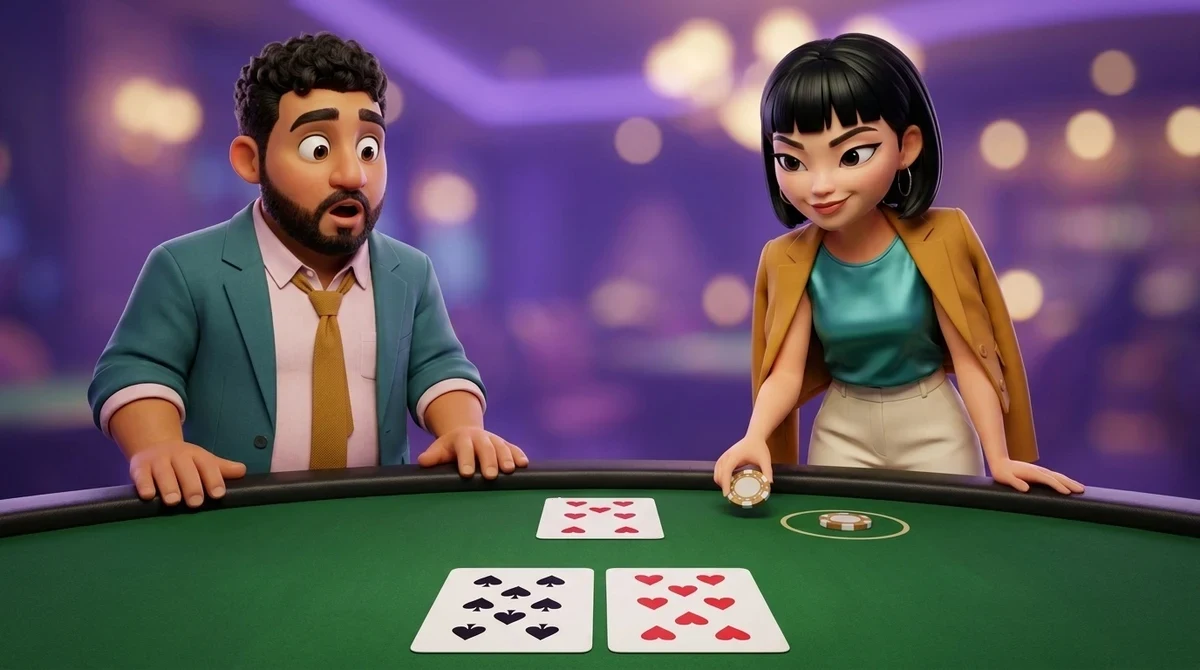
Splitting a pair puts a second bet of the same size on the felt, so every pair is a question about money — answered here for the rules Lotería de Córdoba publishes for Córdoba casinos.
About 15 minutes
Illustrated hosts: Leo and Maya
Last checked 25 October 2026
Lesson 9 of the blackjack track. You need one thing from earlier: that a pair can be split, and that splitting it is your move; Hit, stand, double, split has the moves. Here, pair by pair: which ones you split at Córdoba tables, which you leave alone, and what the other answer costs.
You are dealt two 8s. The dealer shows a 10, and the dealer’s second card lies face down. Do you split them?
The short answer
Split aces against every dealer card but an ace, and 8s against a 2 to 9. Never split 10s, 5s or 4s. Split 2s and 7s against a 2 to 7, 3s against a 3 to 7, and 6s against a 2 to 6. Two 9s: split against a 2 to 6, an 8 and a 9; stand against a 7, a 10 and an ace. Against a 10 or an ace the 8s and the aces take a card instead: the dealer’s face-down card is turned after you play, and a dealer blackjack takes the split bet too.
A split costs a second bet
Two cards of the same value can be pulled apart and played as two hands. You pay for the second hand: a bet the same size as the first, put on the second card.
One hand of 16, one bet.
→
First hand, first bet.
Second hand, second bet.
Split two 8s and the 16 is gone. Each 8 starts a hand of its own, and the second one has to be paid for.
One split a hand. If a split hand comes out as another pair, it stays as it is.
Split aces take one card each in the PBA rulebook. The Córdoba rules do not say how many; the figures here assume one, the same.
After a split, an ace and a ten is a 21, not a blackjack, at Córdoba tables: it is paid 1 to 1.
A dealer blackjack takes the split bet too. The dealer’s second card is turned over after you play, and its blackjack takes every bet on your hand.
How often a pair turns up
Out of an eight-deck shoe
You are dealt
How often
A pair of any kind
14.6% of hands, one in 6.9
Two ten-value cards
9.4% of hands, and 64.5% of all pairs
Two of one named rank, say two 8s
0.57% of hands, one in 174
So the pair you see most is the pair you never split, and the two worth knowing cold come round rarely enough that you want the answer ready first.
The pairs chart
Eight decks · the dealer stands on every 17 · blackjack pays 3 to 2 · double on 11 only · one split a hand · the dealer’s second card is turned after you play · house edge 2.08% with the full chart, hard totals and soft hands included
Pairs, rules published by Lotería de Córdoba for Córdoba casinos
Pair
2
3
4
5
6
7
8
9
10
A
2,2
P
P
P
P
P
P
H
H
H
H
3,3
H
P
P
P
P
P
H
H
H
H
4,4
H
H
H
H
H
H
H
H
H
H
5,5
H
H
H
H
H
H
H
H
H
H
6,6
P
P
P
P
P
H
H
H
H
H
7,7
P
P
P
P
P
P
H
H
H
H
8,8
P
P
P
P
P
P
P
P
H
H
9,9
P
P
P
P
P
S
P
P
S
S
10,10
S
S
S
S
S
S
S
S
S
S
A,A
P
P
P
P
P
P
P
P
P
H
Psplit
Sstand
Hhit
Find your pair down the left and the dealer’s card across the column headings. Two 5s sit there as a hard 10, because that is what they are, and at these tables a 10 is not doubled.
The PBA and Entre Rios rulebooks answer a few squares differently; the practice table below switches between all three, and One game, three rulebooks sets them side by side.
Amounts are in betting units, not pesos: a unit can stand for any amount, and the arithmetic is the same at any scale.
The rows with nothing to decide
Split, but not against an ace
Together, a poor hand. Apart, two hands that each start on 11, worth having against every card up to a 10.
Split against a 2 to 9
Together, a 16, the total nobody wants. Apart, two hands starting on 8, and almost any card helps an 8. Against a 10 or an ace, take a card.
Never split
A 20. You stand on it against every dealer card there is.
Never split
Read the total, not the pair: two 5s are a hard 10. The rules allow a double only on 11, so a 10 takes a card against every dealer card.
Two 4s join them at these tables: a hard 8 takes a card against every dealer card, and splitting it is never the answer here.
The small pairs
Four rows are left, and on each of them the dealer’s card decides.
Split only against the cards named. Against anything else, take a card.
You hold
Split when the dealer shows
Two 2s
2 to 7
Two 3s
3 to 7
Two 6s
2 to 6
Two 7s
2 to 7
They go apart not because two small hands are good, but because of what lands on them next. A 2, 3, 6 or 7 is a fine card to start on against a weak dealer card: the dealer goes over 21 often, and two hands collect when that happens. Against an 8 and above the dealer finishes strongly too often, and the second bet stays in your pocket.
Against a 10 or an ace
At Córdoba tables the dealer takes a second card face down at the deal and turns it over only once every player has finished. If it makes a blackjack, it takes every bet on your hand, the split bet as well. Against a 10 or an ace that is a real chance, and it turns three squares of the chart.
What the chart says, by what a dealer blackjack takes
You hold
At Córdoba tables
If it took only your first bet
Two 8s against a 10
Take a card: −5.72 units a hand
Split
Two 8s against an ace
Take a card: −6.65 units a hand
Split
Two aces against an ace
Take a card: −4.52 units a hand
Split
The right-hand column is not a guess: in the PBA rulebook a dealer blackjack takes only your first bet, and there the chart splits 8s and aces against every dealer card. The Entre Rios guide does not say what a dealer blackjack takes from a split hand; the practice table counts the dearer reading for it, every bet.
Splitting two 8s against an ace anyway costs 2.22 units a hand here; against a 10, 0.39 units. Every answer on these squares loses on average: the chart only picks the smallest loss.
One split, and no more
If a split hand comes out as another pair, it stays as it is: the Córdoba rules allow one split a hand, and so does the PBA rulebook. The Entre Rios guide names no limit.
And the limit moves the price without moving one square of your chart. Solve the same rules with four hands allowed: all hundred squares come back the same, and the house keeps 2.04% of every bet instead of 2.08%. When you compare two tables, put this line near the bottom.
Ace and ten on a split ace
Split two aces and draw a ten on one of them, and the rulebooks part. At Córdoba tables the hand is a 21 paid 1 to 1, not a blackjack; the Entre Rios guide says the same. The PBA rulebook pays it 150% of the bet, as a blackjack.
It changes no square of the pairs chart: aces are split against the same cards either way. It changes the price. Paid 150%, the same Córdoba rules would leave the house 1.89% of every bet instead of 2.08%.
Three wrong answers, and what each costs
Amounts are for an example bet of 10 units; at twice the bet, twice the cost.
vs
Not splitting what the chart splits
Leaving two 8s together against a 7
6.75 units
every time you stand on that 16. Split it and the average moves from −4.79 units a hand to +1.96 units, with twice the money on the hand.
Fix: against a 2 to 9, the 8s go apart without thinking.
vs
Splitting what the chart stands on
Splitting two 10s against a weak card
1.34 units
every time you split them against a 6. The 20 is +7.03 units a hand, two hands starting on 10 are +5.69 units. A weak dealer card does not make your strong hand worse.
Fix: two ten-value cards stand against all ten dealer cards.
vs
The habit from other tables
Splitting two 8s against an ace
2.22 units
every time you split them against an ace, where a dealer blackjack would take both bets. Against a 10, 0.39 units.
Fix: against a 10 or an ace, take a card.
Rarer ones, though not all of them small: splitting two 5s against a 9 costs 6.47 units a hand; a card on two 6s against a 6, 2.02 units; on two 7s against a 7, 2.20 units. Standing on two 9s against a 6, 1.59 units; splitting them against a 7, 0.31 units.
At the table, with Maya
The second bet is the same as the first. Not more and not less: the rules set it.
One split, then play the hands. A second pair on a split hand is played as it stands.
Remember the face-down card. Against a 10 or an ace the dealer’s blackjack is still to come when you decide, and at Córdoba tables it takes every bet on your hand.
What the chart does to the price
Play the whole chart, hard totals, soft hands and the pairs here, and these Córdoba rules still keep about 2.08% of every bet for the house. The chart lowers the price of playing. It does not take the price away.
Some squares here have a positive average: two 8s split against a 7 come out at +1.96 units a hand, over many thousands of hands. But a pair is dealt to you only now and then, and the whole chart still leaves the house about 2.08%. A good square is not an evening, and it is not a plan.
Mayaformer floor supervisor · manners, money and breaks
Splitting doubles what is at risk on the hand. It makes the hand cheaper, not safe, and there is no square here to reach for because the last hand went badly.
Decide your time and your money before you sit down, and keep to them whether the pairs came or not. If the money on the table starts to feel like money you need, stop and call one of the lines below.
If it stops being fun
If gambling stops being entertainment, help is available. Minimum entry age: each province sets its own. Where we found the rule or regulator that sets it, we cite it on the page; those we found set it at 18. More on responsible gaming.
Show all provinces
0800-666-6006Buenos Aires City (CABA) · Línea de orientación por juego problemático (LOTBA) · Monday to Friday, 9 to 17
0800-444-4000Buenos Aires Province · Programa de Prevención y Asistencia al Juego Compulsivo (IPLyC)
0800-777-2983Cordoba · Línea 0800-777-AYUDA (Lotería de Córdoba) · 24 hours
0800-268-5640Santa Fe · Línea gratuita de la APRECOD (Santa Fe) · Every day, 8 to 24
0800-888-2202Entre Rios · Departamento Juego Responsable (IAFAS, PREVENJUEGO)
0261-424-7536Mendoza · Programa de Juego Responsable (IPJyC) · Monday to Friday, 8 to 14
0800-888-5836Misiones · Programa de Juego Responsable del IPLyC S.E. (0800-888-LUDO)
0800-888-2008Chaco · Línea de Juego Responsable (Lotería Chaqueña)
0299-403-8900Neuquen · Líneas de contacto, orientación y tratamiento (IJAN, juego responsable) · Monday to Friday, 8 to 15
0800-222-1700Rio Negro · Línea de Orientación al Jugador Problemático (Lotería de Río Negro)
02901-433515Tierra del Fuego · Departamento Juego Responsable (IPRA, Ushuaia)
0800-555-7678Tucuman · Juego Responsable, Ley 8986 (Caja Popular de Ahorros)
0800-999-1314San Juan · Línea gratuita del Programa Provincial de Juego Responsable (Caja de Acción Social) · Monday to Friday, 08 to 12
Pairs and nothing else, on three levels, with the three rulebooks on a switch above the table. Every answer is the square of the chart for the rules you pick, so the squares that change from rulebook to rulebook change here too, and you can watch it happen. Amounts are for an example bet of 10 units, an example and not a suggested bet.
Each hand is answered by the chart for the rules you pick here. A few squares are answered differently under them: two 8s and two aces against a 10 or an ace, two 5s, two 3s against a 2 and two 4s against a 6.
Lesson done
Right first time
Fixed in practice
Still to fix
To go
Review my mistakes (0)
Progress stays in this browser; nothing is sent anywhere.
The practice table needs JavaScript. Here is one hand from it, with the answer.
Eight decks · dealer stands on every 17 · double on 11 only · one split a hand · ace and ten on a split ace pays 1 to 1 · a dealer blackjack takes every bet on the hand
Two 8s against a 7. Together they are a 16, and the dealer is showing a card that finishes strongly. What now?
The chart says: Split.
Split them Yes. One 16 becomes two hands that start on 8, and the average result moves from −4.79 units for standing to +1.96 units.
Stand on 16 A 16 that stands is paid only when the dealer goes over 21, and against a 7 that is not often. It costs 6.75 units a hand.
Take a card Better than standing, and still 6.06 units a hand worse than splitting. A card that helps a 16 is a 5 or less; a card that helps an 8 is almost anything.
Two hands that start on 8 against a dealer 7 are worth more than one 16. The split also puts a second bet on the felt, and that bet can lose too.
The practice table deals these hands on three levels, and the answer to every hand is the square of the chart for the rules you pick.
How the practice table works
One strip, no rounds. Every square on the strip is one hand of this lesson, and they are all there from the start. The square keeps your first answer; when a level’s squares are full the next level begins by itself, with no button in between.
The answers. Every hand is a square of the chart for the rules you picked, read from the engine, not written down beside the hand. The moves offered follow those rules too: a double on two 5s appears only where the rulebook allows a double on 10.
Practice. A hand answered against the chart goes on your list. Practising deals those again; answering one correctly takes it off. Practice does not change the count: only first answers do.
Levels. Level 1: aces and 8s against a middle card, two ten-value cards, and two 5s, which are a hard 10. Level 2: 2s, 3s, 4s, 6s and 7s, where the dealer’s card decides. Level 3: the 9s row, and 8s and aces against a 10 or an ace under each set of rules.
Check yourself
Mayaformer floor supervisor · manners, money and breaks
Five quick ones. Pick an answer, then check it. No timer, no points: just whether it stuck.
And the question we opened with
Two 8s against a 10 at a Córdoba table: no, you take a card. Every answer on that square loses on average, −5.72 units a hand for the card and −6.11 units for the split, because a dealer blackjack, turned over after you play, would take the second bet as well.
18+ under each province’s rules · Play responsibly · the helplines are further up this page
Further reading
Reglamento del juego «Black Jack» · Lotería de Córdoba S.E.Córdoba’s full rules for blackjack: eight decks, the dealer stands on 17, a blackjack pays 150 %, and how doubling, splitting and insurance work.
Rules. The figures on this page follow the rules Lotería de Córdoba publishes for Córdoba casinos: at least eight decks (the figures take exactly eight), the dealer standing on every 17, blackjack paid 3 to 2, a double only on a two-card 11, one split a hand, an ace and a ten on a split ace paid 1 to 1, and a dealer’s second card turned over after the players, whose blackjack takes every bet on the hand. The rulebook does not say whether a split hand may be doubled or how many cards a split ace takes; the figures assume a double on 11 after a split and one card on each split ace. It is a preset for learning, not a statement about any one casino: the room settles anything its rulebook leaves open.
Numbers. Every figure on this page is worked out when the page is built, by our blackjack engine. For each pair and each dealer card the engine averages every way the hand can go, including the hands that follow a split, and the chart shows the move with the higher average result. A mistake’s cost is the average result of the chart’s move minus that of the mistake, per hand, for an example bet of 10 units, with each average rounded to the hundredth first. Against a 10 or an ace the averages include the hands where the dealer turns up a blackjack. How often a pair comes is arithmetic on an eight-deck shoe. The house edge assumes the full chart, hard totals, soft hands and pairs, and cards shuffled after every hand.
Hosts. Leo and Maya are illustrated characters. Their backstories, a former dealer and a former floor supervisor, are written for the course: neither is a real person, and neither speaks for any casino. The rules and numbers on this page come from the sources it cites, not from their experience.
No promise. Blackjack is played against the house. The chart lowers the price of playing; nothing on this page removes that price or tells you how an evening will end.
Source
A pair may be split
APERTURA : Cuando las dos primeras cartas recibidas por el jugador sean iguales en valor (dos 4, dos 6, etc.), el jugador podrá considerarlas como dos jugadas independientes, en este caso la postura original permanecerá para una de las cartas, debiendo apostar a la otra carta una suma igual a la original.
Free translation: OPENING: When the first two cards received by the player are equal in value (two 4s, two 6s, etc.), the player may treat them as two independent hands; in this case the original bet shall remain on one of the cards, and the player must bet on the other card an amount equal to the original.
Cuando el apostador reciba dos cartas iguales en número, podrá separarlas (abrir juego) y formar dos juegos realizando para el segundo una apuesta igual a la inicial.
Free translation: When the bettor receives two cards of the same number, he may separate them (open the hand) and form two hands, placing for the second a bet equal to the initial one.
APERTURA DE PARES del DOS al NUEVE: Es la opción del Apostador que al recibir dos (2) naipes de idéntico valor elige la apertura de los mismos, haciendo una apuesta igual a la original en cada uno de ellos, recibiendo cuantos naipes desee, al menos dos obligatoriamente por columna, siempre y cuando no se exceda de veintiún puntos.
Free translation: OPENING OF PAIRS from TWO to NINE: This is the option of the Bettor who, on receiving two (2) cards of identical value, chooses to open them, placing a bet equal to the original on each of them, and receiving as many cards as he wishes, at least two per column being mandatory, provided that twenty-one points are not exceeded.
Section Capítulo 9, Black Jack modalidad carta descubierta: Reglamento del Juego (9.1 a 9.14)
El jugador que ha logrado con sus dos primeras cartas la suma de Once (11), puede doblar su apuesta requiriendo una sola carta que se le entregará cubierta.
Free translation: A player who has reached a total of Eleven (11) with his first two cards may double his bet, requesting a single card, which will be dealt to him face down.
dará una segunda carta descubierta para cada una de las apuestas y una para sí cubierta.
Free translation: will deal a second card face up for each of the bets and one face down for himself.
Una vez determinados los puntajes de los apostadores, el pagador definirá el suyo de acuerdo con las siguientes reglas
Free translation: Once the bettors' scores have been determined, the pagador will settle his own according to the following rules
Descubrirá su segunda carta y efectuará la sumatoria de ésta y la primera.
Free translation: He will turn up his second card and add it to the first.
Cuando el pagador finalice con su juego, descubrirá la carta tapada del jugador y comparará el puntaje obtenido con el suyo, valiendo para la definición lo establecido en el punto catorce (14) del Desarrollo del Juego.
Free translation: When the pagador has finished his play, he will turn up the player's face-down card and compare the score obtained with his own, the provisions of point fourteen (14) of the Game Procedure applying to the settlement.
Section Desarrollo del juego, 8), 12) y 14); Otras apuestas, 1)
APERTURA : Cuando las dos primeras cartas recibidas por el jugador sean iguales en valor (dos 4, dos 6, etc.), el jugador podrá considerarlas como dos jugadas independientes, en este caso la postura original permanecerá para una de las cartas, debiendo apostar a la otra carta una suma igual a la original.
Free translation: OPENING: When the first two cards received by the player are equal in value (two 4s, two 6s, etc.), the player may treat them as two independent hands; in this case the original bet shall remain on one of the cards, and the player must bet on the other card an amount equal to the original.
Cuando el apostador reciba dos cartas iguales en número, podrá separarlas (abrir juego) y formar dos juegos realizando para el segundo una apuesta igual a la inicial.
Free translation: When the bettor receives two cards of the same number, he may separate them (open the hand) and form two hands, placing for the second a bet equal to the initial one.
APERTURA DE PARES del DOS al NUEVE: Es la opción del Apostador que al recibir dos (2) naipes de idéntico valor elige la apertura de los mismos, haciendo una apuesta igual a la original en cada uno de ellos, recibiendo cuantos naipes desee, al menos dos obligatoriamente por columna, siempre y cuando no se exceda de veintiún puntos.
Free translation: OPENING OF PAIRS from TWO to NINE: This is the option of the Bettor who, on receiving two (2) cards of identical value, chooses to open them, placing a bet equal to the original on each of them, and receiving as many cards as he wishes, at least two per column being mandatory, provided that twenty-one points are not exceeded.
Section Capítulo 9, Black Jack modalidad carta descubierta: Reglamento del Juego (9.1 a 9.14)
Se conforma esta variante cuando el Apostador, sumados sus dos primeros naipes, obtiene un puntaje de diez (10) u once (11), pudiendo duplicar la apuesta original; recibiendo una carta cubierta.
Free translation: This variant arises when the Bettor, adding his first two cards, obtains a score of ten (10) or eleven (11), and may double the original bet, receiving one face-down card.
En caso que el Apostador haya DUPLICADO LA APUESTA, si la Banca forma Black Jack, perderá la APUESTA ORIGINAL, o sea el cincuenta por ciento (50%) del monto total apostado.
Free translation: If the Bettor has DOUBLED THE BET, and the Banca makes Black Jack, he will lose the ORIGINAL BET, that is, fifty percent (50%) of the total amount wagered.
Si no se excediese en una de las posturas, perderá la apuesta original, o sea el cincuenta por ciento (50%).
Free translation: If he does not go over on one of the hands, he will lose the original bet, that is, fifty percent (50%).
APERTURA : Cuando las dos primeras cartas recibidas por el jugador sean iguales en valor (dos 4, dos 6, etc.), el jugador podrá considerarlas como dos jugadas independientes, en este caso la postura original permanecerá para una de las cartas, debiendo apostar a la otra carta una suma igual a la original.
Free translation: OPENING: When the first two cards received by the player are equal in value (two 4s, two 6s, etc.), the player may treat them as two independent hands; in this case the original bet shall remain on one of the cards, and the player must bet on the other card an amount equal to the original.
Cuando el apostador reciba dos cartas iguales en número, podrá separarlas (abrir juego) y formar dos juegos realizando para el segundo una apuesta igual a la inicial.
Free translation: When the bettor receives two cards of the same number, he may separate them (open the hand) and form two hands, placing for the second a bet equal to the initial one.
APERTURA DE PARES del DOS al NUEVE: Es la opción del Apostador que al recibir dos (2) naipes de idéntico valor elige la apertura de los mismos, haciendo una apuesta igual a la original en cada uno de ellos, recibiendo cuantos naipes desee, al menos dos obligatoriamente por columna, siempre y cuando no se exceda de veintiún puntos.
Free translation: OPENING OF PAIRS from TWO to NINE: This is the option of the Bettor who, on receiving two (2) cards of identical value, chooses to open them, placing a bet equal to the original on each of them, and receiving as many cards as he wishes, at least two per column being mandatory, provided that twenty-one points are not exceeded.
Section Capítulo 9, Black Jack modalidad carta descubierta: Reglamento del Juego (9.1 a 9.14)
dará una segunda carta descubierta para cada una de las apuestas y una para sí cubierta.
Free translation: will deal a second card face up for each of the bets and one face down for himself.
Una vez determinados los puntajes de los apostadores, el pagador definirá el suyo de acuerdo con las siguientes reglas
Free translation: Once the bettors' scores have been determined, the pagador will settle his own according to the following rules
Descubrirá su segunda carta y efectuará la sumatoria de ésta y la primera.
Free translation: He will turn up his second card and add it to the first.
Cuando el pagador finalice con su juego, descubrirá la carta tapada del jugador y comparará el puntaje obtenido con el suyo, valiendo para la definición lo establecido en el punto catorce (14) del Desarrollo del Juego.
Free translation: When the pagador has finished his play, he will turn up the player's face-down card and compare the score obtained with his own, the provisions of point fourteen (14) of the Game Procedure applying to the settlement.
Section Desarrollo del juego, 8), 12) y 14); Otras apuestas, 1)
APERTURA : Cuando las dos primeras cartas recibidas por el jugador sean iguales en valor (dos 4, dos 6, etc.), el jugador podrá considerarlas como dos jugadas independientes, en este caso la postura original permanecerá para una de las cartas, debiendo apostar a la otra carta una suma igual a la original.
Free translation: OPENING: When the first two cards received by the player are equal in value (two 4s, two 6s, etc.), the player may treat them as two independent hands; in this case the original bet shall remain on one of the cards, and the player must bet on the other card an amount equal to the original.
Cuando el apostador reciba dos cartas iguales en número, podrá separarlas (abrir juego) y formar dos juegos realizando para el segundo una apuesta igual a la inicial.
Free translation: When the bettor receives two cards of the same number, he may separate them (open the hand) and form two hands, placing for the second a bet equal to the initial one.
APERTURA DE PARES del DOS al NUEVE: Es la opción del Apostador que al recibir dos (2) naipes de idéntico valor elige la apertura de los mismos, haciendo una apuesta igual a la original en cada uno de ellos, recibiendo cuantos naipes desee, al menos dos obligatoriamente por columna, siempre y cuando no se exceda de veintiún puntos.
Free translation: OPENING OF PAIRS from TWO to NINE: This is the option of the Bettor who, on receiving two (2) cards of identical value, chooses to open them, placing a bet equal to the original on each of them, and receiving as many cards as he wishes, at least two per column being mandatory, provided that twenty-one points are not exceeded.
Section Capítulo 9, Black Jack modalidad carta descubierta: Reglamento del Juego (9.1 a 9.14)
APERTURA : Cuando las dos primeras cartas recibidas por el jugador sean iguales en valor (dos 4, dos 6, etc.), el jugador podrá considerarlas como dos jugadas independientes, en este caso la postura original permanecerá para una de las cartas, debiendo apostar a la otra carta una suma igual a la original.
Free translation: OPENING: When the first two cards received by the player are equal in value (two 4s, two 6s, etc.), the player may treat them as two independent hands; in this case the original bet shall remain on one of the cards, and the player must bet on the other card an amount equal to the original.
Cuando el apostador reciba dos cartas iguales en número, podrá separarlas (abrir juego) y formar dos juegos realizando para el segundo una apuesta igual a la inicial.
Free translation: When the bettor receives two cards of the same number, he may separate them (open the hand) and form two hands, placing for the second a bet equal to the initial one.
APERTURA DE PARES del DOS al NUEVE: Es la opción del Apostador que al recibir dos (2) naipes de idéntico valor elige la apertura de los mismos, haciendo una apuesta igual a la original en cada uno de ellos, recibiendo cuantos naipes desee, al menos dos obligatoriamente por columna, siempre y cuando no se exceda de veintiún puntos.
Free translation: OPENING OF PAIRS from TWO to NINE: This is the option of the Bettor who, on receiving two (2) cards of identical value, chooses to open them, placing a bet equal to the original on each of them, and receiving as many cards as he wishes, at least two per column being mandatory, provided that twenty-one points are not exceeded.
Section Capítulo 9, Black Jack modalidad carta descubierta: Reglamento del Juego (9.1 a 9.14)
APERTURA DE ASES: Es la opción del Apostador que al recibir en los dos (2) primeros naipes dos (2) ASES, decide la apertura de los mismos, apostando una suma igual a la original en cada uno, recibiendo una carta cubierta para cada AS.
Free translation: OPENING OF ACES: This is the option of the Bettor who, on receiving two (2) ACES as his first two (2) cards, decides to open them, betting an amount equal to the original on each, and receiving a face-down card for each ACE.
Section Capítulo 9, Black Jack modalidad carta descubierta: Reglamento del Juego (9.1 a 9.14)
En el caso que la segunda carta que reciba para cada una sea un 10 o una figura (J, Q, K), su apuesta se pagará en forma "simple" como 21 (veintiuno) y no como BLACK JACK.
Free translation: If the second card received for each one is a 10 or a face card (J, Q, K), the bet will be paid as a "simple" 21 (twenty-one) and not as BLACK JACK.
dará una segunda carta descubierta para cada una de las apuestas y una para sí cubierta.
Free translation: will deal a second card face up for each of the bets and one face down for himself.
Una vez determinados los puntajes de los apostadores, el pagador definirá el suyo de acuerdo con las siguientes reglas
Free translation: Once the bettors' scores have been determined, the pagador will settle his own according to the following rules
Descubrirá su segunda carta y efectuará la sumatoria de ésta y la primera.
Free translation: He will turn up his second card and add it to the first.
Cuando el pagador finalice con su juego, descubrirá la carta tapada del jugador y comparará el puntaje obtenido con el suyo, valiendo para la definición lo establecido en el punto catorce (14) del Desarrollo del Juego.
Free translation: When the pagador has finished his play, he will turn up the player's face-down card and compare the score obtained with his own, the provisions of point fourteen (14) of the Game Procedure applying to the settlement.
Section Desarrollo del juego, 8), 12) y 14); Otras apuestas, 1)
El jugador que ha logrado con sus dos primeras cartas la suma de Once (11), puede doblar su apuesta requiriendo una sola carta que se le entregará cubierta.
Free translation: A player who has reached a total of Eleven (11) with his first two cards may double his bet, requesting a single card, which will be dealt to him face down.
dará una segunda carta descubierta para cada una de las apuestas y una para sí cubierta.
Free translation: will deal a second card face up for each of the bets and one face down for himself.
Una vez determinados los puntajes de los apostadores, el pagador definirá el suyo de acuerdo con las siguientes reglas
Free translation: Once the bettors' scores have been determined, the pagador will settle his own according to the following rules
Descubrirá su segunda carta y efectuará la sumatoria de ésta y la primera.
Free translation: He will turn up his second card and add it to the first.
Cuando el pagador finalice con su juego, descubrirá la carta tapada del jugador y comparará el puntaje obtenido con el suyo, valiendo para la definición lo establecido en el punto catorce (14) del Desarrollo del Juego.
Free translation: When the pagador has finished his play, he will turn up the player's face-down card and compare the score obtained with his own, the provisions of point fourteen (14) of the Game Procedure applying to the settlement.
Section Desarrollo del juego, 8), 12) y 14); Otras apuestas, 1)
En caso que el Apostador haya DUPLICADO LA APUESTA, si la Banca forma Black Jack, perderá la APUESTA ORIGINAL, o sea el cincuenta por ciento (50%) del monto total apostado.
Free translation: If the Bettor has DOUBLED THE BET, and the Banca makes Black Jack, he will lose the ORIGINAL BET, that is, fifty percent (50%) of the total amount wagered.
Si no se excediese en una de las posturas, perderá la apuesta original, o sea el cincuenta por ciento (50%).
Free translation: If he does not go over on one of the hands, he will lose the original bet, that is, fifty percent (50%).
APERTURA : Cuando las dos primeras cartas recibidas por el jugador sean iguales en valor (dos 4, dos 6, etc.), el jugador podrá considerarlas como dos jugadas independientes, en este caso la postura original permanecerá para una de las cartas, debiendo apostar a la otra carta una suma igual a la original.
Free translation: OPENING: When the first two cards received by the player are equal in value (two 4s, two 6s, etc.), the player may treat them as two independent hands; in this case the original bet shall remain on one of the cards, and the player must bet on the other card an amount equal to the original.
Cuando el apostador reciba dos cartas iguales en número, podrá separarlas (abrir juego) y formar dos juegos realizando para el segundo una apuesta igual a la inicial.
Free translation: When the bettor receives two cards of the same number, he may separate them (open the hand) and form two hands, placing for the second a bet equal to the initial one.
APERTURA DE PARES del DOS al NUEVE: Es la opción del Apostador que al recibir dos (2) naipes de idéntico valor elige la apertura de los mismos, haciendo una apuesta igual a la original en cada uno de ellos, recibiendo cuantos naipes desee, al menos dos obligatoriamente por columna, siempre y cuando no se exceda de veintiún puntos.
Free translation: OPENING OF PAIRS from TWO to NINE: This is the option of the Bettor who, on receiving two (2) cards of identical value, chooses to open them, placing a bet equal to the original on each of them, and receiving as many cards as he wishes, at least two per column being mandatory, provided that twenty-one points are not exceeded.
Section Capítulo 9, Black Jack modalidad carta descubierta: Reglamento del Juego (9.1 a 9.14)