Atlassino Academy · Blackjack · Lesson 10
The whole chart and your printed card
Three tables on one page, and your own two cards decide which of them you read. The whole chart, the movement of the eye that finds one cell, and a card to print.
Your two cards are an eight and an eight, the dealer shows a 6, and the chart in front of you has three tables printed on it. Which of the three do you read?
The short answer
Your own two cards decide which table you read, before you look at a single number. Two cards of equal value send you to the pairs table; an ace among your first two cards sends you to the table for the ace you declare, because at Córdoba tables you declare it 1 or 11 before you play; everything else is a hard total. In that table your own hand runs down the left-hand side and the dealer’s card runs across the row of headings above, and the letter in the cell where the two meet is the play.
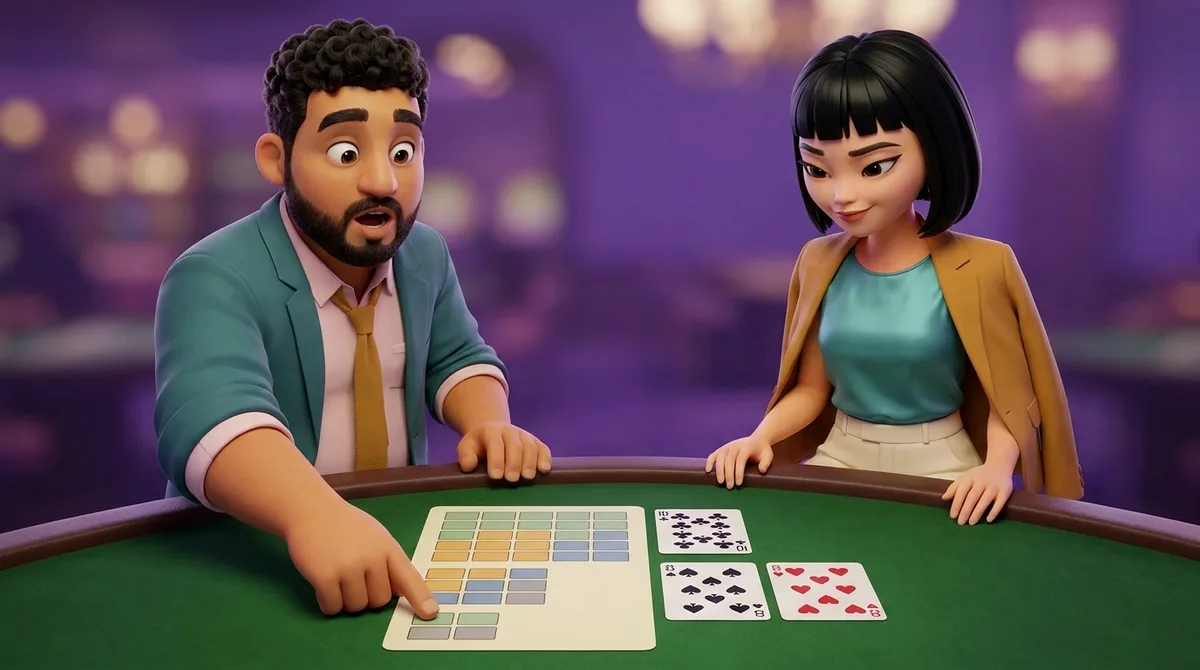
All three hands above count sixteen, and all three are facing the same 6. The only thing that changed from picture to picture is which table the two cards belong to, and the play changed with it: split the pair of eights, declare the ace 1 and take a card on the ace and five, stop on the ten and six. Splitting the eights puts a second bet on the felt, and that second bet can lose as readily as the first one.
Which of the three tables your cards send you to
A basic strategy chart looks like one big page of letters, and it is three tables stacked on that page. Nothing on it can be read until you know which of the three you are in, and what picks the table is not the total of your hand. It is what your two cards are.
- Two cards of equal valueA pair, and the pairs table answers it. Two eights, two nines, two aces, or a king beside a ten: what matters is that the two cards are worth the same, not what they add up to.
- An ace among your first two cardsAt these tables you declare that ace 1 or 11 before you play, and the table for the ace you declare tells you which. An ace and a five is a 6 or a 16, and you pick one.
- Everything elseA hard total, and the hard totals table answers it: no ace at all, or an ace you have already declared.
Each of the three tests above is a test on the cards themselves, not on the number they add up to. That is why a count of sixteen can send you to any of the three tables, depending on which two cards made it.
A pair has a table of its own because it has a move of its own: a second bet, and the two cards played as two hands. That second bet can lose exactly as the first can. The pairs table is read only on the first two cards.
An ace is the other card that changes which table you are in, because an ace counts as one or as eleven. At Córdoba tables, when an ace is one of your first two cards, the dealer asks you to declare it 1 or 11, and the choice holds until the hand is settled. So a hand like an ace and a five has no two totals at once here: it has two totals to choose between, and the table for the ace you declare is the one that tells you which to choose. An ace that arrives later, as a third card or after, is not declared and counts whichever way suits the hand.

Leoformer dealer · rules and maths
Table, then row, then column, in that order every time. The first of those three steps is the one people skip: they see sixteen, walk straight to the hard totals table, and never notice that the sixteen in front of them is a pair of eights or an ace and a five. If you make yourself name the hand out loud before you look anything up, you will not skip it.
The whole chart, printed here
Here are all three tables for the rules published for Córdoba casinos: hard totals first, then the ace you declare, then pairs. Together they hold 280 cells, and a hand in front of you needs exactly one of them.
| Hard | 2 | 3 | 4 | 5 | 6 | 7 | 8 | 9 | 10 | A |
|---|---|---|---|---|---|---|---|---|---|---|
| 5–8 | H | H | H | H | H | H | H | H | H | H |
| 9 | H | H | H | H | H | H | H | H | H | H |
| 10 | H | H | H | H | H | H | H | H | H | H |
| 11 | Dh | Dh | Dh | Dh | Dh | Dh | Dh | Dh | H | H |
| 12 | H | H | S | S | S | H | H | H | H | H |
| 13 | S | S | S | S | S | H | H | H | H | H |
| 14 | S | S | S | S | S | H | H | H | H | H |
| 15 | S | S | S | S | S | H | H | H | H | H |
| 16 | S | S | S | S | S | H | H | H | H | H |
| 17+ | S | S | S | S | S | S | S | S | S | S |
| Ace | 2 | 3 | 4 | 5 | 6 | 7 | 8 | 9 | 10 | A |
|---|---|---|---|---|---|---|---|---|---|---|
| A,2 | H | H | H | H | H | H | H | H | H | H |
| A,3 | H | H | H | H | H | H | H | H | H | H |
| A,4 | H | H | H | H | H | H | H | H | H | H |
| A,5 | H | H | H | H | H | H | H | H | H | H |
| A,6 | H | H | H | H | H | H | H | H | H | H |
| A,7 | S | S | S | S | S | S | S | S | S | S |
| A,8 | S | S | S | S | S | S | S | S | S | S |
| A,9 | S | S | S | S | S | S | S | S | S | S |
| Pair | 2 | 3 | 4 | 5 | 6 | 7 | 8 | 9 | 10 | A |
|---|---|---|---|---|---|---|---|---|---|---|
| 2,2 | P | P | P | P | P | P | H | H | H | H |
| 3,3 | H | P | P | P | P | P | H | H | H | H |
| 4,4 | H | H | H | H | H | H | H | H | H | H |
| 5,5 | H | H | H | H | H | H | H | H | H | H |
| 6,6 | P | P | P | P | P | H | H | H | H | H |
| 7,7 | P | P | P | P | P | P | H | H | H | H |
| 8,8 | P | P | P | P | P | P | P | P | H | H |
| 9,9 | P | P | P | P | P | S | P | P | S | S |
| 10,10 | S | S | S | S | S | S | S | S | S | S |
| A,A | P | P | P | P | P | P | P | P | P | H |
A single letter is a single move. Two letters name two: the move the chart wants, then what to do if it is not available. At these tables a double is allowed only on two cards that make 11, so an 11 made of three cards takes the second letter.
- HTake another card.
- STake no more cards.
- DhDouble your bet and take one card. If the table will not let you double this hand, take a card instead.
- PPut a second bet down and play the two cards as two hands.
In the table for the ace you declare, the same two letters mean a declaration as well: H — declare the ace 1 and take a card. S — declare the ace 11 and take no more cards.
Finding the one cell you need
- Name the hand. A pair of equal value, a hand with an ace among the first two cards, or a total. That names the table.
- Run down the left-hand side until you reach your own hand, and stop on that row.
- Run along that row to the column headed by the dealer’s card, and read the letter where the row and the column meet.
A row read without its column gives a wrong answer out of a right table. A hand has no play of its own; it only has a play against the card the dealer is showing.
| Pair | 2 | 3 | 4 | 5 | 6 | 7 | 8 | 9 | 10 | A |
|---|---|---|---|---|---|---|---|---|---|---|
| 8,8 | P | P | P | P | P | P | P | P | H | H |
Nine of the ten cells in the row belong to other dealer cards: the same pair of eights against a ten is a different cell, and at these tables a different play — there the dealer’s face-down card is turned over after you play, and a dealer blackjack would take the second bet too.
What a cell settles, and what it does not
The letter in a cell is the play that comes out ahead on average over every hand of that one pairing — your hand against that dealer card. It is not a reading of the two cards lying in front of you, and it cannot be: the chart was worked out before those cards were dealt and knows nothing about them.
Played by every row of all three tables, these Córdoba rules still leave the house 2.08% of every bet on average. The house keeps its edge; the chart only makes it smaller. What following the chart does is reduce the house advantage and the cost of playing; what it cannot do is settle how a hand, or an evening, comes out.
| Your two cards, and the dealer’s card | What that hand’s own table says | Read as a different hand instead | Costs each time |
|---|---|---|---|
| Eight and eight against a 6 | Split the pair | Read as a hard sixteen, and take no more cards | 4.39 units |
| Ace and five against a 6 | Declare the ace 1 and take a card | Read as a hard sixteen, and declare the ace 11 and take no more cards | 1.39 units |
| Nine and nine against an 8 | Split the pair | Read as a hard eighteen, and take no more cards | 1.12 units |
Each row above is one hand read in the wrong table, and the last column is the difference between the two plays, averaged over many hands of that pairing, for an example bet of 10 units — an example, not a suggested bet. The price is not the same in every row, and that is where to spend your attention: the three tables are not equally forgiving.
The card you carry to the table
None of this has to be carried in your head. The card further down this page holds all three tables and is made to be printed; keep it open on your phone instead if that is easier. The rulebooks we read say nothing about a printed card or a phone at the table, either way, and what a rulebook leaves open is settled by the room: ask before you put one on the felt. What the rulebook does say is that the decisions on your hand are yours alone, and advice from anyone else at the table counts for nothing.

Mayaformer floor supervisor · manners, money and breaks
Decide how much money the evening gets and how long it runs before you sit down, and stop when either one is used up. A run of losing hands is not a debt the table owes you, and playing every cell of the chart correctly does not make the next hand owe you anything either: putting more money down to get it back only makes the hour dearer. If the money on the table starts to feel like money you need, call one of the lines below — that is what they are for.
If it stops being fun
If gambling stops being entertainment, help is available. Minimum entry age: each province sets its own. Where we found the rule or regulator that sets it, we cite it on the page; those we found set it at 18. More on responsible gaming.
Show all provinces
If you are thinking about suicide, call 135 or 0800 345 1435 from anywhere in the country
The lesson on one card
That is the lesson. Here it is on one card, with all three tables on it: print the card, or keep it on your phone.
| Hard | 2 | 3 | 4 | 5 | 6 | 7 | 8 | 9 | 10 | A |
|---|---|---|---|---|---|---|---|---|---|---|
| 5–8 | H | H | H | H | H | H | H | H | H | H |
| 9 | H | H | H | H | H | H | H | H | H | H |
| 10 | H | H | H | H | H | H | H | H | H | H |
| 11 | Dh | Dh | Dh | Dh | Dh | Dh | Dh | Dh | H | H |
| 12 | H | H | S | S | S | H | H | H | H | H |
| 13 | S | S | S | S | S | H | H | H | H | H |
| 14 | S | S | S | S | S | H | H | H | H | H |
| 15 | S | S | S | S | S | H | H | H | H | H |
| 16 | S | S | S | S | S | H | H | H | H | H |
| 17+ | S | S | S | S | S | S | S | S | S | S |
| Ace | 2 | 3 | 4 | 5 | 6 | 7 | 8 | 9 | 10 | A |
|---|---|---|---|---|---|---|---|---|---|---|
| A,2 | H | H | H | H | H | H | H | H | H | H |
| A,3 | H | H | H | H | H | H | H | H | H | H |
| A,4 | H | H | H | H | H | H | H | H | H | H |
| A,5 | H | H | H | H | H | H | H | H | H | H |
| A,6 | H | H | H | H | H | H | H | H | H | H |
| A,7 | S | S | S | S | S | S | S | S | S | S |
| A,8 | S | S | S | S | S | S | S | S | S | S |
| A,9 | S | S | S | S | S | S | S | S | S | S |
| Pair | 2 | 3 | 4 | 5 | 6 | 7 | 8 | 9 | 10 | A |
|---|---|---|---|---|---|---|---|---|---|---|
| 2,2 | P | P | P | P | P | P | H | H | H | H |
| 3,3 | H | P | P | P | P | P | H | H | H | H |
| 4,4 | H | H | H | H | H | H | H | H | H | H |
| 5,5 | H | H | H | H | H | H | H | H | H | H |
| 6,6 | P | P | P | P | P | H | H | H | H | H |
| 7,7 | P | P | P | P | P | P | H | H | H | H |
| 8,8 | P | P | P | P | P | P | P | P | H | H |
| 9,9 | P | P | P | P | P | S | P | P | S | S |
| 10,10 | S | S | S | S | S | S | S | S | S | S |
| A,A | P | P | P | P | P | P | P | P | P | H |
- Hhit
- Sstand
- Dhdouble (if not allowed, hit)
- Psplit
The ace table: H — declare the ace 1 and take a card; S — declare it 11 and stop.
18+ under each province’s rules · Set a limit before you sit · Play responsibly · help, day or night: Línea 0800-777-AYUDA (Lotería de Córdoba) 0800-777-2983, 24 hours
If you are thinking about suicide, call 135 or 0800 345 1435 from anywhere in the country
Practice table
The table below deals hands from a shuffled shoe and checks your first decision on each hand against the chart for the table rules you pick. Decide with the buttons or with the keys H, S and D. There is no money on this table: the amounts beside each decision are averages for the example bet you choose.
What this table does not deal. Every hand it deals is a hard total: hands with an ace and pairs are set aside, so it drills only the hard totals table. It is the same table as in the lessons on hard totals and doubling and keeps your place; pairs and the ace you declare are drilled in their own lessons.
Rules differ by province. Pick the rules closest to the table where you play; this table then answers by the chart for those rules. The bet is only an example for the amounts shown, not a suggested bet.
Dealer
You
Lesson done
Review my mistakes (0)
Progress stays in this browser; nothing is sent anywhere.
The practice table needs JavaScript. Here is one hand from it, with the answer.
Dealer shows a 7
You hard 16
The chart says: Hit.
Hard 16 against a 7: The dealer card is strong: standing on 16 loses whenever the dealer finishes on 17 or more, 73.8% of hands against a 7.
Average result per hand on an example bet of 10 units (a minus means money lost): stand −4.77 units · hit −4.10 units. Standing instead costs about 0.67 units more each time.
Check yourself

Mayaformer floor supervisor · manners, money and breaks
Five quick ones. Pick an answer, then check it. No timer, no points: just whether it stuck.
And the question this lesson started with: an eight and an eight against a 6 is a pair before it is a sixteen, so the pairs table answers it, and the cell says P — put a second bet down and play the two cards as two hands.
Where to go next
How it’s worked out
Rules, numbers and hosts
Where this happens. Every blackjack table on this page is a table you can walk up to in a room. The three tables of the chart are worked out for the rules published for Córdoba casinos: at least eight decks (the figures take exactly eight), the dealer stopping on every 17, blackjack paid three to two, a double only on a two-card 11, one split a hand, no surrender, an ace among the first two cards declared 1 or 11, and a dealer’s second card turned over after the players, whose blackjack takes every bet on the hand. It is a preset for learning, not a statement about any one casino: the room settles anything its rulebook leaves open.
Numbers. Every figure on this page is worked out when the page is built, by our blackjack engine. The cells of all three tables come from one solve of those rules, so the chart here cannot drift away from the chart in the lessons that teach its rows one at a time. In the table for the ace you declare, taking a card means the better of the two hard hands the declaration leaves, and stopping means the ace declared 11. The share of a bet the house keeps assumes the whole chart and cards shuffled after every hand. The count of cells is the count of the rows printed above, not of every total the engine works out: in the hard totals table the lowest totals share one printed row, and so do the highest, where they play the same way all the way across, and the label on the left of each row names the totals that row covers. The price of reading the wrong table is the average result of the hand’s own play minus the average result of the other play, per hand, shown for the example bet, each average rounded to the hundredth first.
What is deliberately absent. There is no count of cards, no betting system and no figure for how long money lasts at a table, and no claim about what any one casino allows you to have in your hands at the table.
Hosts. Leo and Maya are illustrated characters. Their backstories, a former dealer and a former floor supervisor, are written for the course: neither is a real person, and neither speaks for any casino. The rules and numbers on this page come from the sources it cites, not from their experience.
No promise. Blackjack is played against the house. The chart lowers the price of playing; nothing on this page makes the game free of cost, and nothing on it says how an evening will end.
Declaring the ace at Córdoba tables
En el caso de que alguna de las dos primeras cartas del apostador sea un " AS ", el pagador solicitará a aquél que defina su puntaje , haciendo valer al " AS " como Uno ( 1 ) o como Once ( 11 ).Free translation: If either of the bettor's first two cards is an " ACE ", the dealer shall ask the bettor to define his score, counting the " ACE " as One ( 1 ) or as Eleven ( 11 ).
Esta decisión será irrevocable hasta la completa definición del pase.Free translation: This decision shall be irrevocable until the hand is completely settled.
Section Desarrollo del juego, 10)
Lotería de Córdoba · Reglamento del juego «Black Jack» · read
When a pair may be split
APERTURA : Cuando las dos primeras cartas recibidas por el jugador sean iguales en valor (dos 4, dos 6, etc.), el jugador podrá considerarlas como dos jugadas independientes, en este caso la postura original permanecerá para una de las cartas, debiendo apostar a la otra carta una suma igual a la original.Free translation: OPENING: When the first two cards received by the player are equal in value (two 4s, two 6s, etc.), the player may treat them as two independent hands; in this case the original bet shall remain on one of the cards, and the player must bet on the other card an amount equal to the original.
Lotería de Córdoba S.E. (portal) · Reglamento del juego «Black Jack» · read
Cuando el apostador reciba dos cartas iguales en número, podrá separarlas (abrir juego) y formar dos juegos realizando para el segundo una apuesta igual a la inicial.Free translation: When the bettor receives two cards of the same number, he may separate them (open the hand) and form two hands, placing for the second a bet equal to the initial one.
IAFAS Entre Ríos · Black Jack / Juegos Tradicionales de Casinos (DOC-H8-GCA-CSJ-001 V00) · read
Separar: si las dos primeras cartas son del mismo valor numérico, el jugador puede separarlas, poniendo una apuesta adicional.Free translation: Split: if the first two cards have the same numerical value, the player may separate them by placing an additional bet.
APERTURA DE PARES del DOS al NUEVE: Es la opción del Apostador que al recibir dos (2) naipes de idéntico valor elige la apertura de los mismos, haciendo una apuesta igual a la original en cada uno de ellos, recibiendo cuantos naipes desee, al menos dos obligatoriamente por columna, siempre y cuando no se exceda de veintiún puntos.Free translation: OPENING OF PAIRS from TWO to NINE: This is the option of the Bettor who, on receiving two (2) cards of identical value, chooses to open them, placing a bet equal to the original on each of them, and receiving as many cards as he wishes, at least two per column being mandatory, provided that twenty-one points are not exceeded.
Section Capítulo 9, Black Jack modalidad carta descubierta: Reglamento del Juego (9.1 a 9.14)
Se podrá efectuar solamente una apertura por Jugada.Free translation: Only one opening may be made per Hand.
Section Otras apuestas, 2) Apertura
Lotería de Córdoba · Reglamento del juego «Black Jack» · read
What an ace is worth
En el caso de que alguna de las dos primeras cartas del apostador sea un " AS ", el pagador solicitará a aquél que defina su puntaje , haciendo valer al " AS " como Uno ( 1 ) o como Once ( 11 ). Esta decisión será irrevocable hasta la completa definición del pase.-Free translation: If either of the bettor's first two cards is an " ACE ", the dealer shall ask the bettor to define his score, counting the " ACE " as One ( 1 ) or as Eleven ( 11 ). This decision shall be irrevocable until the hand is completely settled.-
Lotería de Córdoba S.E. (portal) · Reglamento del juego «Black Jack» · read
Todas las cartas se cuentan según su valor, excepto las figuras (J,Q,K) que valen 10 (diez) y los ases que pueden valer 1 (uno) u 11 (once) según la conveniencia o criterio del jugador.Free translation: All cards are counted at their face value, except the face cards (J,Q,K), which are worth 10 (ten), and the aces, which may be worth 1 (one) or 11 (eleven) at the player's convenience or discretion.
IAFAS Entre Ríos · Black Jack / Juegos Tradicionales de Casinos (DOC-H8-GCA-CSJ-001 V00) · read
Las cartas numéricas suman su valor, las figuras suman 10 y el as es un 11 o un 1, según como convenga al jugadorFree translation: Numbered cards add up to their value, face cards count as 10, and the ace is an 11 or a 1, whichever suits the player
Declaring the ace at Córdoba tables
En el caso de que alguna de las dos primeras cartas del apostador sea un " AS ", el pagador solicitará a aquél que defina su puntaje , haciendo valer al " AS " como Uno ( 1 ) o como Once ( 11 ).Free translation: If either of the bettor's first two cards is an " ACE ", the dealer shall ask the bettor to define his score, counting the " ACE " as One ( 1 ) or as Eleven ( 11 ).
Esta decisión será irrevocable hasta la completa definición del pase.Free translation: This decision shall be irrevocable until the hand is completely settled.
Section Desarrollo del juego, 10)
Lotería de Córdoba · Reglamento del juego «Black Jack» · read
Doubling at Córdoba tables
El jugador que ha logrado con sus dos primeras cartas la suma de Once (11), puede doblar su apuesta requiriendo una sola carta que se le entregará cubierta.Free translation: A player who has reached a total of Eleven (11) with his first two cards may double his bet, requesting a single card, which will be dealt to him face down.
Section Otras apuestas, 1) Doblar apuestas
Lotería de Córdoba · Reglamento del juego «Black Jack» · read
What the rules leave open
Toda duda en la interpretación de las disposiciones que anteceden, como así también situaciones no contempladas en el presente Reglamento, serán resueltas exclusivamente por las autoridades de la Sala de Juegos.-Free translation: Any doubt in the interpretation of the foregoing provisions, as well as situations not covered by these Rules, shall be resolved exclusively by the authorities of the Gaming Room.
Lotería de Córdoba S.E. (portal) · Reglamento del juego «Black Jack» · read
Who decides the hand
Las decisiones de los apostadores, ya sean montos a apostar, o en alternativas de juego- como valores de cartas, doblar, asegurar o abrir juego- serán estrictamente personales, no teniendo ninguna validez las indicaciones que efectuaren otros jugadores o personas del Público.Free translation: The decisions of the bettors, whether the amounts to bet or the playing options (such as card values, doubling, insuring or splitting), shall be strictly personal, and any indications given by other players or persons from the Public shall have no validity.
Lotería de Córdoba S.E. (portal) · Reglamento del juego «Black Jack» · read
No se admitirá a persona alguna, aconsejar a éste, acerca de sus decisiones en el desarrollo del juego, ni efectuar manifestación alguna al respecto.Free translation: No person shall be allowed to advise the player about his or her decisions during the course of the game, or to make any comment in that regard.
Section Capítulo 9, Black Jack modalidad carta descubierta: Reglamento del Juego (9.1 a 9.14)