Atlassino Academy · Blackjack · Lesson 5
Why you act first, and what it costs
Where the house edge in blackjack comes from, priced hand by hand for the rules published for Córdoba casinos.
Lesson 5 of the blackjack track. How a hand goes, and what hit, stand, double and split do to it, is taken for granted here. Hit, stand, double, split, declare the ace teaches them. Underneath all of those moves sits one question: where does the price of blackjack come from, and how big is it?
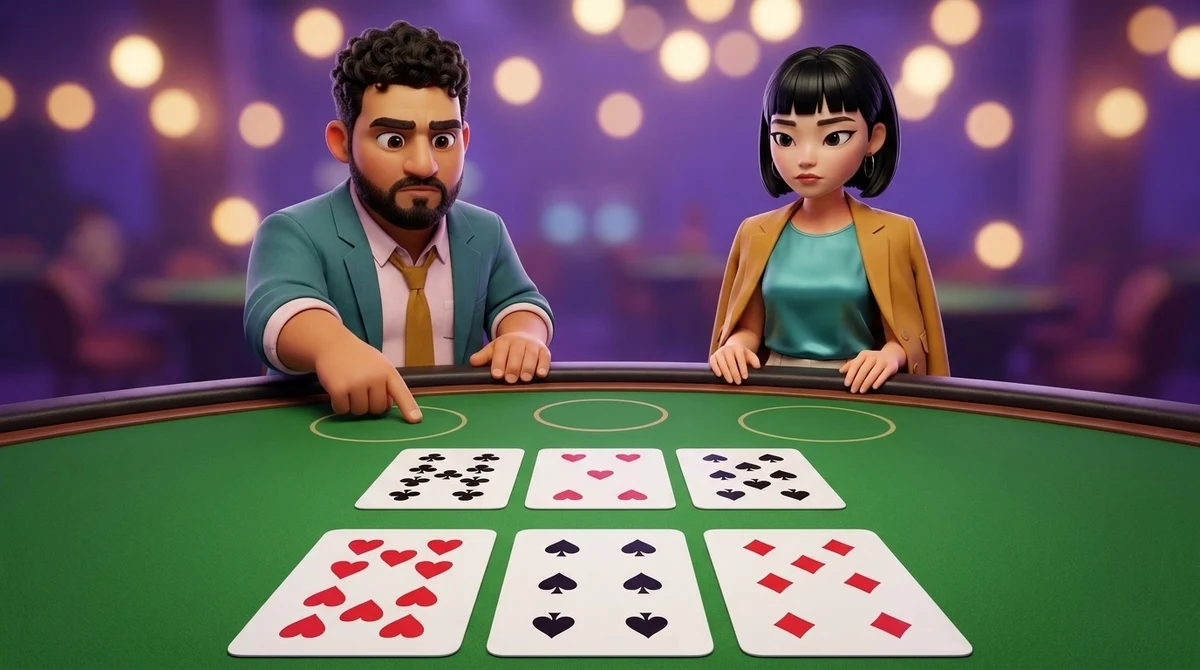
The dealer’s face-up card is a 6, the card the dealer goes over 21 behind more often than any other. You hold a hard 16. On an example bet of 10 units, what is your hand worth on average?
Dealer
You
The short answer
You play your own hand before the dealer plays the house hand, and a total over 21 is lost before the dealer plays — so once your own total has gone over 21, the 28.2% of hands where the dealer goes over 21 arrive a turn too late to pay you anything. The four things the table lets you do and the dealer may not are the payment for going first, and at Córdoba tables that payment falls short of the bill: played by the full chart, the house keeps 2.08% of every bet.

Leoformer dealer · rules and maths
The question players asked me most, in all those years dealing: how is the house ahead at a game where the dealer has no skill at all? The answer is the order of play. The dealer needs no skill because the dealer goes last, and going last is worth more at this game than any decision is. So we will walk through a hand in the order a hand actually happens at the table.
The order of a hand, and what it settles
A hand of blackjack at Córdoba tables happens in the same four steps, and the price of the game is hidden in the order of those four steps rather than in any one of them.
You play your hand first
Every player gets two cards face up, and the dealer one face up and one face down; then each player in turn asks for cards or stops.
Over 21, and the bet is gone
A total over 21 is lost on its own: nobody compares it with the dealer’s total, and nobody waits for the dealer to play.
Then the dealer plays the house hand
The dealer turns the second card over, draws on any total of 16 or less, and stops on every 17 or more — the same line on every hand, against every player.
Or never plays the house hand at all
If every player has gone over 21, the dealer draws no cards for the house hand: there is nobody left to play against.
So the hands where you go over 21 and the dealer goes over 21 as well belong to the house. The rulebook says it in its own way: a dealer over 21 has lost to every player still in the game. Your bet is not in the game any more — it left the table a turn earlier.
Dealer
You
One more thing at these tables comes after you have played: the dealer’s face-down card. A dealer blackjack shows itself only when that card is turned over, and then it takes every bet on your hand, a second bet or a split included. A dealer showing a 10 holds blackjack on 7.7% of hands, and a dealer showing an ace on 30.8%. Not every rulebook in the country settles this the same way: One game, three rulebooks sets them side by side.
How often the dealer goes over 21
How often the dealer goes over 21 is the number players lean on at the table, and it is a real number. Played out across a whole shoe, the house hand goes over 21 on 28.2% of hands — about one hand in 3.5. The dealer does not go over 21 as often behind every card, though: almost all of the difference hangs on which card the dealer has face up, and that face-up card is the only card of the dealer’s you can read before you decide anything.
| Dealer shows | 17 | 18 | 19 | 20 | 21 | Blackjack | Over 21 |
|---|---|---|---|---|---|---|---|
| Weak cards: 2 to 6 | |||||||
| 2 | 14.0 | 13.5 | 13.0 | 12.4 | 11.8 | – | 35.4 |
| 3 | 13.4 | 13.1 | 12.5 | 12.1 | 11.5 | – | 37.4 |
| 4 | 13.1 | 12.5 | 12.1 | 11.6 | 11.2 | – | 39.5 |
| 5 | 12.2 | 12.2 | 11.8 | 11.2 | 10.8 | – | 41.8 |
| 6 | 16.6 | 10.6 | 10.6 | 10.2 | 9.7 | – | 42.3 |
| Strong cards: 7 to ace | |||||||
| 7 | 36.9 | 13.8 | 7.8 | 7.9 | 7.4 | – | 26.2 |
| 8 | 12.9 | 36.0 | 12.9 | 6.9 | 6.9 | – | 24.4 |
| 9 | 12.0 | 11.8 | 35.2 | 12.0 | 6.1 | – | 22.9 |
| 10 | 11.2 | 11.2 | 11.2 | 34.1 | 3.5 | 7.7 | 21.2 |
| Ace | 13.0 | 13.1 | 13.1 | 13.1 | 5.4 | 30.8 | 11.5 |
Only the dealer’s face-up card changes from row to row. The eight decks and the Córdoba dealer rule are the same in every row, and the bar in the last column is the share of hands that end over 21 behind that one card.
- Behind a 7, an 8, a 9, a ten or an ace the house hand goes over 21 on 11.5% to 26.2% of hands — and one of those five cards is the face-up card 61.5% of the time.
- Behind a 2, 3, 4, 5 or 6 the house hand goes over 21 on 35.4% to 42.3% of hands. Far more often, that is, and on the smaller share of the deals: the dealer is in trouble much less often than a table full of players feels it to be.
The dealer going over 21 never reaches a hand that has already been lost. That is the whole asymmetry of blackjack in one sentence. How often the dealer goes over 21 is counted with the house hand played out to the rule on every deal, whether a dealer at a table would play that hand or not, and by the time a dealer does play it, some of the bets on the table have already been picked up — yours among them, on every hand where your own total went over 21 first.
Two rows, one above the other. In the upper row your own ten, six and nine make twenty-five, and the bet in front of those three cards is picked up. In the lower row, a turn later, the dealer draws to twenty-five as well, and the bet from the upper row is no longer on the table.
The hands that can go over 21 are yours to play first
Going first would cost you nothing at all if your own hand could not go over 21. Your hand can go over 21, and a great many starting hands are one card away from it — while a starting total of eleven or less cannot be taken over 21 by any single card, because the largest card in the deck is a ten.
A hard 12 to 16 meets a dealer’s 7 or better more often than not — the hand where the choice costs you either way, decided before the dealer decides anything.

Leoformer dealer · rules and maths
Here is the part that surprises people. Take the friendliest spot on the whole table: the dealer’s face-up card is a 6, the card the dealer goes over 21 behind more often than any other, and you are already finished on a hard 17. There is nothing left for you to decide on that hand. Watch how little the hand is worth anyway.
Dealer
You
A finished hard 17 against a 6 is worth almost exactly nothing — a fraction above it, on a hand you cannot play badly because there is nothing left to play. Three things can become of the bet on it, and there is no fourth:
| The dealer ends | Share | Your bet |
|---|---|---|
| over 21 | 42.3% | is paid |
| on 17, level with you | 16.6% | comes back |
| on 18 or better | 41.1% | goes to the house |
The dealer going over 21 pays this hand, and a finish of 18 or better takes the bet away — and those two shares come out nearly level, behind the dealer’s weakest card, on a hand with nothing whatever wrong with it. That near balance is what going first costs you on your strongest hands.
| Your hard total | If you stop | If you take a card |
|---|---|---|
| 16 | −1.57 units | −4.27 units |
| 17 | +0.09 units | −5.06 units |
| 18 | +2.82 units | −6.05 units |
The hard 16 in the first row is the hand you were asked about before we started; only from 17 up does stopping average more than nothing. A plus sign means this hand is in your favour on average; it can still lose, and over all hands the house keeps its edge.
A hard 16 against a 6 is not a special case. From hard 12 up to hard 16, against every one of the ten cards the dealer can show — fifty hands in all — no move averages more than nothing, and a hard 17 gets above nothing against a 6 alone. Picking the smaller of two losses is the whole job on those hands, and that job is what the next lessons of the track are for, starting with hard totals.
What the table gives you back
A game built on nothing but that order of play would be unplayable, and nobody would sit down at it twice. So the rules of the table hand some things back to your seat, and the dealer gets none of them. At Córdoba tables there are four.
| At your seat | You | The dealer |
|---|---|---|
| Two cards to 21 | paid 3 to 2 — half as much again as any other hand of yours that is paid | takes the bets and no more: the house is never paid odds |
| A second bet | as much again on two cards that make 11, for exactly one more card | never |
| A pair | taken apart into two hands, once a hand | plays the same two cards as one hand |
| The right to stop | stand on 12 to 16 — the plainest of the four, and the easiest to miss | must draw to 16 |
There is no fifth: the Córdoba rulebook names no surrender, so at these tables nobody gives a hand up for half the bet.
Which is why playing your own hand the way the dealer is obliged to play the house hand is not a neutral habit. Copying the dealer hands three of those four things straight back to the house: no second bet, no split and no stopping on a hard 16 — a blackjack of your own paid at three to two is the only one of the four that survives the habit. The decisions on your hand are yours alone; advice from anyone else at the table counts for nothing.
| The habit | What it does to every hand |
|---|---|
| Never going over 21 | Never take a card that could take the hand over 21, which means stopping on every hard 12 or more, whatever the dealer’s face-up card is. |
| Playing like the dealer | Play your own hand by the rule the dealer follows: draw to 16, stop on 17, and use neither the second bet nor the split. |
| Assuming a ten | Play every hand as though the dealer’s face-down card were already a ten, whatever the face-up card is. |
The three habits differ only in what the player settles on before the cards come out: that the hand must never go over 21, that the dealer’s rule is the right rule, or that the dealer’s face-down card is a ten. Playing like the dealer is the middle habit of the three, and the only one of the three with a price on it in the practice table further on.
Played by the full chart, these Córdoba rules still leave the house 2.08% of every bet. The house keeps its edge; the chart only makes it smaller — the correct move cannot decide how a hand ends; what it lowers is the house advantage and the cost of playing. Neither that share nor any amount on this page is what one evening will do: a single evening lands a long way from an average in either direction.

Mayaformer floor supervisor · manners, money and breaks
The price follows the number of hands, and the number of hands follows how long you sit. So the one decision that moves the price most is made before the first card is dealt: how long you are staying, and how much money the evening gets. Settle how long and how much before you sit down, or the shoe will settle both for you.
And if the money on the table starts to feel like money you need, no arithmetic on this page is the thing to reach for. Stop there, and call one of the lines below.
If it stops being fun
If gambling stops being entertainment, help is available. Minimum entry age: each province sets its own. Where we found the rule or regulator that sets it, we cite it on the page; those we found set it at 18. More on responsible gaming.
Show all provinces
If you are thinking about suicide, call 135 or 0800 345 1435 from anywhere in the country
Practice: play like the dealer?
Nine hands, and the same question on each one: play the hand the way the dealer is obliged to, or use what the table gives you? Each move is named for you, because choosing between moves yourself is what the later lessons of the track are for. What these hands price is the difference between the dealer’s rule and the table’s move, on an example bet of 10 units, at Córdoba table rules.
Nothing is scored here and there is no level to open: on all the hands but one the answer is the same, and a score would only measure how quickly you noticed that. The hand worth slowing down for is the hard 12 against a 7 — on that hand the dealer’s rule and the chart ask for exactly the same card, and both answers count.
Lesson done
Review my mistakes (0)
Progress stays in this browser; nothing is sent anywhere.
The practice table needs JavaScript. Here is one hand from it, with the answer.
These table rules · eight decks · the dealer stops on every 17 · a double on 11 only · one split · no surrender
Dealer
You
The dealer has no choice on any hand: draw on 16 or less, stop on every 17 or more — never double, never split. Play your hand that way, or use what the table gives you?
The answer: Use what the table gives you: stop on 16.
The dealer may not stop on 16; you may. On an example bet of 10 units, stopping on this hand is worth −1.57 units a hand on average and taking a card −4.27 units, so playing it the dealer’s way costs 2.70 units every time. Both amounts are below nothing: the right to stop makes the loss smaller, it does not turn the hand around.
Si la sumatoria de las cartas es 17, 18, 19, 20, o 21 ( Black Jack ) habrá definido su jugada no pudiendo extraer mas cartas .-Free translation: If the sum of the cards is 17, 18, 19, 20, or 21 (Black Jack) he will have settled his play and may not draw more cards.
En caso de que la sumatoria sea menor a diecisiete ( 17 ) extraerá cartas hasta llegar a esa cifra o más, en cuyo caso plantará definiendo su juego.-Free translation: If the sum is less than seventeen (17) he will draw cards until reaching that figure or more, in which case he will stand, settling his hand.
Lotería de Córdoba S.E. (portal) · Reglamento del juego «Black Jack» · readEl Tallador debe obligatoriamente pedir naipes siempre que su puntuación fuere de DIECISEIS (16) PUNTOS O MENOR. Habiendo obtenido 17, 18, 19,20 ó 21, está obligado a PLANTAR. Cuando se diese un AS, deberá utilizarlo como ONCE en la medida que no se exceda.Free translation: The Tallador must draw cards whenever his score is SIXTEEN (16) POINTS OR LESS. Having obtained 17, 18, 19,20 or 21, he is obliged to STAND. When an ACE is dealt, he must use it as ELEVEN as long as he does not go over.
IPLyC Buenos Aires (Sistema de Normas) · Resolución 1452/12, Anexo I: Marco Normativo de los Juegos de Azar Artesanales y Electrónicos · section Capítulo 9, Black Jack modalidad carta descubierta: Reglamento del Juego (9.1 a 9.14) · readPor su parte el crupier tiene reglas rígidas a las que atenerse: si su puntuación inicial fuera 16 o menor está obligado a tomar otra carta, y se plantará siempre que su puntuación alcance 17.Free translation: For its part, the croupier has strict rules to follow: if his initial score is 16 or less he is obliged to take another card, and he will always stand once his score reaches 17.
IPJyC Mendoza (SAPIA, Res. Dir. 812-16) · Información sobre juegos vivos o de paño: JUEGOS CARTEADOS, pagos, probabilidades · readThe other hands work the same way: the same question, another hand, and every amount worked out by the same engine that priced the hard 16 against a 6 further up.
How the practice table works
The hands. All of them are fixed, not dealt: each one is a position where the dealer’s rule and the chart for these table rules part company, plus one where they agree. The amounts are the average result of each move over every two-card hand of that total, from the same engine that works out the tables on this page, and a cost is the difference between two amounts already rounded to the hundredth — so the subtraction on the screen comes out.
No score. There is no round, no threshold and no level: this table is a price list in the shape of a hand, not a test. Your mistakes are not kept, and nothing is sent anywhere.
The example bet. Every amount is for an example bet of 10 units. It is an example, not a suggested bet; at a bet twice as large each amount is twice as much. There is no balance here and nothing adds up from one hand to the next.
Check yourself

Mayaformer floor supervisor · manners, money and breaks
Five quick ones. Pick an answer, then check it. No timer, no points: just whether it stuck.
And the question at the start
Less than nothing, whichever way you play it — the third of the three answers. A hard 16 against a 6 is worth −1.57 units on an example bet of 10 units if you stop and −4.27 units if you take a card: both amounts are below nothing, and the better of the two is only the smaller loss. A 6 really is the card the dealer goes over 21 behind most often, on 42.3% of those hands, and that is still not enough to make the hand worth having — because you had to play your hand first, and most of the shoe takes a hard 16 over 21. That is the whole lesson in one hand.
Where this is played, and further reading
18+ under each province’s rules · Play responsibly · the helplines are further up this page
Further reading
- Reglamento del juego «Black Jack» · Lotería de Córdoba S.E.Córdoba’s full rules for blackjack: eight decks, the dealer stands on 17, a blackjack pays 150 %, and how doubling, splitting and insurance work.
- Resolución 1452/12, Anexo I: Black Jack modalidad carta descubierta (Reglamento del Juego) · Instituto Provincial de Lotería y Casinos de la Provincia de Buenos AiresThe Buenos Aires province rulebook for its face-up blackjack, including the rules for opening pairs, aces and tens.
- Black Jack / Juegos tradicionales de casinos (DOC-H8-GCA-CSJ-001 V00) · Instituto de Ayuda Financiera a la Acción Social, Entre RíosA one-page player guide from Entre Ríos, approved 20 August 2021.
- Información sobre juegos vivos o de paño: juegos carteados · Instituto Provincial de Juegos y Casinos de Mendoza (SAPIA)Mendoza’s public information on card games: blackjack terms, payouts and the dealer’s fixed rule.
How it’s worked out
Rules, numbers and hosts
Rules. The figures on this page follow the rules published for Córdoba casinos: at least eight decks (the figures take exactly eight), the dealer stopping on every 17, blackjack paid 3 to 2, a double only on a two-card 11, one split a hand, no surrender, and a dealer’s second card turned over after the players, whose blackjack takes every bet on the hand. It is a preset for learning, not a statement about any one casino: the room settles anything its rulebook leaves open.
Numbers. Every figure on this page is worked out when the page is built, by our blackjack engine. The dealer’s table goes through every order in which the dealer’s cards can come out of an eight-deck shoe with the face-up card removed, and plays the house hand out to the rule every time — including the hands a real dealer would not play at all, because every player had already gone over 21. The 28.2% figure weights those ten face-up cards by how often each comes out of a full shoe; your own two cards are not taken out, so with them in view the figures shift slightly. The value of a hand is the average result of that move over every two-card hand of the total, per bet, shown for an example bet of 10 units, each average rounded to the hundredth first, so a cost is always the difference of two amounts shown. Against a 10 or an ace the averages include the hands where the dealer turns up a blackjack, because at these tables that card is turned after you play. The rulebook pays a higher total and does not speak of an equal one; the figures count an equal total as a tie. The house edge assumes the full chart, pairs and the ace you declare included, and cards shuffled after every hand.
What is deliberately absent. There is not one cell of the strategy chart on this page: when to take a card and when to stop is the subject of the lessons that follow this one, and this page prices the order of play instead. There is no price of an hour, because no document we could read gives a number of hands an hour for these tables, and there is no figure here for how an evening ends either, because nothing on this page can produce one.
Hosts. Leo and Maya are illustrated characters. Their backstories, a former dealer and a former floor supervisor, are written for the course: neither is a real person, and neither speaks for any casino. The rules and numbers on this page come from the sources it cites, not from their experience.
No promise. Blackjack is played against the house. Everything on this page is about the size of the price and where it comes from; nothing here says the game can be played at no cost, and nothing here says how an evening will end.
Going over 21
pero si se pasa de 21 pierde automáticamente.Free translation: but if he goes over 21 he loses automatically.
The dealer stops when everyone is settled
Cuando todos los Jugadores se pasaren de puntaje ( más de 21 ), el Pagador no tirará cartas para sí, por cuanto no hay con quien jugar.-Free translation: When all the Players have gone over the score (more than 21), the Pagador shall not draw cards for himself, since there is no one to play against.
Lotería de Córdoba S.E. (portal) · Reglamento del juego «Black Jack» · read
The order of a hand at Córdoba tables
Una vez efectuadas la apuestas, el Pagador procederá a distribuir una carta descubierta por cada una de las apuestas realizadas, de izquierda a derecha y una para sí descubierta.Free translation: Once the bets have been placed, the Pagador will proceed to deal one card face up for each of the bets made, from left to right, and one face up for himself.
Posteriormente, dará una segunda carta descubierta para cada una de las apuestas y una para sí cubierta.Free translation: Afterwards, he will deal a second card face up for each of the bets and one face down for himself.
Cada apostador, en posesión de sus dos cartas, está habilitado para solicitar mas cartas siempre que las mismas no sumen veintiuno ( 21 ) ( BLACK JACK ) con lo cual el juego estaría definido o, " Plantar " con el puntaje obtenido con sus dos primeras cartas.Free translation: Each bettor, holding his two cards, is entitled to ask for more cards as long as they do not add up to twenty-one (21) (BLACK JACK), in which case the hand would be settled, or to "Stand" with the score obtained with his first two cards.
Si la sumatoria de las cartas es 17, 18, 19, 20, o 21 ( Black Jack ) habrá definido su jugada no pudiendo extraer mas cartas .-Free translation: If the sum of the cards is 17, 18, 19, 20, or 21 (Black Jack) he will have settled his play and may not draw more cards.
En caso de que la sumatoria sea menor a diecisiete ( 17 ) extraerá cartas hasta llegar a esa cifra o más, en cuyo caso plantará definiendo su juego.-Free translation: If the sum is less than seventeen (17) he will draw cards until reaching that figure or more, in which case he will stand, settling his hand.
En caso de que la sumatoria de cartas extraídas supere veintiuno ( 21 ) habrá perdido ante cualquier puntaje de los apostadores en Juego.-Free translation: If the sum of the cards drawn exceeds twenty-one (21), he will have lost to any score of the bettors in play.
Lotería de Córdoba S.E. (portal) · Reglamento del juego «Black Jack» · read
Splitting a pair at Córdoba tables
APERTURA : Cuando las dos primeras cartas recibidas por el jugador sean iguales en valor (dos 4, dos 6, etc.), el jugador podrá considerarlas como dos jugadas independientes, en este caso la postura original permanecerá para una de las cartas, debiendo apostar a la otra carta una suma igual a la original.Free translation: OPENING: When the first two cards received by the player are equal in value (two 4s, two 6s, etc.), the player may treat them as two independent hands; in this case the original bet shall remain on one of the cards, and the player must bet on the other card an amount equal to the original.
Lotería de Córdoba S.E. (portal) · Reglamento del juego «Black Jack» · read
Cuando el apostador reciba dos cartas iguales en número, podrá separarlas (abrir juego) y formar dos juegos realizando para el segundo una apuesta igual a la inicial.Free translation: When the bettor receives two cards of the same number, he may separate them (open the hand) and form two hands, placing for the second a bet equal to the initial one.
IAFAS Entre Ríos · Black Jack / Juegos Tradicionales de Casinos (DOC-H8-GCA-CSJ-001 V00) · read
Separar: si las dos primeras cartas son del mismo valor numérico, el jugador puede separarlas, poniendo una apuesta adicional.Free translation: Split: if the first two cards have the same numerical value, the player may separate them by placing an additional bet.
APERTURA DE PARES del DOS al NUEVE: Es la opción del Apostador que al recibir dos (2) naipes de idéntico valor elige la apertura de los mismos, haciendo una apuesta igual a la original en cada uno de ellos, recibiendo cuantos naipes desee, al menos dos obligatoriamente por columna, siempre y cuando no se exceda de veintiún puntos.Free translation: OPENING OF PAIRS from TWO to NINE: This is the option of the Bettor who, on receiving two (2) cards of identical value, chooses to open them, placing a bet equal to the original on each of them, and receiving as many cards as he wishes, at least two per column being mandatory, provided that twenty-one points are not exceeded.
Section Capítulo 9, Black Jack modalidad carta descubierta: Reglamento del Juego (9.1 a 9.14)
Se podrá efectuar solamente una apertura por Jugada.Free translation: Only one opening may be made per Hand.
Section Otras apuestas, 2) Apertura
Lotería de Córdoba · Reglamento del juego «Black Jack» · read
The dealer’s second card at Córdoba tables
dará una segunda carta descubierta para cada una de las apuestas y una para sí cubierta.Free translation: will deal a second card face up for each of the bets and one face down for himself.
Una vez determinados los puntajes de los apostadores, el pagador definirá el suyo de acuerdo con las siguientes reglasFree translation: Once the bettors' scores have been determined, the pagador will settle his own according to the following rules
Descubrirá su segunda carta y efectuará la sumatoria de ésta y la primera.Free translation: He will turn up his second card and add it to the first.
Cuando el pagador finalice con su juego, descubrirá la carta tapada del jugador y comparará el puntaje obtenido con el suyo, valiendo para la definición lo establecido en el punto catorce (14) del Desarrollo del Juego.Free translation: When the pagador has finished his play, he will turn up the player's face-down card and compare the score obtained with his own, the provisions of point fourteen (14) of the Game Procedure applying to the settlement.
Section Desarrollo del juego, 8), 12) y 14); Otras apuestas, 1)
Lotería de Córdoba · Reglamento del juego «Black Jack» · read
The order of a hand at Córdoba tables
Una vez efectuadas la apuestas, el Pagador procederá a distribuir una carta descubierta por cada una de las apuestas realizadas, de izquierda a derecha y una para sí descubierta.Free translation: Once the bets have been placed, the Pagador will proceed to deal one card face up for each of the bets made, from left to right, and one face up for himself.
Posteriormente, dará una segunda carta descubierta para cada una de las apuestas y una para sí cubierta.Free translation: Afterwards, he will deal a second card face up for each of the bets and one face down for himself.
Cada apostador, en posesión de sus dos cartas, está habilitado para solicitar mas cartas siempre que las mismas no sumen veintiuno ( 21 ) ( BLACK JACK ) con lo cual el juego estaría definido o, " Plantar " con el puntaje obtenido con sus dos primeras cartas.Free translation: Each bettor, holding his two cards, is entitled to ask for more cards as long as they do not add up to twenty-one (21) (BLACK JACK), in which case the hand would be settled, or to "Stand" with the score obtained with his first two cards.
Si la sumatoria de las cartas es 17, 18, 19, 20, o 21 ( Black Jack ) habrá definido su jugada no pudiendo extraer mas cartas .-Free translation: If the sum of the cards is 17, 18, 19, 20, or 21 (Black Jack) he will have settled his play and may not draw more cards.
En caso de que la sumatoria sea menor a diecisiete ( 17 ) extraerá cartas hasta llegar a esa cifra o más, en cuyo caso plantará definiendo su juego.-Free translation: If the sum is less than seventeen (17) he will draw cards until reaching that figure or more, in which case he will stand, settling his hand.
En caso de que la sumatoria de cartas extraídas supere veintiuno ( 21 ) habrá perdido ante cualquier puntaje de los apostadores en Juego.-Free translation: If the sum of the cards drawn exceeds twenty-one (21), he will have lost to any score of the bettors in play.
Lotería de Córdoba S.E. (portal) · Reglamento del juego «Black Jack» · read
Going over 21
pero si se pasa de 21 pierde automáticamente.Free translation: but if he goes over 21 he loses automatically.
The dealer has no choices
Si la sumatoria de las cartas es 17, 18, 19, 20, o 21 ( Black Jack ) habrá definido su jugada no pudiendo extraer mas cartas .-Free translation: If the sum of the cards is 17, 18, 19, 20, or 21 (Black Jack) he will have settled his play and may not draw more cards.
En caso de que la sumatoria sea menor a diecisiete ( 17 ) extraerá cartas hasta llegar a esa cifra o más, en cuyo caso plantará definiendo su juego.-Free translation: If the sum is less than seventeen (17) he will draw cards until reaching that figure or more, in which case he will stand, settling his hand.
Lotería de Córdoba S.E. (portal) · Reglamento del juego «Black Jack» · read
El Tallador debe obligatoriamente pedir naipes siempre que su puntuación fuere de DIECISEIS (16) PUNTOS O MENOR. Habiendo obtenido 17, 18, 19,20 ó 21, está obligado a PLANTAR. Cuando se diese un AS, deberá utilizarlo como ONCE en la medida que no se exceda.Free translation: The Tallador must draw cards whenever his score is SIXTEEN (16) POINTS OR LESS. Having obtained 17, 18, 19,20 or 21, he is obliged to STAND. When an ACE is dealt, he must use it as ELEVEN as long as he does not go over.
Section Capítulo 9, Black Jack modalidad carta descubierta: Reglamento del Juego (9.1 a 9.14)
Por su parte el crupier tiene reglas rígidas a las que atenerse: si su puntuación inicial fuera 16 o menor está obligado a tomar otra carta, y se plantará siempre que su puntuación alcance 17.Free translation: For its part, the croupier has strict rules to follow: if his initial score is 16 or less he is obliged to take another card, and he will always stand once his score reaches 17.
Si la sumatoria de las cartas es 17, 18, 19, 20, o 21 ( Black Jack ) habrá definido su jugada no pudiendo extraer mas cartasFree translation: If the sum of the cards is 17, 18, 19, 20, or 21 (Black Jack) he will have settled his play and may not draw more cards
cuando el puntaje de las cartas anteriores más el "AS" considerado como Once (11) suma diecisiete (17) o más: "PLANTA"Free translation: when the score of the previous cards plus the "ACE" counted as Eleven (11) adds up to seventeen (17) or more: "STANDS"
Section Desarrollo del juego, 12 b) y 13 c)
Lotería de Córdoba · Reglamento del juego «Black Jack» · read
The dealer stops when everyone is settled
Cuando todos los Jugadores se pasaren de puntaje ( más de 21 ), el Pagador no tirará cartas para sí, por cuanto no hay con quien jugar.-Free translation: When all the Players have gone over the score (more than 21), the Pagador shall not draw cards for himself, since there is no one to play against.
Lotería de Córdoba S.E. (portal) · Reglamento del juego «Black Jack» · read
The dealer’s second card at Córdoba tables
dará una segunda carta descubierta para cada una de las apuestas y una para sí cubierta.Free translation: will deal a second card face up for each of the bets and one face down for himself.
Una vez determinados los puntajes de los apostadores, el pagador definirá el suyo de acuerdo con las siguientes reglasFree translation: Once the bettors' scores have been determined, the pagador will settle his own according to the following rules
Descubrirá su segunda carta y efectuará la sumatoria de ésta y la primera.Free translation: He will turn up his second card and add it to the first.
Cuando el pagador finalice con su juego, descubrirá la carta tapada del jugador y comparará el puntaje obtenido con el suyo, valiendo para la definición lo establecido en el punto catorce (14) del Desarrollo del Juego.Free translation: When the pagador has finished his play, he will turn up the player's face-down card and compare the score obtained with his own, the provisions of point fourteen (14) of the Game Procedure applying to the settlement.
Section Desarrollo del juego, 8), 12) y 14); Otras apuestas, 1)
Lotería de Córdoba · Reglamento del juego «Black Jack» · read
How the dealer’s hand ends at Córdoba tables
Worked out: for each face-up card, every order in which the dealer’s next cards can come out of an eight-deck shoe with that card taken out, following the dealer rule of the Córdoba rulebook; the 28.2% figure weights those ten cards by how often each one comes out of a full shoe.
Si la sumatoria de las cartas es 17, 18, 19, 20, o 21 ( Black Jack ) habrá definido su jugada no pudiendo extraer mas cartasFree translation: If the sum of the cards is 17, 18, 19, 20, or 21 (Black Jack) he will have settled his play and may not draw more cards
cuando el puntaje de las cartas anteriores más el "AS" considerado como Once (11) suma diecisiete (17) o más: "PLANTA"Free translation: when the score of the previous cards plus the "ACE" counted as Eleven (11) adds up to seventeen (17) or more: "STANDS"
Section Desarrollo del juego, 12 b) y 13 c)
Lotería de Córdoba · Reglamento del juego «Black Jack» · read
What a hand is paid
La obtención de un puntaje mayor al del pagador o habiendo este excedido el puntaje de veintiuno (21), beneficiará al jugador con el 100% de su apuesta.-Free translation: If the player obtains a higher score than the payer's, or the latter has exceeded the score of twenty-one (21), the player shall be paid 100% of the bet.-
La obtención de Black Jack por parte del jugador, habiendo obtenido la Banca Veintiuno (21) o menos o haberse excedido ( mas de 21 ), beneficiará al jugador con el 150% de su apuesta.-Free translation: If the player obtains Black Jack, whether the Bank has obtained Twenty-one (21) or less or has gone over (more than 21), the player shall be paid 150% of the bet.-
Lotería de Córdoba S.E. (portal) · Reglamento del juego «Black Jack» · read
Se paga el mismo importe de la apuesta: 1 x 1, a menos que el jugador lograre un Black Jack directo ('As" y 10 o "As" y figura : J,Q,K), el cual pagará 150%, salvo que la Banca también tenga 'Black Jack"; en este caso se produce un empate y el apostador conservará su apuesta.Free translation: The amount paid equals the bet: 1 x 1, unless the player gets a direct Black Jack ("Ace" and 10 or "Ace" and a face card: J,Q,K), which will pay 150%, unless the Bank also has "Black Jack"; in that case there is a tie and the bettor keeps his bet.
IAFAS Entre Ríos · Black Jack / Juegos Tradicionales de Casinos (DOC-H8-GCA-CSJ-001 V00) · read
Todas las apuestas ganadoras cobrarán el cien por cien (100%) del monto total apostado. Excepto los Black Jack, que cobrarán el ciento cincuenta por ciento (150%).Free translation: All winning bets will be paid one hundred percent (100%) of the total amount bet. Except for Black Jacks, which will be paid one hundred and fifty percent (150%).
Section Capítulo 9, Black Jack modalidad carta descubierta: Reglamento del Juego (9.1 a 9.14)
En el caso de obtener mayor puntuación el jugador cobra una cantidad igual a la apostada.Free translation: If the player obtains the higher score, the player is paid an amount equal to the amount bet.
También existe la posibilidad de sacar blackjack, en este caso, el jugador cobra a razón de 3 a 2 según lo apostado.Free translation: It is also possible to get a blackjack; in that case, the player is paid at a rate of 3 to 2 on the amount bet.
En el empate ni se pierde ni se gana.Free translation: In a tie, the player neither loses nor wins.
La obtención de Black Jack por parte del jugador, habiendo obtenido la Banca Veintiuno (21) o menos o haberse excedido ( mas de 21 ), beneficiará al jugador con el 150% de su apuesta.Free translation: A Black Jack obtained by the player, whether the Banca has obtained Twenty-one (21) or less or has gone over (more than 21), will give the player 150% of his bet.
Section Formas de pago, 1)
Lotería de Córdoba · Reglamento del juego «Black Jack» · read
Doubling at Córdoba tables
El jugador que ha logrado con sus dos primeras cartas la suma de Once (11), puede doblar su apuesta requiriendo una sola carta que se le entregará cubierta.Free translation: A player who has reached a total of Eleven (11) with his first two cards may double his bet, requesting a single card, which will be dealt to him face down.
Section Otras apuestas, 1) Doblar apuestas
Lotería de Córdoba · Reglamento del juego «Black Jack» · read
Splitting a pair
APERTURA : Cuando las dos primeras cartas recibidas por el jugador sean iguales en valor (dos 4, dos 6, etc.), el jugador podrá considerarlas como dos jugadas independientes, en este caso la postura original permanecerá para una de las cartas, debiendo apostar a la otra carta una suma igual a la original.Free translation: OPENING: When the first two cards received by the player are equal in value (two 4s, two 6s, etc.), the player may treat them as two independent hands; in this case the original bet shall remain on one of the cards, and the player must bet on the other card an amount equal to the original.
Lotería de Córdoba S.E. (portal) · Reglamento del juego «Black Jack» · read
Cuando el apostador reciba dos cartas iguales en número, podrá separarlas (abrir juego) y formar dos juegos realizando para el segundo una apuesta igual a la inicial.Free translation: When the bettor receives two cards of the same number, he may separate them (open the hand) and form two hands, placing for the second a bet equal to the initial one.
IAFAS Entre Ríos · Black Jack / Juegos Tradicionales de Casinos (DOC-H8-GCA-CSJ-001 V00) · read
Separar: si las dos primeras cartas son del mismo valor numérico, el jugador puede separarlas, poniendo una apuesta adicional.Free translation: Split: if the first two cards have the same numerical value, the player may separate them by placing an additional bet.
APERTURA DE PARES del DOS al NUEVE: Es la opción del Apostador que al recibir dos (2) naipes de idéntico valor elige la apertura de los mismos, haciendo una apuesta igual a la original en cada uno de ellos, recibiendo cuantos naipes desee, al menos dos obligatoriamente por columna, siempre y cuando no se exceda de veintiún puntos.Free translation: OPENING OF PAIRS from TWO to NINE: This is the option of the Bettor who, on receiving two (2) cards of identical value, chooses to open them, placing a bet equal to the original on each of them, and receiving as many cards as he wishes, at least two per column being mandatory, provided that twenty-one points are not exceeded.
Section Capítulo 9, Black Jack modalidad carta descubierta: Reglamento del Juego (9.1 a 9.14)
Se podrá efectuar solamente una apertura por Jugada.Free translation: Only one opening may be made per Hand.
Section Otras apuestas, 2) Apertura
Lotería de Córdoba · Reglamento del juego «Black Jack» · read
The dealer has no choices
Si la sumatoria de las cartas es 17, 18, 19, 20, o 21 ( Black Jack ) habrá definido su jugada no pudiendo extraer mas cartas .-Free translation: If the sum of the cards is 17, 18, 19, 20, or 21 (Black Jack) he will have settled his play and may not draw more cards.
En caso de que la sumatoria sea menor a diecisiete ( 17 ) extraerá cartas hasta llegar a esa cifra o más, en cuyo caso plantará definiendo su juego.-Free translation: If the sum is less than seventeen (17) he will draw cards until reaching that figure or more, in which case he will stand, settling his hand.
Lotería de Córdoba S.E. (portal) · Reglamento del juego «Black Jack» · read
El Tallador debe obligatoriamente pedir naipes siempre que su puntuación fuere de DIECISEIS (16) PUNTOS O MENOR. Habiendo obtenido 17, 18, 19,20 ó 21, está obligado a PLANTAR. Cuando se diese un AS, deberá utilizarlo como ONCE en la medida que no se exceda.Free translation: The Tallador must draw cards whenever his score is SIXTEEN (16) POINTS OR LESS. Having obtained 17, 18, 19,20 or 21, he is obliged to STAND. When an ACE is dealt, he must use it as ELEVEN as long as he does not go over.
Section Capítulo 9, Black Jack modalidad carta descubierta: Reglamento del Juego (9.1 a 9.14)
Por su parte el crupier tiene reglas rígidas a las que atenerse: si su puntuación inicial fuera 16 o menor está obligado a tomar otra carta, y se plantará siempre que su puntuación alcance 17.Free translation: For its part, the croupier has strict rules to follow: if his initial score is 16 or less he is obliged to take another card, and he will always stand once his score reaches 17.
Who decides the hand
Las decisiones de los apostadores, ya sean montos a apostar, o en alternativas de juego- como valores de cartas, doblar, asegurar o abrir juego- serán estrictamente personales, no teniendo ninguna validez las indicaciones que efectuaren otros jugadores o personas del Público.Free translation: The decisions of the bettors, whether the amounts to bet or the playing options (such as card values, doubling, insuring or splitting), shall be strictly personal, and any indications given by other players or persons from the Public shall have no validity.
Lotería de Córdoba S.E. (portal) · Reglamento del juego «Black Jack» · read
No se admitirá a persona alguna, aconsejar a éste, acerca de sus decisiones en el desarrollo del juego, ni efectuar manifestación alguna al respecto.Free translation: No person shall be allowed to advise the player about his or her decisions during the course of the game, or to make any comment in that regard.
Section Capítulo 9, Black Jack modalidad carta descubierta: Reglamento del Juego (9.1 a 9.14)